
Piani di assicurazione dentale per individui e famiglie
I piani di assicurazione dentale per individui e famiglie possono contribuire a rendere la cura preventiva più accessibile e a ridurre parte del costo delle protesi dentarie, dei ponti, dei canali radicolari, delle protesi e di altri servizi coperti. Tuttavia, l’assicurazione dentale non è concepita come l’assicurazione sanitaria generale. La franchigia, la rete dei fornitori, i periodi di attesa, i percentuali di copertura e il massimale annuale dei benefici possono essere altrettanto importanti quanto la quota mensile di premio.
Se si acquista la copertura indipendentemente, si sostituisce un piano aziendale, si confrontano i benefici familiari o si cerca una copertura dentale durante la pensione, il piano giusto dipende dalle cure che si prevede di ricevere e dalle limitazioni del contratto.

DENTAL INSURANCE SERVICES | STERLING ARC GROUP
Dental Insurance in Florida for Individuals, Families and Businesses
Compare dental insurance plans for preventive care, basic and major dental services, and available orthodontic benefits. We help you understand provider networks, waiting periods, annual maximums and out-of-pocket costs before selecting coverage.
Serving individuals, families and employers in Boca Raton, Palm Beach County, Broward and Miami-Dade.
Our Dental Insurance Services
Individual Dental Insurance
Compare individual dental plans for routine checkups, cleanings, fillings and other eligible services, with attention to premiums and network access.
Family Dental Insurance
Review family dental benefits, covered dependents, pediatric services and possible orthodontic coverage where offered.
Dental PPO and HMO Plans
Compare available PPO and dental HMO or prepaid plans, including dentist choice, referral rules, networks and covered-service costs.
Employer and Group Dental Benefits
Explore group dental coverage and voluntary employee-paid options for eligible businesses, subject to insurer participation requirements.
Individual Dental Insurance Plans in Florida
Individual dental insurance can help manage eligible preventive, basic and major dental expenses, depending on the policy. Compare the plan’s premium, deductible, annual benefit maximum, waiting periods, coinsurance, frequency limits and dentist network. Preventive care may receive different coverage than crowns, root canals or other major procedures.
Dental Insurance for Families and Children
Family dental insurance may include eligible spouses and children, with benefit provisions varying by age and plan. Some products offer orthodontic benefits, but braces and aligners are not automatically covered; lifetime orthodontic limits, age restrictions and waiting periods may apply. Review pediatric dental benefits separately from adult coverage.
Dental PPO vs. Dental HMO: Which Fits Your Needs?
Dental PPO: Often provides access to a preferred network with different cost sharing for participating and nonparticipating dentists. Dental HMO or prepaid dental: May require choosing a participating primary dentist and generally follows a defined network and fee schedule. Exact provider access, referrals and charges depend on the contract.
Group Dental Insurance for Small Businesses
Employers may explore group dental plans as part of an employee benefits package. Available designs may include employer-paid or voluntary employee-paid premiums. Minimum group size, employee eligibility, participation rules and contribution requirements differ by insurer. See our Assicurazione sanitaria collettiva e Benefici integrativi per i dipendenti services.
How Much Does Dental Insurance Cost in Florida?
Dental insurance premiums vary based on ZIP code, insurer, covered individuals, plan type, network and benefit levels. The lowest premium is not necessarily the lowest total cost if you anticipate major dental work. Compare premiums alongside deductibles, copays, coinsurance, annual maximums and exclusions.
How We Help You Compare Dental Coverage
- Review who needs coverage and your preferred dentists.
- Compare available individual, family or group dental plan options.
- Explain preventive, basic, major and orthodontic benefits, where available.
- Check waiting periods, annual maximums, exclusions and effective dates before enrollment.
Dental Insurance FAQs
Does dental insurance cover cleanings and exams?
Many plans include eligible preventive services, but frequency limits, networks and cost sharing vary.
Does dental insurance cover crowns, implants or root canals?
Some policies cover certain major procedures, often with waiting periods, coinsurance, annual limits or exclusions. Implant coverage is not universal.
Does family dental insurance cover braces?
Some plans include orthodontic benefits, but eligibility, age limits, waiting periods and lifetime maximums vary.
What is the difference between dental insurance and a dental discount plan?
Dental insurance pays or reimburses covered benefits according to the contract. A dental discount plan typically provides negotiated prices with participating providers and is not insurance.
Explore our Servizi di assicurazione sanitaria e Marketplace ACA pages for related coverage.
Confronta la copertura dentale disponibile in base allo stato di residenza, al dentista preferito, ai servizi previsti e al budget disponibile. I benefici, le tariffe e la disponibilità del piano variano.
Indice
Cos'è l'assicurazione dentale?
L'assicurazione dentale è una copertura destinata a coprire o rimborsare una parte dei costi delle prestazioni dentali ammissibili. La maggior parte dei piani punta sulla prevenzione e poi ripartisce il costo dei trattamenti di base e più complessi in base a un piano di prestazioni.
Può essere offerta una polizza dentaria:
- Attraverso un datore di lavoro o un'associazione.
- Come polizza individuale o familiare acquistata direttamente presso un’assicurazione.
- Come copertura dentale inclusa nel piano medico.
- Come piano dentale autonomo offerto in combinazione con la copertura sanitaria del Marketplace.
- Come vantaggio aggiuntivo tramite alcuni piani Medicare Advantage.
La copertura non significa che ogni procedura sia pagata integralmente. Le polizze dentistiche utilizzano comunemente premi, franchigie, coperture integrative, coassicurazione, reti di medici, limiti di frequenza, periodi di attesa e massimali annuali. La polizza e il calendario dei benefici determinano ciò che il piano effettivamente copre.
Come funziona l'assicurazione dentale?
Si paga un premio per mantenere attiva la polizza. Quando si riceve un servizio coperto, il piano calcola il pagamento utilizzando la categoria di beneficio applicabile, l’importo consentito dal piano, il proprio contributo individuale e qualsiasi beneficio annuale residuo.
Premium mensile
La franchigia è l'importo dovuto per mantenere la copertura. È distinta da quanto potreste dover pagare in caso di trattamento. Una franchigia più bassa può comportare una rete sanitaria più limitata, prestazioni più ridotte, tempi di attesa più lunghi o un importo massimo annuale inferiore.
Franchigia
La franchigia è l'importo che devi pagare per determinati servizi coperti prima che il piano inizi a condividere i costi ammissibili. I servizi preventivi sono talvolta esenti dalla franchigia, ma questo non è un criterio generale.
Copagamento e coassicurazione
Il copagamento è un importo fisso indicato per un servizio coperto. La coperture è un’aliquota percentuale dell’importo consentito dal piano. Ad esempio, se un piano copre il 50% di un servizio importante ammissibile, il membro paga generalmente la quota rimanente ammissibile dopo ogni parte rimborsabile, secondo il massimale annuale e le altre norme della polizza.
Massimo annuale
Il massimo annuale è generalmente il massimo che il piano dentale coprirà per i servizi coperti durante un anno di copertura. Ciò funziona in modo diverso rispetto al massimo forfettario dell’assicurazione sanitaria. Quando il piano dentale raggiunge il suo massimo annuale, il membro potrebbe essere tenuto a sostenere ulteriori spese per il resto dell’anno di copertura.
Alcuni piani prevedono un importo massimo individuale per tutta la vita per i servizi ortodontici. I benefici dentali pediatrici disciplinati dalle norme dell'Affordable Care Act possono prevedere strutture di ripartizione delle spese diverse.
Rete di fornitori e quantità consentite
I dentisti aderenti all’infrastruttura convenzionata accettano lo schema dei prezzi contrattualmente concordato. Utilizzare un dentista non aderente all’infrastruttura può ridurre i pagamenti previsti dal piano e rischiare di incorrere in un divario tra il costo del servizio del dentista e l’importo riconosciuto dalla polizza.
Periodo di attesa
Un periodo di attesa è il periodo che intercorre dopo l’inizio della copertura e durante il quale la polizza non copre ancora i servizi specificati. Le cure preventive possono essere disponibili immediatamente, mentre i servizi di base o importanti richiedono un periodo di copertura aggiuntivo di diversi mesi. Durante il periodo di attesa, continuerai comunque a pagare la polizza assicurativa.
Limiti di frequenza e sostituzione
I piani possono limitare la frequenza dei servizi di pulizia, gli esami, le radiografie, le corone, le protesi o gli ausili sostitutivi. Un intervento può essere generalmente coperto ma comunque non idoneo perché eseguito troppo recentemente in base alle regole di frequenza del piano assicurativo.
Cosa copre solitamente l'assicurazione dentale?
I piani dentali spesso raggruppano le prestazioni in base a servizi preventivi, di base e di manutenzione. Le categorie e i percentuali riportati di seguito sono esempi generali e non rappresentano garanzie.
| Categoria di copertura | Servizi che potrebbero essere inclusi | Importanti limitazioni per la revisione |
|---|---|---|
| Preventivo e diagnostico | Esami, pulizie, radiografie di routine, fluoro e guarnizioni | Possono essere applicate limitazioni relative alla frequenza, all'età e alla rete |
| Servizi di base | Riempimenti, estrazioni semplici e alcuni servizi parodontali | Possono applicarsi la franchigia, la coperture assicurativa e il periodo di attesa |
| Servizi principali | Corone, ponti, protesi dentali, chirurgia orale e talvolta impianti dentali | Percentuale di benefici più bassa, periodo di attesa più breve e massimale annuale sono comuni. |
| Servizi endodontici | Trattamento dei canali radicolari | Può essere classificata come base o importante a seconda del piano scelto |
| Ortodonzia | Accoppiamenti, aligners o dispositivi di tenuta quando sono coperti | Spesso facoltativi, limitati all'età e soggetti a un limite massimo individuale per tutta la vita |
| Servizi di bellezza | Trattamenti sbiancanti, veneers e di aspetto solo estetico | Spesso escluso |
La ben nota struttura “100/80/50” – con benefici più elevati per la cura preventiva, benefici più bassi per la cura di base e ancora minori per la cura di emergenza – è solo un esempio. Introduzione dell’American Dental Association sui benefici dentali descrive i modelli di piani comuni e sottolinea che il rimborso effettivo dipende dai costi consentiti dal vettore e dal contratto specifico.
Dental PPO vs. DHMO: Qual è la differenza?
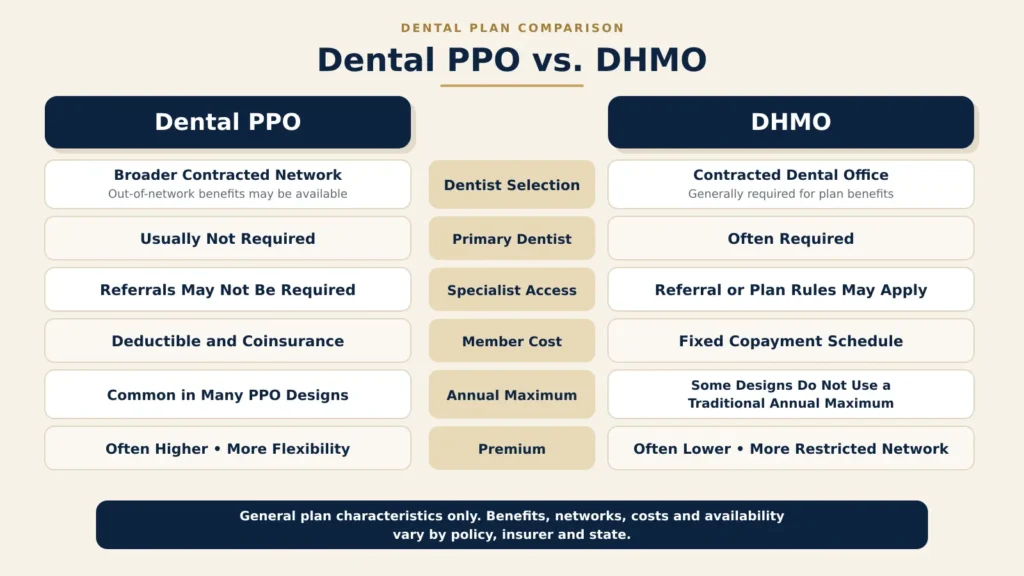
The network structure can determine which dentists you may use and how costs are calculated.
| Funzionalità | Dental PPO | Dental HMO or DHMO |
|---|---|---|
| Dentist selection | Broad contracted network; out-of-network benefits may be available | Care generally must be received from a contracted dental office |
| Primary dentist | Di solito non è richiesto | Spesso richiesto |
| Accesso per specialisti | Referrals may not be required | Referral or plan procedures may apply |
| Member cost | Commonly deductible and coinsurance | Commonly a fixed copayment schedule |
| Annual maximum | Common in many PPO designs | Some DHMO designs do not use the same annual-maximum structure |
| Premium | Often higher in exchange for flexibility | Often lower, with a more restricted network |
Dental PPO
A dental preferred provider organization generally offers more provider flexibility. You usually receive the strongest benefits when you use an in-network dentist, although some policies offer reduced out-of-network benefits. Always verify both the dentist and the specific office location because network participation can change.
Dental HMO or DHMO
A dental health maintenance organization generally requires members to select or use a contracted dental office. Covered services may follow a fixed copayment schedule. Care outside the network is commonly not covered except as stated in the contract.
Dental Indemnity Plan
An indemnity plan may allow broad provider choice and reimburse a percentage or scheduled amount for covered care. The reimbursement may be based on a plan allowance rather than the dentist’s full charge, leaving the member responsible for the difference.
Dental Discount or Savings Plan
A dental discount plan is not insurance. Members pay a fee to obtain reduced prices from participating dentists, then pay the dentist directly. It may have no insurance waiting period or claims process, but it also does not pay benefits or protect the member with an insurance policy’s contractual benefit structure.
Il Associazione nazionale dei commissari delle assicurazioni provides a consumer overview of PPO, DHMO, indemnity and dental savings arrangements.
Come confrontare i piani di assicurazione dentale passo dopo passo
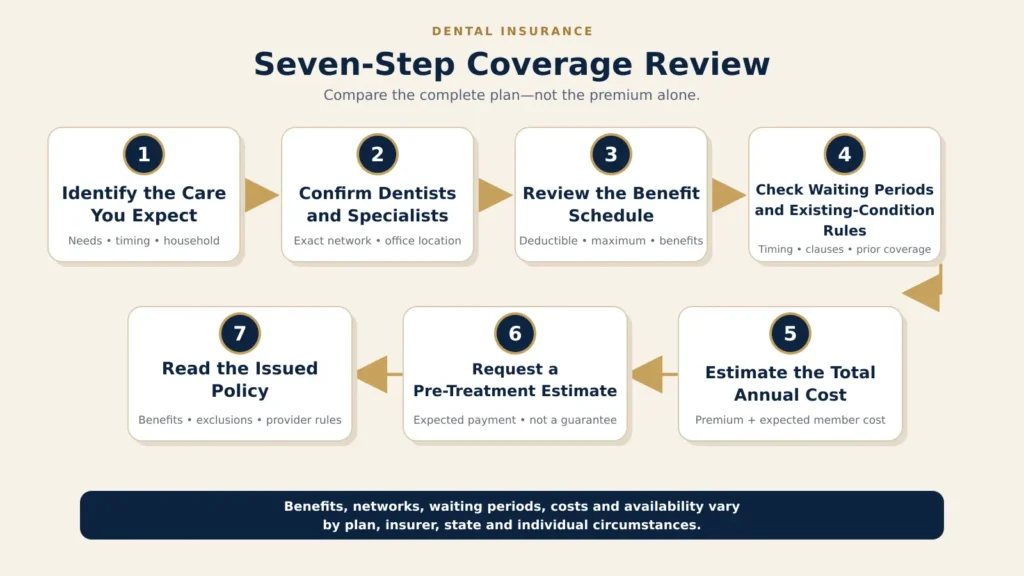
1. Identify the Care You Expect
Start with the people who need coverage and the services that may reasonably be needed during the next 12 to 24 months. Consider preventive visits, fillings, periodontal treatment, crowns, dentures, implants and orthodontics. A dental professional—not an insurance agent—should determine the treatment you need.
2. Confirm Your Dentists and Specialists
Search the plan directory, then call both the dental office and the insurer. Ask whether the dentist is in-network for the exact plan, not merely whether the office “accepts” the insurance company. Confirm access to pediatric dentists, endodontists, periodontists, oral surgeons or orthodontists when relevant.
3. Review the Benefit Schedule
Compare the plan’s treatment categories, benefit percentages or copayments, deductible, annual maximum and frequency limits. Do not assume that two plans classify root canals, periodontal care, implants or oral surgery the same way.
4. Check Waiting Periods and Existing-Condition Rules
Determine when preventive, basic and major benefits begin. Review any missing-tooth provision, replacement clause, prior-coverage credit or limitation involving work started before the policy’s effective date.
5. Estimate the Total Annual Cost
Compare the yearly premium plus the estimated member cost for likely services. Use the plan’s allowed amount—not only the dentist’s retail price—and account for the annual maximum. The plan with the lowest monthly premium may not produce the lowest total cost.
6. Request a Pre-Treatment Estimate
For expensive or multi-stage care, ask the dentist to submit a pre-treatment estimate or predetermination when available. It can clarify the plan’s expected payment, but it is not always a guarantee of final benefits. Eligibility, remaining maximums, clinical documentation and coverage status can still affect the claim.
7. Read the Issued Policy
Review the full policy, certificate, schedule of benefits, exclusions and provider rules. Save the documents and compare them with the proposal used during enrollment.
Assicurazione dentale senza periodi di attesa
“Dental insurance with no waiting period” usually means that one or more categories of covered care can become eligible when the policy takes effect. It does not necessarily mean every procedure is covered immediately or in full.
A no-waiting-period plan may still have:
- A deductible.
- Copayments or coinsurance.
- A limited provider network.
- An annual maximum.
- Frequency or replacement limits.
- Lower first-year benefits.
- Exclusions for implants, orthodontics, cosmetic care or missing teeth.
- A requirement that treatment begin after the effective date.
When major dental work is already recommended, compare the estimated benefit with the full first-year premium and out-of-pocket cost. Buying a policy shortly before treatment does not guarantee that the treatment will be covered.
For Marketplace stand-alone dental coverage, HealthCare.gov specifically advises consumers to check adult waiting periods before enrollment because premiums may be due before certain services become eligible. See the official Marketplace dental coverage guidance.
L'assicurazione dentale copre gli impianti, le corone, i canali radicolari e le protesi dentarie?
Some dental insurance plans cover part of these services, while others limit or exclude them. The procedure name alone is not enough to determine coverage.
Dental Implants
If implants are covered, the plan may treat the implant body, abutment, crown, extraction, bone graft and imaging as separate services. Each component may have a different benefit, limitation or clinical requirement. Check the annual maximum, waiting period and missing-tooth provision before relying on the benefit.
Crowns
Crowns are commonly treated as major services. Coverage may depend on whether the crown is considered necessary under the plan, whether the tooth meets replacement-frequency rules and whether a less costly alternative is used in the plan’s payment calculation.
Root Canals
One plan may classify root canal treatment as a basic service while another classifies it as major. The crown or restoration placed afterward is a separate service and may use a different benefit category.
Dentures and Bridges
Plans may cover part of dentures or bridges but limit how frequently they can be replaced. A missing-tooth clause may affect teeth that were already missing before coverage began.
Ortodonzia
Orthodontic coverage is not automatically included. When available, it may have age restrictions, a waiting period, a separate lifetime maximum and installment-based payments that stop if coverage terminates.
Before beginning costly treatment, request the applicable procedure codes and a written estimate from the dentist, then verify the policy terms with the insurer.
Un esempio di costo semplice dell'assicurazione dentale
Assume a crown has an in-network allowed amount of $1,200. The member has a $50 deductible, and the plan pays 50% of the remaining eligible amount for major services.
- Allowed amount: $1,200
- Deductible paid by the member: $50
- Remaining eligible amount: $1,150
- Illustrative plan payment at 50%: $575
- Illustrative member responsibility: $625
This example assumes the waiting period has been satisfied, the crown is covered, the annual maximum has sufficient room and no other exclusion applies. If an out-of-network dentist charges more than the plan’s recognized amount, the member may also owe the additional balance.
Assicurazione dentale per la famiglia e copertura per i bambini
Family dental insurance may place adults and children on one policy, but each family member can have different needs. Compare:
- The family premium and any family deductible.
- Whether benefit maximums apply per person.
- Pediatric dentist access.
- Fluoride, sealant and X-ray frequency limits.
- Orthodontic benefits, age limits and lifetime maximums.
- Dependent eligibility and termination age.
Marketplace rules treat adult and pediatric dental coverage differently. Pediatric dental coverage must be made available for children age 18 or younger, but families are not necessarily required to purchase it. Adult dental coverage is not an essential health benefit, so medical plans do not have to include it. A Marketplace stand-alone dental plan generally can be purchased only while buying a Marketplace health plan. These rules are explained by HealthCare.gov.
Medicaid and CHIP dental benefits for children are subject to federal and state program rules. Adult Medicaid dental benefits vary by state. Families can review official information through Medicaid.gov and use the InsureKidsNow dentist locator when applicable.
Assicurazione dentale per anziani e persone con il Medicare
Dental needs do not end at age 65, but Original Medicare generally does not cover routine cleanings, fillings, extractions, dentures or implants. Medicare may cover limited dental services when they are directly connected to certain covered medical treatments or qualifying hospital care.
Alcune Medicare Advantage plans include dental benefits, but the network, annual allowance, covered services and prior-authorization rules vary. A separate individual dental policy may also be available. Medicare Supplement insurance generally does not create routine dental benefits that Original Medicare excludes.
Review current details on the official Medicare dental services page. Anyone comparing senior dental options should avoid assuming that the word “dental” means comprehensive coverage.
Possono i cittadini non statunitensi, i possessori di Green Card o di Visa ottenere l'assicurazione dentale?
Citizenship alone does not determine access to every private dental plan. Individual off-Marketplace dental policies or dental savings arrangements may be available to US residents depending on the insurer’s state, residency, identification and payment requirements.
Lawfully present immigrants—including many green card holders and people with valid nonimmigrant visas—may qualify for Marketplace health coverage if they meet the applicable requirements. Because Marketplace stand-alone dental coverage is tied to purchasing Marketplace health coverage, immigration and enrollment rules can affect that route. Review the current HealthCare.gov guidance for lawfully present immigrants.
People who are not eligible for Marketplace coverage may still be able to explore private off-Marketplace dental options, dental discount plans, community health centers, dental schools or local assistance programs. Availability is not guaranteed, and application requirements vary by provider, insurer and state.
Quanto costa l’assicurazione dentale?
Dental insurance pricing varies by state, ZIP code, age or rating method, number of covered family members, plan design, network and benefit level. Instead of selecting a plan by premium alone, compare five numbers:
- Total annual premium.
- Riscoperto.
- Copayments or coinsurance for likely services.
- Annual maximum paid by the plan.
- Potential out-of-network balance.
Also check whether benefits increase after the first year, whether orthodontics has a separate charge, and whether paying annually changes the total premium. Rates and benefits can change, so use the current official plan documents for your location.
La polizza assicurativa dentale vale la pena?
Dental insurance may be useful when the premium is affordable, the network includes dentists you would use, preventive benefits are valuable and the policy provides meaningful help with likely treatment.
It may be less attractive when:
- The only available network does not include accessible dentists.
- A waiting period prevents near-term treatment from being covered.
- The annual maximum is low relative to the premium and expected care.
- The services you need are excluded.
- You expect only limited preventive care and a competitive cash-pay or membership option costs less.
The correct comparison is not “insurance versus free care.” It is the total expected cost, provider access, contract protection and financial predictability under each available option.
Assicurazione dentale vs. piano di sconti dentali
| Question | Assicurazione dentale | Dental discount plan |
|---|---|---|
| Is it insurance? | Sì | No |
| Who pays a covered benefit? | The insurer pays or reimburses according to the policy | No insurance benefit is paid |
| How does the member save? | Contracted rates plus covered plan benefits | Discounted fees from participating dentists |
| Periodi di attesa | Può essere applicata | Insurance waiting periods generally do not apply |
| Annual maximum | Common in many plans | No insurer-paid annual maximum because there is no insured benefit |
| Provider requirement | Network rules depend on plan type | Discounts apply only with participating providers |
A discount plan can be a practical alternative for some people, but it should never be presented as dental insurance. Compare the actual fee schedule and confirm that appropriate dentists participate before enrolling.
Come utilizzare i benefici dentali in modo più efficace
- Confirm eligibility and network status before each significant service.
- Schedule covered preventive care within the plan’s frequency limits.
- Ask for a written treatment plan and procedure codes.
- Request a pre-treatment estimate for major work.
- Track the remaining annual maximum.
- Review whether treatment can be safely phased across benefit years; the dentist must determine the appropriate clinical timing.
- Save explanations of benefits and compare them with the dentist’s bill.
- Appeal a denied claim when the documentation or policy terms support reconsideration.
- Ask a qualified tax professional whether eligible dental expenses or premiums may receive tax-favored treatment. The Pubblicazione 502 dell’IRS explains qualifying medical and dental expenses and applicable limitations.
Perché recensire l'assicurazione dentale ogni anno?
An annual dental coverage review is useful because premiums, provider networks, benefit schedules and policy limitations can change. Your family’s expected treatment may also be different from the year before.
During the review, confirm:
- Whether your dentist and specialists remain in-network.
- The new premium and effective date.
- The annual maximum and deductible.
- Preventive, basic and major-service benefits.
- Waiting periods already satisfied or newly applicable.
- Changes involving implants, orthodontics or missing teeth.
- Whether the benefit year follows the calendar year.
- Whether a different plan would restart waiting periods or replacement limits.
Do not cancel existing coverage until you understand the effective date and restrictions of any replacement policy. A new plan can have different exclusions even when its headline benefits look similar.
Domande frequenti sull'assicurazione dentale
Posso acquistare un'assicurazione dentale senza assicurazione sanitaria?
La copertura dentale individuale può essere disponibile direttamente presso un’assicuratrice senza un piano medico. Tuttavia, un piano dentale indipendente offerto tramite il Marketplace federale generalmente non può essere acquistato senza che si sia anche in possesso di una copertura sanitaria tramite il Marketplace.
Posso iscrivermi all’assicurazione dentale in qualsiasi momento?
Molti piani dentali individuali non presenti sul mercato accettano richieste durante l'anno, ma le date di efficacia e la disponibilità variano. La copertura dentale dell'azienda e del mercato può seguire periodi di iscrizione specifici o regole relative a eventi qualificanti.
L'assicurazione dentale copre immediatamente le cure preventive?
Molti piani prevedono benefici preventivi senza periodi di attesa, ma potrebbero comunque essere applicate limitazioni sulla frequenza, regole relative alla rete e franchigie. Verificate l’elenco dei benefici.
Cosa significa realmente “senza periodo di attesa”?
Significa che il piano non ritarda l’erogazione del beneficio previsto dopo la data di entrata in vigore. Non elimina le franchigie, i copagamenti, la copresenza, i massimali annuali o le esclusioni.
La polizza assicurativa dentale copre gli impianti dentali?
Alcune polizze coprono parte del trattamento con impianti, mentre altre lo escludono. Informatevi sulla copertura per ciascun componente, la durata della sospensione, il massimale annuale e la copertura per perdita di denti.
La polizza assicurativa dentale copre i trattamenti di canalizzazione e le corone dentali?
Possono essere coperti, ma la categoria di beneficio può variare. Un trattamento canalare può essere di base o di livello superiore, mentre una corona è comunemente considerata di livello superiore. La politica ne detiene il controllo.
Esiste un piano dentale senza massimale annuale?
Alcuni piani, inclusi certi DHMO, possono non usare un tradizionale massimale annuale pagato dall’assicuratore. Questo non significa che tutti i servizi siano gratuiti: possono applicarsi copay, restrizioni di network ed esclusioni.
Posso mantenere lo stesso dentista con un nuovo piano dentale?
Solo se il dentista partecipa a quel particolare network o la polizza prevede benefici fuori dal network disponibili. Confermate l'esatto piano e la posizione dell'ufficio prima di iscrivervi.
Il Medicare Supplement copre la cura dentale?
Le polizze Medicare Supplement aiutano generalmente a condividere determinate spese per i servizi coperti dal Medicare Originale. In genere non aggiungono la copertura sanitaria ordinaria per i servizi che il Medicare Originale esclude.
La dentofarmacia è coperta?
Le procedure eseguite esclusivamente per migliorare l’aspetto, come la sbiancamento dei denti o l’applicazione di molteplici faccette, sono comunemente escluse. Il trattamento ricostruttivo può essere gestito in modo diverso a seconda della politica e delle circostanze cliniche.
Può una persona senza documenti ottenere una copertura dentale?
L'accesso al mercato è limitato dalle norme federali sull'immigrazione, ma opzioni dentali private fuori dal mercato, piani di sconto e risorse comunitarie potrebbero essere disponibili a seconda dei requisiti locali e dei fornitori. Verificate l'idoneità prima di presentare la domanda.
Devo sostituire l'assicurazione dentale attuale solo perché un altro piano costa meno?
Non senza confrontare le reti, i periodi di attesa, i massimali annuali, le clausole di sostituzione e le classificazioni dei servizi. Una tariffa più bassa può comportare costi più elevati quando è necessario un trattamento.
Trova una copertura dentaria che soddisfi le tue aspettative di cura
Choosing dental insurance requires more than comparing monthly premiums. A coverage review can help you evaluate the dentist network, waiting periods, annual maximum, treatment categories and likely out-of-pocket costs before you apply.
Complete the request form to receive an educational review of dental coverage options that may be available in your state. We can explain how the plans differ and help you identify questions to ask before enrollment. We do not diagnose dental conditions or determine which treatment is medically necessary.
Informazioni importanti
This page is for general educational purposes and is not dental, medical, tax or legal advice. It does not describe every policy or guarantee eligibility, approval, rates, provider participation, reimbursement or coverage for a specific service. Dental professionals determine appropriate treatment. Insurance benefits are determined by the issued policy and the insurer’s claim rules. Products, networks, exclusions, waiting periods, costs and availability vary by insurer, state and individual circumstances.