

Insurance Solutions for Individuals, Families & Business Owners
Insurance solutions should not start with a product.
It should start with a question:
What are you trying to protect?
For one family, the priority may be health coverage and replacing income if a parent cannot work. For a business owner, the concerns may include employee benefits, retirement planning and protecting the people who depend on the business. Someone approaching retirement may be thinking about Medicare, long-term care and creating predictable retirement income.
That is why insurance planning works best when coverage is viewed as a connected protection strategy rather than a collection of unrelated policies.
SAG helps individuals, families and business owners understand their available insurance and protection options in clear language, compare important trade-offs and identify questions worth asking before making a decision.
Products, eligibility, underwriting, costs, benefits and availability vary by state, insurer and individual circumstances.

Indice
Risposta rapida: Quale assicurazione effettivamente ho bisogno?
There is no universal insurance package that everyone should own.
Your needs depend on what could create the greatest financial disruption in your life.
For many people, that means evaluating several areas:
- Health and medical expenses
- Income protection
- Financial protection for dependents
- Long-term care
- Retirement income
- Medicare
- Home and automobile risks
- Employee benefits
- Business continuity
- Legacy and estate-planning needs
The goal is not to buy every possible product.
The goal is to understand which risks matter most, which risks you can reasonably absorb yourself and which risks may be appropriate to transfer through insurance.
The National Association of Insurance Commissioners describes insurance fundamentally as a way to manage financial risk and unexpected costs.
Learn how insurance works — NAIC
Cominciate con ciò di cui avete bisogno per proteggervi
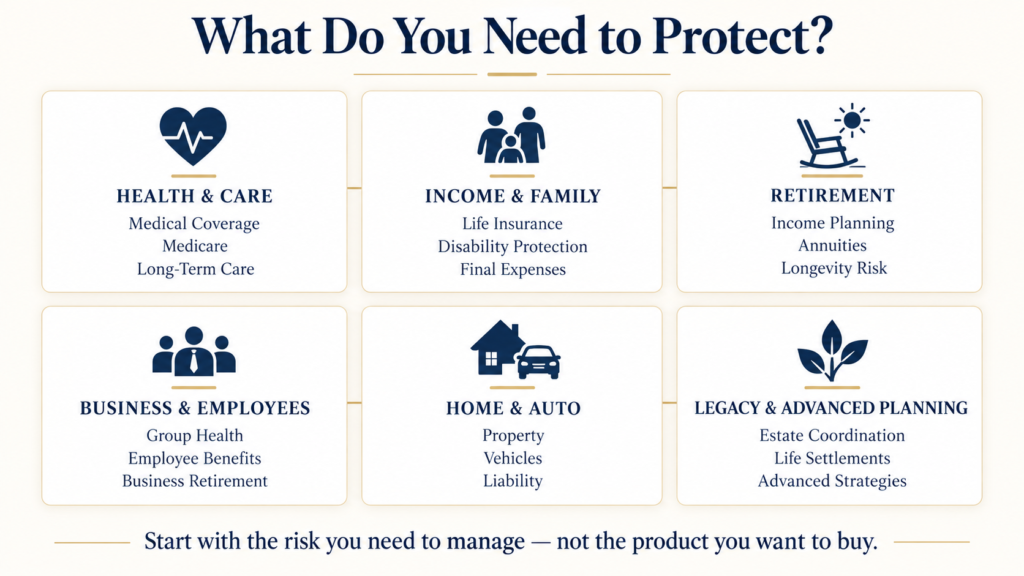
Instead of beginning with insurance terminology, begin with your responsibilities.
Your Health
Domanda:
- How would I pay for major medical care?
- Do I have access to employer coverage?
- Am I eligible for ACA Marketplace coverage?
- Are my doctors and prescriptions covered?
- What is my potential out-of-pocket exposure?
Health insurance deserves its own evaluation because premium alone tells only part of the story.
Your Income
Domanda:
What happens if I am alive but unable to work?
Life insurance addresses death.
Disability insurance addresses a very different risk: losing the ability to earn income because of a qualifying illness or injury.
For professionals, self-employed individuals and business owners in particular, income can be one of their most valuable financial assets.
Your Family
If someone depends on your income, your financial protection needs change.
Considerate:
- Mortgage or housing obligations
- Income replacement
- Children
- Education expenses
- Debts
- Final expenses
- Caregiving responsibilities
- Business obligations
Life insurance is designed to provide a death benefit to designated beneficiaries according to the policy contract. Term and permanent insurance solve different types of needs and involve different costs and trade-offs.
Your Future Care
Health insurance and Medicare do not automatically cover every form of long-term custodial care.
Long-term care planning may become relevant when considering:
- Home-based care
- Assisted living
- Nursing care
- Help with activities of daily living
- Cognitive impairment
Traditional long-term care insurance and certain life-insurance-based strategies can operate very differently.
Your Retirement
Protection planning does not necessarily stop when employment ends.
Retirement can introduce new risks:
- Longevity
- Market volatility
- Healthcare expenses
- Income needs
- Long-term care
- Legacy objectives
Annuities are insurance contracts that may be used for accumulation or income purposes depending on the contract.
Different types — including fixed indexed annuities, MYGAs and immediate annuities — should not be treated as interchangeable products.
Your Business
For business owners, personal and business risks frequently overlap.
Le domande possono includere:
- What happens if the owner cannot work?
- How will the owner’s family be protected?
- What benefits should be offered to employees?
- How will healthcare benefits be structured?
- Does the business need a retirement plan?
- What happens during an ownership transition?
- Are existing personal policies still appropriate as the company grows?
Recent business-owner discussions continue to show significant concern around health-benefit costs, disability protection and building competitive employee-benefit packages.
Explore SAG Insurance Solutions
Protezione Vita e Reddito
Life and income protection address two different questions:
What happens to the people who depend on me if I die?
e
What happens if I remain alive but can no longer earn my normal income?
Assicurazione sulla vita
Life insurance options can include:
- Assicurazione sulla vita a termine
- Rientro della polizza vita con premio
- Assicurazione sulla vita intera
- Assicurazione per le spese finali
- Assicurazione universale di vita con indice
- Vita universale garantita
Different products have different objectives, guarantees, costs, cash-value characteristics and policy risks.
Permanent insurance should never automatically be described as superior to term insurance.
The appropriate structure depends on the purpose of the coverage.
Assicurazione invalidità
Disability insurance can help replace a portion of qualifying income when an insured person meets the policy’s definition of disability.
Important considerations can include:
- Benefit amount
- Periodo di beneficio
- Periodo di eliminazione
- Definition of disability
- Occupation
- Income documentation
- Exclusions and limitations
For self-employed individuals and business owners, this deserves particular attention because the ability to earn income may be central to both household and business finances.
Assicurazione per la cura a lungo termine
Long-term care insurance is designed around qualifying long-term-care needs rather than ordinary medical treatment.
Benefits, elimination periods, inflation options, benefit periods and eligibility triggers vary by policy.
Assicurazione sanitaria per individui e famiglie
Health insurance is one of the most complicated areas of U.S. insurance because coverage choices can depend on employment, household circumstances, income, state, enrollment periods and eligibility.
SAG’s health-insurance resources include:
Assicurazione sanitaria del mercato ACA
ACA Marketplace coverage may provide comprehensive individual or family major-medical insurance.
Eligible consumers may qualify for Premium Tax Credits based on applicable federal rules and actual household and tax circumstances.
Assicurazione sanitaria privata
Individual health coverage may also be available outside the Marketplace.
Consumers should verify whether a plan is comprehensive major-medical coverage and understand exclusions, underwriting and limitations before enrolling.
Assicurazione dentale
Dental coverage has its own rules, including:
- Annual maximums
- Waiting periods
- Riduzioni imponibili
- Preventive services
- Basic services
- Major services
- PPO or DHMO networks
Assicurazione sanitaria complementare
Supplemental products can include coverage such as accident, critical illness or hospital indemnity benefits.
These products may help address specific financial risks but generally should not be represented as replacements for comprehensive major-medical insurance.
HealthCare.gov provides official information about individual Marketplace coverage, enrollment and eligibility.
Explore official Health Insurance Marketplace information
Medicare Solutions
Turning 65 or becoming eligible for Medicare introduces an entirely different set of decisions.
Medicare is not one single all-inclusive insurance plan.
Individuals may need to understand:
- Medicare Part A
- Medicare Part B
- Medicare originale
- Medicare Advantage
- Medicare Parte D
- Medicare Supplement Insurance, or Medigap
Original Medicare and Medicare Advantage work differently, including differences involving networks, costs and how coverage is administered.
SAG’s Medicare educational resources are designed to explain those choices before comparing specific plans.
Review official Medicare coverage options
Retiro e protezione patrimoniale
Retirement planning involves more than accumulating assets.
It also involves determining how future income needs may be addressed.
Insurance-based retirement solutions can include:
Anagrafiche Indexed Annuities
Fixed indexed annuities are insurance contracts whose interest-crediting methodology may reference the performance of an external index.
They do not represent direct ownership of the index.
Annuity garantite pluriennali
MYGAs generally provide a stated interest rate for a specified contractual period, subject to the insurer and contract.
Annuite immediate
Immediate annuities are structured to begin income payments relatively soon after purchase.
Benefici garantiti per il ritiro a vita
Certain annuity contracts may offer optional riders designed to establish contractual withdrawal benefits under specified conditions.
Income values, accumulation values and surrender values are not necessarily the same.
Annuity guarantees depend on the claims-paying ability of the issuing insurance company.
Benefici per l'azienda e per i dipendenti
As a business grows, benefits can influence recruiting, retention and workforce planning.
Assicurazione sanitaria collettiva
Small businesses may evaluate employer-sponsored group health coverage based on:
- Workforce size
- Employee locations
- Employer budget
- Participation
- Rete di fornitori
- Funding arrangements
- Eligibility requirements
Alternative structures such as ICHRA or QSEHRA may also deserve comparison when appropriate.
Benefici integrativi per i dipendenti
Employers can potentially supplement core benefits with products such as:
- Accident coverage
- Critical illness
- Hospital indemnity
- Disability
- Assicurazione sulla vita
- Dental
- Vision
These benefits should be clearly distinguished from comprehensive health insurance.
Piani 401(k) aziendali
A 401(k) is not an insurance product.
It is an employer-sponsored retirement plan.
It belongs within SAG’s broader business-planning ecosystem because business owners may need to coordinate healthcare benefits, retirement benefits and employee-protection strategies rather than evaluating each decision in isolation.
Assicurazione Casa e Auto
Some risks are connected directly to property ownership and transportation.
Home Insurance
Homeowners insurance may help address covered losses involving areas such as:
- Dwelling
- Personal property
- Responsabilità
- Loss of use
Coverage limits, exclusions and deductibles require careful review.
Flood and other risks are not necessarily covered by a standard homeowners policy.
Auto Insurance
Auto coverage can include different combinations of:
- Bodily injury liability
- Property damage liability
- Collision
- Comprehensive
- Uninsured or underinsured motorist coverage
- Medical-related benefits depending on state requirements
Required coverages and limits vary significantly by state.
Strategie avanzate in materia di assicurazione e successione
Some circumstances require more specialized planning.
These strategies should not be treated as appropriate for everyone.
Finanziamento dei premi assicurativi
Premium financing can involve borrowing funds to help finance insurance premiums.
It introduces:
- Interest-rate risk
- Obblighi di garanzia
- Rischio di rifinanziamento
- Policy-performance risk
It is not free money and should not be presented as such.
Assicurazione internazionale o offshore
International insurance arrangements can involve additional jurisdictional, legal, tax and regulatory considerations.
They require careful professional review.
Cessioni di polizze sulla vita
A life settlement involves selling an existing life-insurance policy to a third party rather than maintaining or surrendering it.
Eligibility, valuation, taxation and consumer protections can vary.
Trusts, Wills & Legacy Planning
Trusts and wills are legal-planning tools, not insurance products.
Insurance may sometimes be coordinated with estate or legacy planning, but legal documents should be prepared and reviewed by appropriately qualified legal professionals.
Le esigenze assicurative cambiano con la vita
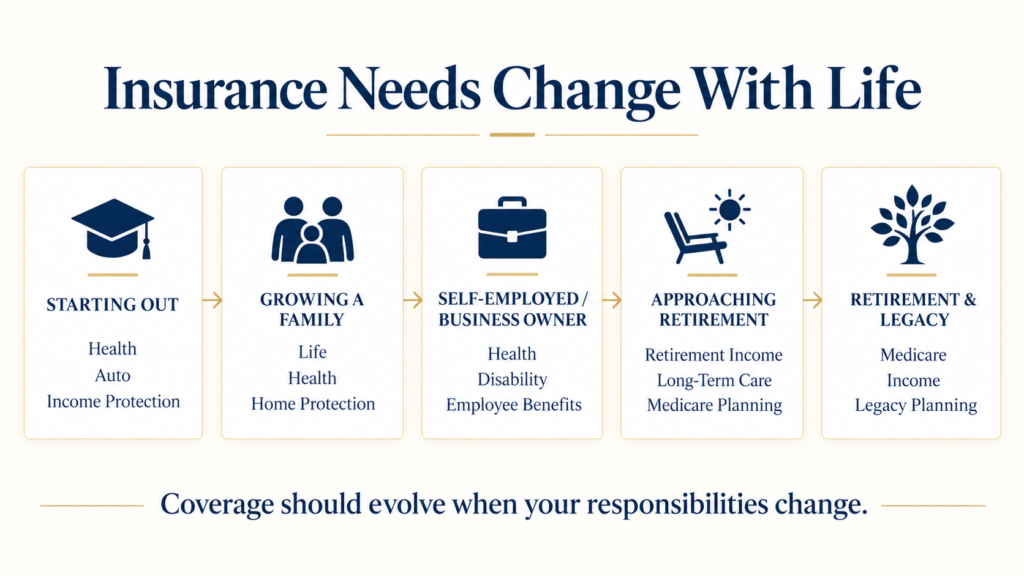
Insurance planning should not be a one-time exercise.
Starting Your Career
Common areas to consider may include:
- Assicurazione sanitaria
- Auto insurance
- Renters or home insurance
- Disability protection
Building a Family
Additional priorities may include:
- Assicurazione sulla vita
- Income protection
- Health coverage
- Home protection
- Education and legacy considerations
Becoming Self-Employed
Leaving an employer can affect:
- Assicurazione sanitaria
- Disability coverage
- Assicurazione sulla vita
- Retirement benefits
The question becomes especially important when one person’s ability to work supports both the household and the business.
Growing a Business
A business owner may need to reconsider:
- Assicurazione sanitaria per gruppi
- Supplemental employee benefits
- Disability protection
- Assicurazione sulla vita
- Retirement plans
- Business-continuity needs
Approaching Retirement
Priorities often shift toward:
- Retirement income
- Healthcare
- Long-term care
- Medicare preparation
- Legacy planning
Medicare & Retirement Years
Coverage decisions may include:
- Medicare originale
- Medicare Advantage
- Medigap
- Parte D
- Long-term care
- Retirement income
- Legacy objectives
There is no single age when every insurance product suddenly becomes necessary.
Come diverse soluzioni assicurative possono collaborare tra loro
Insurance gaps often occur because products are purchased separately without considering the entire financial picture.
Consider a hypothetical family with:
- Two working parents
- Two children
- A mortgage
- Employer health insurance
- Two vehicles
- Retirement savings
They may already have health and auto insurance.
But that does not answer:
- What happens if one parent dies?
- What happens if one parent cannot work?
- Is the home adequately protected?
- Is employer life insurance sufficient?
- Will benefits disappear after changing jobs?
- Are beneficiaries current?
A coordinated review asks how the different pieces interact.
It does non automatically mean buying more insurance.
Sometimes the correct result of a review is that existing coverage is appropriate.
Come valutare le proprie esigenze assicurative passo dopo passo
1. Identify Your Biggest Financial Risks
Start with consequences, not products.
Ask what would have the greatest financial impact if something unexpected occurred.
2. Inventory Existing Coverage
Review coverage you already have through:
- Employers
- Individual policies
- Business plans
- Medicare
- Property and auto insurance
Do not assume that having a policy automatically means the amount or structure is still appropriate.
3. Identify Possible Gaps
Look for responsibilities that are not adequately addressed.
Gli esempi includono:
- Income replacement
- Dependents
- Medical costs
- Long-term care
- Business responsibilities
- Retirement income
4. Prioritize
Not every potential risk requires insurance.
Some risks may reasonably be self-funded.
Others could create financial consequences that would be difficult to absorb.
5. Compare Coverage — Not Just Price
Recensione:
- Benefits
- Exclusions
- Limits
- Riduzioni imponibili
- Waiting periods
- Networks
- Riders
- Tasse per le politiche
- Garanzie
- Surrender provisions
- Affidamento
A lower premium does not automatically represent better value.
6. Review the Strategy Regularly
Insurance needs can change after:
- Marriage
- Divorce
- Birth or adoption
- Home purchase
- Starting a business
- Major income changes
- Moving states
- Retirement
- Idoneità a Medicare
- Significant changes in assets or debt
Insurance should evolve when your responsibilities change.
Quanto costano le soluzioni assicurative?
There is no useful universal answer.
Different insurance categories use completely different pricing methods.
| Coverage Area | Important Cost Factors |
|---|---|
| Assicurazione sanitaria | Age, location, household, plan, network, eligibility |
| Assicurazione sulla vita | Age, health, coverage amount, duration, product type |
| Assicurazione invalidità | Income, occupation, benefit amount, waiting period |
| Long-Term Care | Age, health, benefits, elimination period |
| Rendite | Premium amount, product structure, riders, surrender schedule |
| Medicare Plans | Location, coverage type, insurer and plan |
| Home Insurance | Property, replacement cost, location, deductible, risks |
| Auto Insurance | Vehicle, drivers, location, coverage and driving factors |
| Group Benefits | Workforce, location, plan structure and participation |
A price without context can therefore be misleading.
The more useful question is:
What am I paying, what risk am I transferring, and what financial exposure remains?
Perché una revisione assicurativa può essere più utile di un'altra offerta
Shopping only for a lower premium answers one question:
Can I pay less?
A proper coverage review asks several:
- What do I already have?
- What am I actually protecting?
- Where could a significant gap exist?
- Am I paying for coverage I no longer need?
- Have my responsibilities changed?
- Does my current policy still match my goals?
- Should another strategy even be considered?
Insurance should not automatically be replaced simply because another product is available.
Existing policies may contain guarantees, pricing or provisions that would be difficult or impossible to recreate.
Never cancel existing coverage until replacement coverage has been properly reviewed, approved when applicable and confirmed in force.
Guida assicurativa per gli italiani residenti negli Stati Uniti
The American insurance system can feel especially complicated when you grew up with a different healthcare, retirement or social-benefit system.
Terms such as:
- Riscossione
- Coassicurazione
- Massima spesa personale
- Affidamento
- Valore in contanti
- Importo dovuto per la resa
- Medicare Supplement
- HMO
- EPO
- PPO
may have no direct equivalent to what someone previously experienced in Italy.
SAG’s educational approach is designed to make those concepts easier to understand without assuming that the client already knows the U.S. system.
The objective is not to create separate insurance rules for Italian families.
The laws and contracts are the same.
The difference is providing explanations in language and context that make the American system easier to navigate.
Esemplo pratico: un imprenditore con una famiglia
Consider a hypothetical 47-year-old business owner with a spouse and two children.
The family’s initial question is:
“Do I need more life insurance?”
A broader review may reveal several separate questions:
Salute
Does the family have appropriate medical coverage?
Income
What happens if the business owner cannot work for an extended period?
Life
How much income would the family lose if the owner died?
Business
Would the company continue operating?
Employees
Does the company need employee health or supplemental benefits?
Retirement
Is the business owner building retirement assets outside the company?
Property
Are home and auto liability limits appropriate?
The solution may involve one product, several products or no immediate change at all.
The purpose of the review is to understand the risks before choosing a solution.
This example is hypothetical and does not represent individualized insurance, legal, financial or tax advice.
Domande da por prima che si acquisti un'assicurazione
Before applying, ask:
- What problem is this policy designed to solve?
- What exactly is covered?
- What is excluded?
- What is guaranteed?
- What can change?
- How long does the coverage last?
- What could cause the policy to lapse?
- What are the ongoing costs?
- Are there deductibles or waiting periods?
- Are there surrender charges?
- Does underwriting apply?
- Does availability vary by state?
- What happens if I move?
- What happens if my health changes?
- How does this coordinate with coverage I already own?
- What alternatives should I compare?
- What happens if I decide not to buy it?
A good insurance decision should still make sense after those questions are answered.
Domande frequenti
Quali tipi di assicurazione necessita una famiglia media?
Non esiste una lista universale. Le coperture sanitarie, auto e per la casa sono considerazioni comuni, mentre le esigenze in materia di vita, disabilità e cure a lungo termine dipendono fortemente dal reddito, dai familiari a carico, dagli asset e dalle responsabilità.
Come faccio a sapere se ho un’assicurazione sufficiente?
Cominciate identificando quali conseguenze finanziarie la polizza intende affrontare e confrontando tale rischio con il volume e i termini della vostra copertura esistente.
Devo acquistare ogni tipo di assicurazione?
No.
L'assicurazione è un metodo per gestire il rischio finanziario. Alcuni rischi minori possono essere ragionevolmente coperti o sostenuti a proprie spese.
Con che frequenza dovrei rivedere la mia assicurazione?
Una revisione è utile dopo importanti cambiamenti nella vita o nella sfera finanziaria e periodicamente anche quando nulla di ovvio è cambiato.
La vita assicurativa per il datore di lavoro è sufficiente?
It depends on the amount, portability and your family’s financial needs. Employer coverage should be evaluated as part of the overall picture rather than automatically assumed to be sufficient or insufficient.
Ho bisogno di una polizza di assicurazione invalidità se già ho un'assicurazione sanitaria?
Risolvono problemi diversi.
L'assicurazione sanitaria aiuta a coprire le spese mediche.
Disability insurance may provide income benefits if you meet the policy’s definition of disability.
È la stessa cosa avere un'assicurazione sulla vita e un conto di investimento?
No.
Una rendita è un contratto di assicurazione. Alcuni tipi di rendita presentano caratteristiche legate al mercato o all’investimento, ma la struttura del contratto, le garanzie, le commissioni e i rischi devono essere considerati separatamente.
Le rendite vitalizie sono assicurate dalla FDIC?
In generale, i contratti di rendita non sono depositi bancari assicurati dalla FDIC. Le garanzie sono soggette alla capacità di pagamento dei sinistri da parte dell’assicuratore emittente.
Il Medicare sostituisce tutti i tipi di assicurazione dopo i 65 anni?
No.
Medicare has defined benefits, costs and coverage rules. Depending on the individual’s circumstances, other coverage considerations may still exist.
Il 401(k) è un prodotto assicurativo?
No.
Un 401(k) è un piano di pensionamento sponsorizzato dal datore di lavoro.
Sono i trust e i testamenti prodotti assicurativi?
No.
They are legal-planning tools. Insurance can sometimes coordinate with estate planning, but they should not be confused.
Can one insurance solution be right for everyone?
No.
Age, health, income, family, employment, location, business ownership, assets and goals can materially change what is appropriate.
Importante comunicazione
Coverage availability, eligibility, premiums, deductibles, coverage limits, exclusions, discounts, underwriting requirements, and policy terms vary by insurer, state, applicant, and policy. Coverage is subject to insurer approval and the terms and conditions of the issued policy. This content is provided for general educational purposes and is not individualized insurance, tax, legal, or financial advice.
Conosca le vostre opzioni con una chiara guida
You do not need to begin by knowing which policy to ask for.
Start with what you want to protect.
A structured review can help identify your priorities, understand existing coverage and compare appropriate options before making a decision.