


ACA Marketplace Health Insurance: How It Works, Open Enrollment, Subsidies and Plan Types
ACA Marketplace health insurance gives eligible individuals and families access to comprehensive major medical coverage under the Affordable Care Act. For a broader overview of individual, family, and employer coverage options, visit our Health Insurance page.
But choosing a Marketplace plan involves much more than finding the lowest monthly premium.
Your household, expected income, doctors, hospitals, prescriptions, provider network, deductible, copayments, coinsurance and maximum out-of-pocket exposure can all affect how a plan may work for you.
Timing is equally important.

ACA individual health insurance generally cannot be purchased or changed whenever someone decides they need medical care. Enrollment normally occurs during the annual Open Enrollment Period or during a qualifying Special Enrollment Period.
Understanding the coverage, costs and enrollment rules before you need significant medical care can help reduce unexpected coverage gaps and financial surprises.
Indice
Cos'è l'assicurazione sanitaria del mercato ACA?
The Health Insurance Marketplace is a system through which eligible individuals and families can compare and enroll in qualified individual health insurance plans.
Most states use the federal Marketplace through HealthCare.gov, while some states operate their own Marketplace platforms.
Marketplace plans are comprehensive major medical insurance subject to Affordable Care Act requirements.
They are commonly called:
- ACA insurance
- ACA health insurance
- Marketplace insurance
- Marketplace health insurance
- Obamacare
- Obamacare insurance
These terms are often used interchangeably, but consumers should still confirm that the coverage they are considering is actually ACA-compliant major medical insurance.
An inexpensive health product advertised online is not necessarily a Marketplace Qualified Health Plan.
Chi può iscriversi all'assicurazione sanitaria del Marketplace?
General Marketplace eligibility includes requirements related to U.S. residence, citizenship or qualifying immigration status and incarceration status.
Marketplace coverage may be particularly relevant for:
- Self-employed professionals
- Freelancers
- Consultants
- Independent contractors
- 1099 workers
- Gig workers
- Small-business owners without appropriate group coverage
- Individuals between jobs
- People losing employer-sponsored insurance
- Young adults losing coverage through a parent’s plan
- Families without appropriate employer-sponsored coverage
- Early retirees who are not yet eligible for Medicare
Eligibility for Marketplace coverage does not automatically mean that someone qualifies for Premium Tax Credits.
Financial assistance has additional requirements involving household income, tax household composition and access to other qualifying coverage.
Cosa copre l'assicurazione sanitaria del mercato ACA?
Marketplace Qualified Health Plans cover the ten categories of Benefici essenziali per la salute required under the Affordable Care Act.
These include:
- Ambulatory and outpatient services
- Servizi di emergenza
- Allontanamento dall’ospedale
- Pregnancy, maternity and newborn care
- Mental health and substance use disorder services
- Farmaci da prescrizione
- Rehabilitative and habilitative services and devices
- Servizi di laboratorio
- Preventive and wellness services and chronic-disease management
- Servizi pediatrici, tra cui la cura orale e visiva pediatrica
Specific benefits, provider networks, prescription formularies, prior-authorization requirements and cost sharing still vary by plan.
ACA Marketplace plans also include significant consumer protections.
For example, Marketplace insurers generally cannot reject an applicant or charge a higher premium solely because of that person’s health history or a pre-existing medical condition.
Coverage must still be obtained during an applicable enrollment period.
Come funzionano i piani ACA Bronze, Silver, Gold e Platinum?
Marketplace plans are organized into metal categories.
The metal category does not grade the quality of doctors, hospitals or medical care.
Instead, it describes the general relationship between the portion of covered medical costs paid by the health plan and the portion paid by members across the plan population.
| Metal Level | Approximate Plan Share of Covered Costs | General Cost Pattern |
|---|---|---|
| Bronze | About 60% | Often lower premiums and higher cost sharing |
| Silver | About 70% | Middle range; particularly important for Cost-Sharing Reductions |
| Gold | About 80% | Often higher premiums and lower cost sharing |
| Platinum | About 90% | Generally highest premiums and lower cost sharing; not available everywhere |
These percentages are actuarial averages across a population. They do not mean that the insurer will pay exactly that percentage of every individual medical bill.
Why Silver Plans Deserve Special Attention
Eligible consumers who qualify for Cost-Sharing Reductions, sometimes called extra savings, generally receive those additional reductions only when they enroll in an eligible Silver plan.
Cost-Sharing Reductions can lower deductibles, copayments, coinsurance and the applicable maximum out-of-pocket exposure.
Someone who qualifies for both a Premium Tax Credit and Cost-Sharing Reductions should therefore compare Silver carefully before choosing another metal level solely because its advertised premium appears lower.
What About Catastrophic Plans?
Catastrophic plans may be available to certain eligible consumers and in certain areas.
They typically combine relatively lower premiums with very high cost sharing and are primarily designed to provide protection against major medical expenses.
Eligibility rules and availability should be checked for the applicable coverage year.
Descrizione dei premi, dell'indennizzo, della copagione, della coassicurazione e del massimale a carico del paziente
One of the biggest mistakes people make when comparing Marketplace health insurance is looking only at the monthly premium.
A health plan can have an attractive premium and still expose the member to substantial costs when medical care is used.
Premium
Il premium is the amount you pay to keep the insurance coverage active, generally each month.
You pay it whether you use the plan or not.
Riscossione
Il deductible is the amount you may need to pay toward certain covered services before the plan begins sharing those costs according to the policy.
Not every service necessarily requires the deductible to be met first.
Some plans provide office visits, prescriptions or other benefits using copayments before the full deductible is satisfied.
Copayment
A copayment, or copay, is a fixed amount charged for a covered service under the plan terms.
Examples might include a stated copay for:
- Primary-care visits
- Specialist visits
- Urgent care
- Prescriptions
Coassicurazione
Coassicurazione is generally a percentage of an allowed covered medical expense that the member pays according to the plan terms.
For example, a plan may require the member to pay a percentage of the allowed amount after the applicable deductible.
Maximum Out-of-Pocket
Il maximum out-of-pocket, or MOOP, is one of the most important financial protections in a health plan.
Once the member reaches the applicable annual maximum for covered in-network services, the plan generally pays 100% of additional covered in-network benefits for the remainder of the plan year, subject to the contract.
Premiums generally do not count toward the maximum.
Out-of-network care, non-covered services and certain amounts may also be excluded.
For 2027, HealthCare.gov currently lists the maximum Marketplace out-of-pocket limit as $12,000 for an individual and $24,000 for a family. Individual plans may have lower limits.
Because these federal limits change, this figure should be reviewed each coverage year.
Why the Cheapest Premium May Not Be the Cheapest Plan
The more useful comparison is often:
Annual Premium + Expected Cost Sharing + Worst-Case In-Network Exposure
Someone who expects several specialist visits, expensive prescriptions or surgery may evaluate two plans very differently from someone who expects very little medical care.
Come funzionano i sussidi del mercato ACA?
Marketplace financial assistance can take different forms.
The best-known is the Credito d'imposta per i premi, or PTC.
Eligible consumers can choose to have some or all of their estimated Premium Tax Credit paid directly to the insurance company during the year.
This is called an Advance Premium Tax Credit, or APTC.
The APTC reduces the monthly amount the consumer pays for the Marketplace policy.
It is not simply an insurance-company discount.
It is connected to the consumer’s federal tax situation and is later reconciled with the actual Premium Tax Credit when the federal income tax return is filed.
Current Income Rule After the Enhanced Subsidies
The temporary federal expansion that applied for tax years 2021 through 2025 allowed some households above 400% of the Federal Poverty Level to qualify for Premium Tax Credits.
Under current IRS guidance for 2026, the general PTC income requirement again uses household income from at least 100% through no more than 400% of the applicable Federal Poverty Level, subject to the other eligibility rules and limited exceptions.
This is an important change from the previous several years.
APTC Is Based on an Estimate – But the Estimate Must Be Reasonable
Marketplace applications use expected household income for the coverage year.
The estimate should reflect what the household reasonably expects to earn.
It should not be an arbitrary number selected simply to obtain a larger subsidy.
Changes that may affect the estimate include:
- Starting or losing a job
- Changes in wages
- Changes in self-employment income
- Marriage
- Divorce
- Birth or adoption
- Changes in tax dependents
- Becoming eligible for employer coverage
- Becoming eligible for Medicare or another government program
Consumers receiving APTC should update their Marketplace application when material changes occur.
Important 2026 Tax Consideration
The IRS reconciles advance Premium Tax Credits with the final credit calculated on the federal tax return.
Consumers should not assume that an inaccurate income estimate will have only a small consequence.
Current IRS guidance describes the former repayment-cap rules as applying to tax years before 2026.
Because individual tax situations can be complex, questions about MAGI, self-employment income, deductions, Form 8962 or repayment of excess APTC should be reviewed with a qualified tax professional.
Come funziona l'apertura della copertura assicurativa tramite l'ACA?
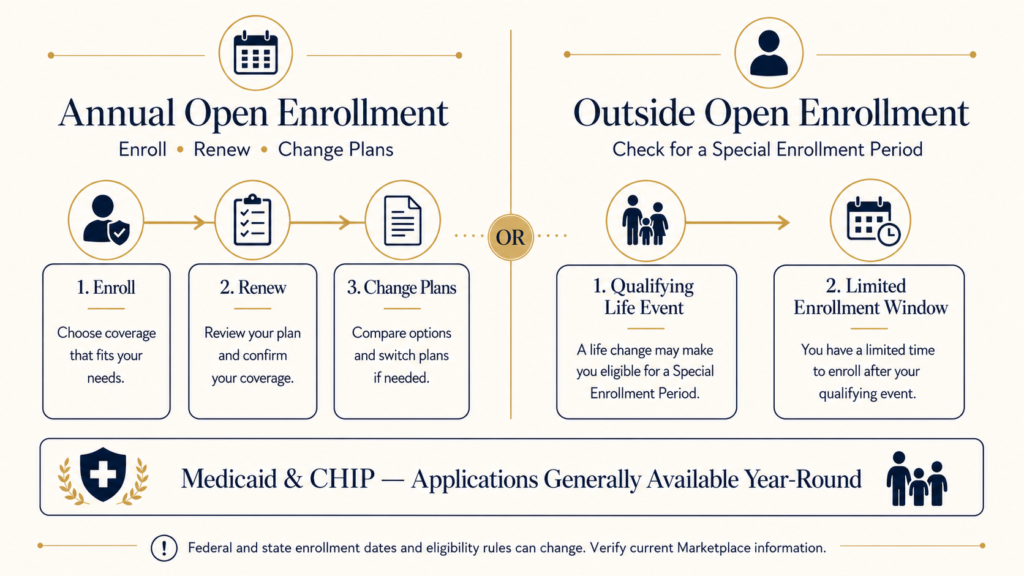
Il Open Enrollment Period, or OEP, is the annual period during which eligible consumers can generally:
- Enroll in a Marketplace plan
- Renew Marketplace coverage
- Change from one Marketplace plan to another
without needing a qualifying life event.
Current Federal Marketplace Dates for 2027 Coverage
Last verified: September 4, 2026
HealthCare.gov currently publishes the following federal Marketplace schedule:
- November 1, 2026: Open Enrollment begins.
- December 15, 2026: General deadline for selecting coverage to begin January 1, 2027.
- January 1, 2027: Coverage generally begins for consumers who enrolled by the December deadline and completed required premium payment.
- December 15, 2026: For the federal Marketplace, CMS finalized a November 1–December 15 Open Enrollment window beginning with plan year 2027. State-based Marketplaces may use different dates within federal requirements, so consumers should verify the current deadline for their Marketplace before enrolling.
- Coverage effective date: For the federal Marketplace’s 2027 Open Enrollment window, verify the effective-date rules shown in your Marketplace application and plan materials. State-based Marketplace timing may differ.
State-Based Marketplaces may operate under different deadlines.
Always verify the current Marketplace dates for the state and plan year before enrolling.
Perché alcuni siti web mostrano date diverse per l'iscrizione aperta nel 2027?
Consumers may currently find conflicting information online about the 2027 enrollment period.
CMS issued a 2025 rule that attempted to shorten future Open Enrollment periods, including changes affecting the 2027 coverage year.
On June 12, 2026, a federal district court reviewing that rule concluded that the shortened Open Enrollment provision was arbitrary and capricious.
Important 2027 update: CMS finalized a November 1 through December 15 Open Enrollment window for the federal Marketplace beginning with plan year 2027. Some HealthCare.gov educational pages may still display the older November 1–January 15 wording, so consumers should confirm the current deadline shown by their Marketplace before relying on a date. State-based Marketplace schedules may differ.
Because federal litigation, regulations and Marketplace policies can change, consumers should rely on the current official Marketplace information available when they actually enroll rather than an older blog post or remembered deadline.
Why Can’t You Normally Buy ACA Insurance at Any Time of the Year?
This question is especially important because ACA plans protect people with pre-existing conditions.
Federal law requires the Marketplace to provide annual and Special Enrollment Periods, and federal guaranteed-availability rules permit individual-market enrollment to be limited to designated enrollment windows.
The structure combines two important ideas:
Guaranteed access protections — a Marketplace insurer generally cannot reject you because you become sick.
Defined enrollment periods — you generally cannot wait until significant treatment is immediately necessary and then enroll at any time of the year solely because your medical needs changed.
Enrollment periods are also used as a mechanism to reduce adverse selection within the individual insurance market.
In practical terms, becoming sick does not ordinarily create a new enrollment right by itself.
That is why consumers should understand their health insurance options before a major medical problem develops.
Che cosa succede se non si avanza alla registrazione per l’anno civile 2018 dell’ACA?
If Open Enrollment ends and you did not enroll, you generally cannot simply purchase a Marketplace Qualified Health Plan the following week.
Your next options may include:
- Qualifying for a Special Enrollment Period
- Qualifying for Medicaid o CHIP, which generally accept applications throughout the year
- Waiting for the next annual Open Enrollment Period
Other forms of health coverage may exist outside the ACA Marketplace, but they may operate under different rules and may not provide the same benefits or protections as comprehensive ACA-compliant major medical insurance.
Cos'è un periodo di iscrizione speciale?
A Special Enrollment Period, commonly called an SEP, allows certain eligible consumers to enroll in or change Marketplace coverage outside annual Open Enrollment.
SEPs are usually triggered by a qualifying life event or another circumstance recognized under Marketplace rules.
For many events, the enrollment window is approximately 60 days before or after the qualifying event, although the precise rule depends on the event.
Losing Employer-Sponsored Health Insurance
Losing qualifying job-based coverage can create an SEP.
Examples include losing coverage because of:
- Job loss
- Leaving a job
- Reduced work hours
- Losing coverage through a spouse
- Losing eligibility as a dependent
- Certain COBRA circumstances
Someone who knows job-based coverage will end should consider reviewing Marketplace options before the old coverage terminates to reduce the risk of a gap.
Turning 26
A young adult who loses eligibility under a parent’s health plan because of age may qualify for a Special Enrollment Period.
Marriage
Marriage can create an SEP.
Additional eligibility and prior-coverage rules may apply depending on the circumstances.
Birth of a Child
Birth creates an important SEP.
When applicable, Marketplace coverage can generally be effective from the child’s date of birth even when enrollment is completed afterward within the permitted period.
Adoption or Foster Placement
Adoption or eligible foster placement can also create an SEP, with special effective-date rules where applicable.
Divorce or Legal Separation
Divorce or legal separation alone does not necessarily create an SEP.
If it causes someone to lose qualifying health insurance, the resulting loss of coverage may create the enrollment opportunity.
Permanent Move
Certain permanent moves may qualify.
Examples can include moving to:
- A new ZIP code
- A new county
- Another state
- The United States from another country or U.S. territory
- A new qualifying residence associated with school or seasonal work
Moving only for medical treatment or vacation generally does not qualify.
Prior-coverage requirements can apply to some domestic moves.
Losing Medicaid or CHIP
Loss of Medicaid or Children’s Health Insurance Program coverage can create a Special Enrollment Period.
Under current federal Marketplace rules, consumers losing Medicaid or CHIP generally have up to 90 days after the loss of coverage to select qualifying Marketplace coverage.
Exceptional Circumstances
Certain Marketplace errors, exceptional circumstances or other recognized situations may also create an enrollment opportunity.
Eligibility depends on the facts and applicable Marketplace rules.
Cosa non prevede di solito un periodo speciale di iscrizione?
Not every change or insurance cancellation qualifies.
Voluntarily Cancelling Coverage
Simply deciding to cancel existing health insurance generally does not by itself create a right to immediately obtain Marketplace coverage.
Losing Coverage for Non-Payment
If Marketplace coverage terminates because premiums were not paid, that termination alone generally does not create another SEP.
A consumer may need to wait for the next Open Enrollment unless another independent qualifying event applies.
Voluntarily Ending COBRA Early
Choosing to terminate COBRA before the COBRA period naturally expires generally does not automatically create an SEP.
Normal exhaustion of COBRA or another qualifying loss of coverage may be treated differently.
Becoming Sick or Scheduling Surgery
A new diagnosis, developing a medical condition or learning that surgery is necessary generally does non create a Special Enrollment Period by itself.
ACA plans protect pre-existing conditions once qualifying coverage is in force, but pre-existing-condition protections do not eliminate enrollment-period requirements.
Avrete bisogno di prove dell'evento di vita qualificante?
Possibly.
The Marketplace can request documentation supporting SEP eligibility.
For a loss-of-coverage SEP, documentation might need to show:
- What previous coverage existed
- Who lost coverage
- When the coverage ended or will end
When verification is requested, consumers should submit the required documentation promptly.
Failure to satisfy Marketplace verification requirements can delay or prevent coverage from becoming effective.
Quando inizia la copertura tramite iscrizione speciale?
Effective dates depend on the qualifying event.
For many SEPs, coverage can begin on the first day of the following month after plan selection.
Important exceptions can apply.
For example:
- Birth coverage may be effective from the date of birth.
- Adoption or eligible foster placement may allow coverage from the event date.
- Marriage coverage generally follows the applicable Marketplace effective-date rule.
- A future loss of employer coverage can often be coordinated so the Marketplace plan begins after the prior coverage ends.
Anyone who knows existing coverage will terminate should review their options before the termination date whenever possible.
HMO vs. EPO vs. PPO: Cosa significano questi termini assicurativi sulla salute?
The network structure can be just as important as the deductible or premium.
A low-cost plan may not be useful if the doctors, hospitals or specialists you need are outside its network.
| Tipologia del piano | Basic Structure | Out-of-Network Care | Specialist Referrals |
|---|---|---|---|
| HMO – Health Maintenance Organization | Usually emphasizes a defined network and coordinated care through a primary-care provider | Generally not covered except emergencies, subject to plan terms | Often required |
| EPO – Exclusive Provider Organization | Uses a defined network but often allows direct access to in-network specialists | Generally not covered except emergencies | Often not required, but plan rules vary |
| PPO – Preferred Provider Organization | Generally offers greater provider flexibility | Often provides some out-of-network benefits at greater member cost | Di solito non è richiesto |
HMO
An HMO may be appropriate for someone comfortable receiving most non-emergency care through a defined local network and following the plan’s referral procedures.
EPO
An EPO can provide more direct access to in-network providers than many HMOs but generally offers no non-emergency out-of-network benefit.
PPO
A PPO generally offers greater flexibility and may provide coverage for out-of-network providers, although the member usually pays substantially more.
PPO Marketplace availability varies significantly by state, county and carrier and should never be assumed.
Before enrolling, verify the actual network attached to the exact plan — not merely the insurance-company name.
Come confrontare i piani di assicurazione sanitaria del mercato ACA passo dopo passo
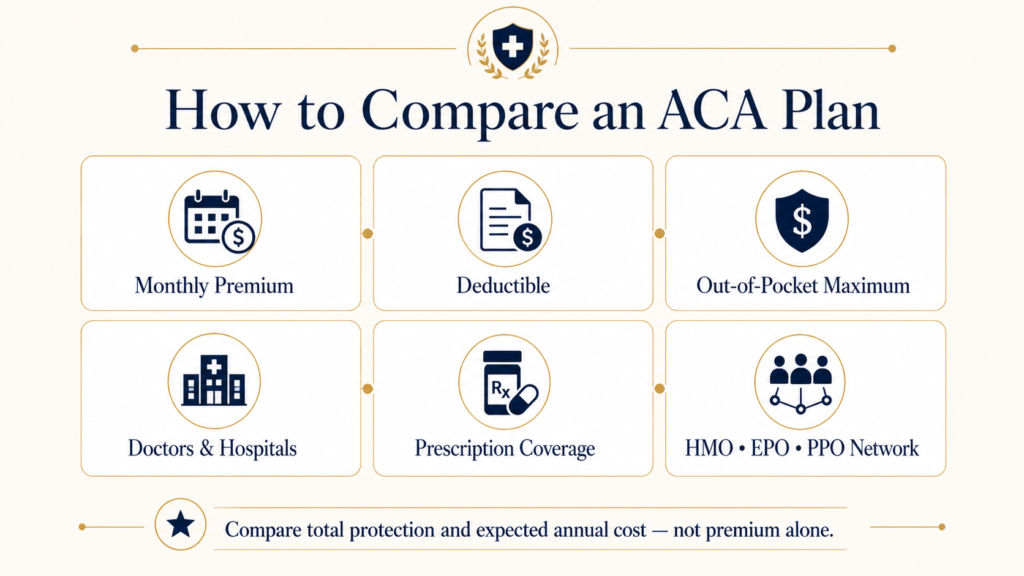
1. Start With Your Doctors and Hospitals
If keeping a physician, specialist, medical group or hospital is important, confirm participation in the exact plan’s network.
A doctor who accepts one plan from an insurance company does not necessarily accept every plan offered by that carrier.
2. Check Prescription Medications
Review the plan’s current prescription formulary.
Verifica:
- Whether the drug is covered
- Drug tier
- Copayment or coinsurance
- Deductible requirements
- Prior authorization
- Quantity limits
- Step-therapy requirements when applicable
3. Compare the Real Monthly Premium
Compare what the household would actually owe after any confirmed Marketplace financial assistance.
Do not compare plans using only an advertisement or generic “plans starting at” price.
4. Review the Deductible
Determine which medical and prescription services are subject to the deductible and which may be available through copays or other cost sharing before the deductible is met.
5. Compare Copays and Coinsurance
Prestate particolare attenzione a:
- Primary care
- Specialists
- Urgent care
- Emergency room
- Outpatient surgery
- Allontanamento dall’ospedale
- Imaging
- Diagnostic testing
- Laboratory work
- Prescription medications
6. Review the Maximum Out-of-Pocket Exposure
Ask what could happen financially during a year involving substantial in-network medical treatment.
The lowest-premium plan is not necessarily the plan with the lowest total financial exposure.
7. Check HMO, EPO or PPO Network Rules
Understand:
- Whether a PCP is required
- Whether specialist referrals are required
- Whether out-of-network benefits exist
- Which hospitals participate
- How emergency care is handled
8. Read the Summary of Benefits and Coverage
The Summary of Benefits and Coverage, or SBC, provides standardized information that can make plan comparison easier.
The provider directory, formulary and actual policy documents should also be reviewed when a specific medical need is important.
9. Compare Expected Annual Cost — Not Just Premium
A useful comparison can include:
12 months of premiums + expected medical spending + prescription costs + possible high-use-year exposure
There is no single carrier, metal level or plan design that is automatically best for everyone.
Assicurazione sanitaria del Marketplace ACA per lavoratori autonomi e lavoratori subordinati
Marketplace coverage can be particularly important for self-employed Americans.
A freelancer, consultant, independent contractor, real estate professional, gig worker or business owner may not have access to traditional employer-sponsored health insurance.
Marketplace coverage provides access to comprehensive ACA-compliant individual major medical insurance when eligibility requirements are met.
Why Income Estimation Can Be More Difficult for Self-Employed Households
Self-employment income may fluctuate considerably.
Marketplace financial assistance is based on the household’s expected income for the coverage year, not simply one particularly good or bad month.
That makes a reasonable annual projection especially important.
Consumers should update the Marketplace if their financial circumstances materially change.
Questions involving self-employed health-insurance deductions, MAGI, business deductions, Premium Tax Credits or Form 8962 are tax issues and should be discussed with a qualified tax professional.
Assicurazione Marketplace dell'ACA vs. Assicurazione sanitaria privata
The phrase assicurazione sanitaria privata can mean several different things.
Some individual plans purchased directly from an insurance company outside the Marketplace can still be ACA-compliant. If you are comparing on- and off-Marketplace options, see our Private Health Insurance overview for additional considerations.
Other private products may operate under different rules and may not provide the same benefits or consumer protections.
Premium Tax Credits are generally available only for qualifying Marketplace coverage.
Before comparing Marketplace insurance with another private option, determine:
- Is the plan ACA-compliant?
- Are pre-existing conditions covered?
- Does it include comprehensive hospitalization?
- Are prescription drugs covered?
- What exclusions apply?
- What provider network is used?
- Does out-of-network coverage exist?
- Qual è il limite di franchigia?
- What is the maximum out-of-pocket exposure?
- Are annual or lifetime benefit limits applicable?
- Is medical underwriting used?
- Can the plan be purchased year-round?
- Is the plan intended as comprehensive major medical insurance or limited-benefit coverage?
Two products with similar monthly premiums can provide very different financial protection.
Importanti protezioni per i consumatori previste dalla ACA
Condizioni Preesistenti
Marketplace plans generally cannot deny coverage, charge a higher premium or refuse coverage of Essential Health Benefits solely because of a pre-existing medical condition.
Health Status Does Not Set the Premium
Marketplace insurers cannot base the premium on the applicant’s individual medical history.
Premium-rating factors allowed under federal law generally include factors such as age, geographic area, tobacco use, family enrollment and plan category, subject to state rules.
Benefici essenziali per la salute
Marketplace plans provide comprehensive coverage across the ACA’s ten Essential Health Benefit categories.
Annual and Lifetime Dollar Limits
ACA protections generally prohibit annual and lifetime dollar limits on Essential Health Benefits, subject to applicable law.
Dependent Coverage to Age 26
When a plan provides dependent coverage, young adults can generally remain covered under a parent’s plan until age 26.
Esiste una penalità federale per non avere un'assicurazione sanitaria?
There is currently no federal tax payment for being uninsured.
The federal Individual Shared Responsibility Payment was reduced to $0 beginning in 2019.
However, some states and jurisdictions can maintain separate coverage requirements or state-level consequences.
The absence of a federal penalty also does non mean that someone can purchase Marketplace health insurance whenever desired.
Open Enrollment and Special Enrollment rules still apply.
Cose comuni che si possono fare di sbagli nel Marketplace dell'ACA da evitare
Common mistakes include:
- Choosing a plan only because it has the lowest monthly premium
- Ignoring the deductible
- Ignoring the maximum out-of-pocket exposure
- Assuming every doctor accepts every plan from the same insurance company
- Failing to verify hospitals
- Failing to review prescriptions
- Confusing an HMO, EPO and PPO
- Missing Open Enrollment
- Missing an SEP deadline
- Assuming illness or scheduled surgery creates enrollment eligibility
- Cancelling coverage without understanding whether a new enrollment opportunity exists
- Allowing coverage to terminate for non-payment
- Using an unrealistic income estimate to obtain financial assistance
- Failing to update major income or household changes
- Automatically renewing without reviewing the new year’s premium, provider network and benefits
- Confusing limited-benefit insurance with comprehensive ACA major medical coverage
Domande frequenti sull'assicurazione sanitaria del mercato ACA
Cos'è l'assicurazione sanitaria del Marketplace dell'ACA?
Si tratta di una copertura sanitaria completa per singole persone o famiglie offerta attraverso il mercato federale o quello statale applicabile e soggetta alle disposizioni della Affordable Care Act.
Quando è l'apertura dell'iscrizione all'ACA per il 2027?
Per l'anno di programmazione 2027, il CMS ha definito come data di inizio l'apertura dell'opzione di iscrizione al Marketplace federale. 1 novembre 2026 e chiude 15 dicembre 2026.
I termini per la registrazione presso lo Stato Marketplace possono variare.
Quando devo iscrivermi per la copertura del 1° gennaio?
For the federal Marketplace’s 2027 Open Enrollment window, December 15, 2026 is the finalized enrollment deadline. Confirm the effective date shown in your Marketplace application and complete any required premium payment. State-based Marketplace rules and dates may differ.
Posso ottenere l'assicurazione ACA anche fuori dall'Open Enrollment?
Possibly, but generally only when you qualify for a Special Enrollment Period or another enrollment opportunity recognized under Marketplace rules.
Medicaid and CHIP generally accept applications throughout the year for eligible individuals.
What qualifies as a life event for health insurance?
Common qualifying events include losing eligible health coverage, marriage, birth, adoption, certain permanent moves and other qualifying household or eligibility changes.
Specific requirements vary by event.
Does getting sick qualify me for Special Enrollment?
A new illness, diagnosis or scheduled surgery by itself generally does not create a Marketplace Special Enrollment Period.
Can ACA insurance cover a pre-existing condition?
Sì.
Marketplace plans generally cannot reject you or charge a higher premium solely because of a pre-existing condition.
You must still enroll during an applicable enrollment period.
How long do I have after losing employer health insurance?
For many qualifying losses of health coverage, the Marketplace window extends up to 60 days before and 60 days after the loss.
How long do I have after losing Medicaid or CHIP?
Current federal Marketplace guidance generally provides up to 90 days after the loss of Medicaid or CHIP coverage.
Can self-employed people buy Marketplace insurance?
Sì.
Eligible freelancers, consultants, independent contractors, 1099 workers and self-employed business owners can use the Individual Marketplace.
Why does my annual income matter for ACA insurance?
Expected household income is one of the factors used to determine potential eligibility for Marketplace Premium Tax Credits and other assistance.
Advance credits are reconciled on the federal tax return.
Is Silver always better than Bronze?
No.
However, consumers eligible for Cost-Sharing Reductions generally need an eligible Silver plan to receive those extra reductions in deductibles, copayments and coinsurance.
Qual è la differenza tra un HMO, un EPO e un PPO?
The major differences involve provider networks, referral requirements and out-of-network coverage.
HMO and EPO plans generally restrict non-emergency care to network providers, while PPOs generally provide greater out-of-network flexibility at additional cost.
Exact plan terms always control.
Is a zero-deductible plan automatically better?
No.
A zero or low deductible does not tell you the premium, copayments, coinsurance, provider network, prescription costs or maximum out-of-pocket exposure.
Is the cheapest ACA plan always the best option?
No.
The appropriate comparison includes premium, deductible, doctors, hospitals, medications, network, expected medical care and maximum out-of-pocket exposure.
Can my ACA subsidy change if my income changes?
Sì.
Marketplace financial assistance is tied to household and income information.
Significant changes should be reported to the Marketplace.
Do I have to pay ACA subsidies back?
Advance Premium Tax Credits are reconciled on the federal income tax return.
Whether additional tax is owed depends on final eligibility and the applicable tax rules.
Consumers should not assume that a previous year’s repayment limitation will apply to 2026 or later years.
Is there a federal penalty for not having health insurance?
The federal Individual Shared Responsibility Payment has been $0 since 2019.
State requirements may differ.
Conclusione: Scegliete il piano, non solo la versione premium
ACA Marketplace health insurance can provide comprehensive protection for individuals and families who need individual major medical coverage.
The most important question is not simply:
“Which plan has the lowest monthly premium?”
A stronger review asks:
- Are my doctors and hospitals in network?
- Le mie prescrizioni sono coperti?
- How does the deductible work?
- What are my copays and coinsurance?
- What is my maximum out-of-pocket exposure?
- Is the plan an HMO, EPO or PPO?
- Do I qualify for Marketplace financial assistance?
- Am I currently allowed to enroll?
- What could this plan realistically cost me during a high-medical-use year?
Understanding those answers before enrollment can make the difference between simply owning an insurance card and having coverage that actually fits your needs.
Hai bisogno di aiuto per confrontare le tue opzioni nel mercato del programma ACA?
Get personalized guidance based on your coverage needs, budget, doctors and enrollment eligibility.
Importante comunicazione
This page is provided for general educational purposes only and is not intended as legal, tax or medical advice.
Insurance eligibility, premiums, benefits, provider networks, subsidies, enrollment opportunities, effective dates and plan availability vary by state, insurance carrier, plan year and individual circumstances.
Marketplace regulations and tax laws may change.
Tax-related questions should be reviewed with a qualified tax professional.
Always review current Marketplace eligibility information, the Summary of Benefits and Coverage, provider directories, prescription formularies and official insurance plan documents before enrolling.