


Who Is Eligible for Medicare? A Guide for Citizens, Green Card Holders and Visa Holders
Who is eligible for Medicare depends on age or another qualifying condition, citizenship or immigration status, US residence, Medicare-covered work and enrollment timing. US citizens and green card holders may qualify through different routes. A temporary visa holder generally cannot enroll based on the visa alone under current federal law, even if the person has paid Medicare taxes while working.
This guide explains Medicare eligibility for citizens, green card holders and visa holders, including what happens without 40 US work credits, how the five-year residence rule works and which coverage may be available before Medicare begins.
For Italian families, one point is especially important: Italian pension credits can help with certain Social Security benefits under the US–Italy agreement, but they do not count toward premium-free Medicare Part A.

Table of Contents
What Is Medicare?
Medicare is the federal health-insurance program primarily for people age 65 or older. It also covers certain younger people who qualify because of a disability, Amyotrophic Lateral Sclerosis (ALS) or End-Stage Renal Disease (ESRD). Medicare is not the same as Social Security retirement, Medicaid, an employer health plan or a private individual policy.
The official Medicare parts overview explains the roles of Part A, Part B, Part D, Medicare Advantage and Medigap.
Eligibility and coverage are separate decisions. Social Security generally handles enrollment in Medicare Part A and Part B and determines the effective dates. After that, a person decides how to receive Medicare benefits and whether to add private coverage for prescriptions or cost sharing.
The Parts of Medicare
| Coverage | What it generally helps cover | Important point |
|---|---|---|
| Part A — Hospital Insurance | Inpatient hospital care, limited skilled-nursing-facility care, hospice and certain home health care | Part A is premium-free for many people with sufficient Medicare-covered work, but deductibles and cost sharing still apply |
| Part B — Medical Insurance | Physician services, outpatient care, durable medical equipment, preventive services and certain home health care | Part B generally has a monthly premium and does not automatically cover every medical expense |
| Part C — Medicare Advantage | A private-plan alternative for receiving Part A and Part B benefits, usually with Part D included | The person must keep Part A and Part B; networks, authorizations, service areas, costs and extra benefits vary by plan |
| Part D — Prescription Drug Coverage | Prescription drugs and certain recommended vaccines | Part D is offered by private plans and has separate enrollment and late-penalty rules |
| Medigap — Medicare Supplement Insurance | Helps pay some deductibles, coinsurance and copayments left by Original Medicare | Medigap works with Original Medicare, not Medicare Advantage; availability and enrollment protections depend on timing and state law |
Original Medicare and Medicare Advantage Are Not the Same
Original Medicare consists of Part A and Part B. A person can generally use any US provider that accepts Medicare, may add a separate Part D plan and may be able to buy Medigap. Original Medicare does not have a general annual out-of-pocket maximum unless the person has other supplemental coverage.
Medicare Advantage, also called Part C, is offered by Medicare-approved private insurers. It combines Part A and Part B and usually Part D. Plans have an annual limit for covered Part A and Part B services, but may use provider networks, referrals or prior authorization. Premiums, copayments, formularies, extra benefits and service areas can change.
Medicare also does not cover everything. Depending on the coverage path, a person may still pay premiums, deductibles, coinsurance, copayments and the full cost of services Medicare excludes. Routine dental, vision, hearing and long-term custodial care are common areas that require careful review rather than assumptions.
Quick Answer: Who Is Eligible for Medicare?
Medicare is generally available to people age 65 or older and certain younger people with qualifying disabilities, Amyotrophic Lateral Sclerosis or End-Stage Renal Disease. Eligibility also depends on the person’s current citizenship or qualifying immigration category and the rules for the particular enrollment path.
| Applicant profile | General Medicare position | What still must be verified |
|---|---|---|
| US citizen or national | May qualify at 65 or through disability, ALS or ESRD rules | Medicare-covered work, residence, enrollment timing and whether Part A is premium-free or purchased |
| Lawful permanent resident or green card holder | Remains an eligible immigration category under current federal law | Work-based entitlement or, for the premium buy-in route, age 65, US residence and five years of continuous US residence |
| Temporary visa holder | A visa alone generally does not create current Medicare eligibility | Whether another qualifying category or entitlement exists; employer or Marketplace coverage may be needed |
| Cuban or Haitian entrant | Included among the categories listed in the 2025 federal Medicare law | Ordinary age, disability, work, residence and enrollment requirements still apply |
| Eligible COFA resident | Included among the categories listed in the 2025 federal Medicare law | Ordinary program and enrollment requirements still apply |
| Other noncitizen status | Older guidance may no longer be current after the 2025 law | Social Security and qualified immigration counsel should review the exact status and transition rules |
Social Security—not an insurance agency or health plan—determines Part A and Part B eligibility and effective dates.
The Four Tests Behind Medicare Eligibility
Medicare eligibility should be reviewed in four separate stages:
- Qualifying basis: Is the person eligible because of age, disability, ALS or ESRD?
- Citizenship or immigration category: Is the person a US citizen or national, lawful permanent resident or another category recognized under current law?
- Work and residence: Does the person qualify for premium-free Part A, or must the person meet the residence requirements to buy Part A or enroll in Part B?
- Enrollment timing: Is the person applying during an Initial, Special or General Enrollment Period?
Passing one test does not automatically satisfy the others. For example, paying Medicare taxes can create work credits, but it does not by itself override current immigration-status requirements.
Medicare Eligibility for US Citizens
US citizens do not have the five-year lawful-permanent-resident requirement. They must still qualify through age or another Medicare basis and enroll at the correct time.
Citizens With Sufficient Medicare-Covered Work
Most people qualify for premium-free Part A through approximately 40 quarters of Medicare-covered work on their own record or a qualifying spouse’s record. Part B generally has a monthly premium.
Citizens With Little or No US Work History
A US citizen age 65 or older who is a US resident may generally enroll in Part B and may be able to buy Part A if premium-free Part A is unavailable. The Part A premium depends on qualifying Medicare-covered quarters. Buying Part A also requires Part B enrollment.
Medicare Before Age 65
Certain people may qualify before age 65 through disability, ALS or ESRD rules. Disability-based Medicare ordinarily involves Social Security Disability Insurance entitlement and a waiting period, while ALS and ESRD follow special rules. Citizenship alone does not create early Medicare eligibility.
Medicare for Green Card Holders
A lawful permanent resident remains within the immigration categories permitted under current Medicare law. The correct path depends on whether the person is entitled to premium-free Part A through Medicare-covered work or needs to buy coverage after meeting the applicable residence requirements.
A green card holder who is at least 65, is a US resident and has lived continuously in the United States for the five years immediately before the qualifying month may generally enroll in Part B and may buy Part A even without 40 Medicare-covered work credits. Social Security must confirm the individual’s eligibility and enrollment period.
In 2026:
- Part A is usually premium-free for someone who qualifies through sufficient Medicare-covered work by the individual or a qualifying spouse.
- Part A costs $311 per month for certain people with 30–39 qualifying quarters.
- Part A costs $565 per month for certain people with fewer than 30 qualifying quarters.
- The standard Part B premium is $202.90 per month and can be higher based on income.
- A person who buys Part A must also enroll in Part B and pay its premium.
Those amounts can change each year. They also do not include Part D, Medigap, Medicare Advantage premiums, deductibles, copayments or other out-of-pocket costs.
A Green Card Is an Immigration Status, Not a Medicare Premium Category
The terms are easy to mix together:
- A green card shows lawful permanent resident status.
- Medicare eligibility depends on federal program rules, age or another qualifying basis, residence, status and sometimes work history.
- Premium-free Part A generally depends on sufficient Medicare-covered employment by the individual or a qualifying spouse.
- The five-year residence rule provides a route to Part B and premium Part A for certain permanent residents who are not otherwise entitled to premium-free Part A.
- Medicare Advantage, Part D and Medigap are coverage choices considered only after the necessary Medicare eligibility and enrollment requirements are met.
Receiving a green card does not automatically enroll someone in Medicare. Turning 65 does not automatically make every permanent resident eligible for every Medicare part. Having 40 work credits does not mean every other status and program requirement can be ignored.
Two Main Medicare Paths for Green Card Holders
The correct analysis begins by asking whether the person is entitled to premium-free Part A or needs the voluntary buy-in path.
| Coverage path | Who may fit this path | How the five-year issue fits | 2026 premium overview |
|---|---|---|---|
| Premium-free Part A | A person entitled through sufficient Medicare-covered work on their own or a qualifying spouse’s record, or another qualifying basis | The five-year buy-in rule is not the basis for this path; Social Security must confirm current noncitizen eligibility | Part A: $0; Part B generally has a monthly premium |
| Buy Part A and enroll in Part B | An eligible person age 65 or older who is not entitled to premium-free Part A | For an LPR using this route, continuous US residence for the five years immediately before eligibility is generally required | Part A: $311 or $565; standard Part B: $202.90 |
| Enroll in Part B without buying Part A | A person who is not eligible for premium-free Part A and meets the Part B citizenship or permanent-residence requirements | The LPR generally must meet the continuous five-year US residence requirement | Part B premium applies; this does not provide Part A hospital coverage |
| Use pre-Medicare coverage | Someone who has not yet met Medicare eligibility or chooses not to buy premium Part A | Marketplace, employer, spouse or private coverage may be available, subject to separate rules | Premiums and financial assistance vary |
This table is educational, not an eligibility determination. Social Security should review the exact work record, marital record, residence history, age, disability status and immigration category.
What Is the Medicare Five-Year Rule for Green Card Holders?
For the premium Part A and Part B buy-in route, Social Security policy generally requires the applicant to:
- Be at least 65.
- Be a resident of the United States.
- Be a US citizen or a lawful permanent resident.
- If relying on lawful permanent resident status, have resided continuously in the United States during the five years immediately before the month the other requirements are met.
- File during a permitted Medicare enrollment period.
- Enroll in Part B when buying premium Part A.
The rule is often described online as “holding a green card for five years,” but the official language focuses on being lawfully admitted for permanent residence and having five years of continuous US residence immediately before enrollment. Do not assume that the green-card issue date alone answers the question. Social Security should determine which periods count and whether travel or an extended absence affected continuity.
If a permanent resident first meets the citizenship or residence requirements after age 65, Social Security policy states that the Initial Enrollment Period generally begins three months before the first eligible month and lasts seven months. This can prevent the incorrect assumption that every late-arriving permanent resident’s Medicare clock began automatically on the 65th birthday.
Do You Need 40 Work Credits for Medicare?
Forty qualifying quarters—often described as about 10 years of Medicare-covered work—are generally associated with premium-free Part A. The number of credits affects the Part A premium; it does not replace all other Medicare eligibility rules.
Work can matter in several ways:
- Your own Medicare-covered earnings may qualify you for premium-free Part A.
- A qualifying current, former or deceased spouse’s record may help, depending on Social Security rules and the relationship history.
- Thirty to 39 qualifying quarters may produce the reduced premium Part A rate.
- Fewer than 30 qualifying quarters may produce the full premium Part A rate.
- Work that was not subject to US Medicare taxes may not create Medicare-covered quarters.
Before budgeting, review the official earnings record through Social Security. Do not estimate credits only from the number of years lived in the United States, because employment, covered earnings and payroll-tax treatment matter.
Medicare Costs When You Have Limited US Work History
The following figures are a 2026 snapshot and should be updated when CMS publishes the next calendar year’s amounts.
| Medicare component | 2026 amount | Important qualification |
|---|---|---|
| Part A with 40 or more qualifying quarters | Usually $0 monthly premium | Eligibility can be based on the individual’s or a qualifying spouse’s Medicare-covered work record |
| Part A with 30–39 qualifying quarters | $311 per month | CMS also describes a reduced rate for certain people married to someone with at least 30 quarters |
| Part A with fewer than 30 qualifying quarters | $565 per month | The full premium generally applies when premium-free or reduced-premium Part A is unavailable |
| Part B standard premium | $202.90 per month | Can be higher based on income; Social Security determines the amount |
| Part B annual deductible | $283 | Applies before Original Medicare begins paying for many Part B services |
| Part D premium | Varies by plan | The 2026 national base premium is used for penalty calculations, not as every plan’s actual premium |
The monthly premium is only one part of the cost. Original Medicare generally includes deductibles and coinsurance and does not have a general annual out-of-pocket maximum. Supplemental coverage, Medicare Advantage plans and prescription-drug plans have their own premiums, networks, formularies, cost sharing and service-area rules.
Important for Italian Families: Do Italian Work Credits Count for Medicare?
Italian work credits do not establish entitlement to premium-free US Medicare Part A.
The Social Security agreement between the United States and Italy allows credits from both countries to be combined in some circumstances for US or Italian retirement, disability or survivor benefits. However, the official agreement expressly states that it does not cover Medicare benefits and that the Social Security Administration cannot count Italian credits to establish entitlement to free Medicare hospital insurance.
This distinction matters for an Italian parent who receives an INPS pension or worked most of a career in Italy:
- Italian contributions may matter for Social Security or pension coordination.
- They do not become US Medicare-covered quarters.
- US work by the applicant or a qualifying spouse may still matter.
- If premium-free Part A is unavailable, the person may need to evaluate premium Part A, Part B alone where permitted or pre-Medicare/private coverage.
- A cross-border pension or tax adviser cannot determine Medicare eligibility; Social Security must confirm it.
Do not rely on a general statement that “totalization agreements make foreign credits count.” The result depends on the program and the specific agreement.
What Changed for Noncitizens Under the 2025 Federal Law?
Federal legislation enacted on July 4, 2025 narrowed the immigration categories that may be entitled to or enrolled in Medicare. The law lists:
- US citizens or nationals.
- Lawful permanent residents.
- Cuban and Haitian entrants as defined by federal law.
- Certain people lawfully residing in the United States under a Compact of Free Association.
Green card holders remain within the listed lawful-permanent-resident category, but they must still satisfy the other Medicare rules that apply to their eligibility path. People with refugee, asylum, Temporary Protected Status, parole or another humanitarian or temporary status should not assume that older online guidance remains current. Existing enrollees outside the listed categories received a statutory transition period, while current administration and enrollment details should be confirmed directly with Social Security.
This page does not provide immigration advice. A qualified immigration attorney should address status questions, and Social Security should determine Medicare eligibility.
Can Visa Holders Get Medicare?
Generally, a temporary visa holder cannot newly qualify for Medicare based only on the visa. The immigration categories listed in the 2025 federal Medicare law do not include ordinary temporary work, student, exchange, dependent or visitor visas.
This distinction matters for people with visas such as H-1B or L-1 who may have worked in the United States and paid Medicare payroll taxes:
- Medicare-covered earnings may create credits on the person’s US record.
- Those credits may become relevant later if the person becomes a lawful permanent resident or US citizen and satisfies the rules in effect at enrollment.
- Paying Medicare tax does not, by itself, overcome the current immigration-category requirement.
- A visa holder should not be promised Medicare merely because the person is 65 or has worked for 10 years.
While Medicare is unavailable, a lawfully present visa holder may have coverage through an employer, a spouse’s employer or the ACA Marketplace. HealthCare.gov includes valid nonimmigrant visas among the statuses that can be considered lawfully present for Marketplace coverage, subject to current household, income, residence and enrollment rules.
Because visa and Medicare rules can change, verify the immigration category with qualified counsel and Medicare eligibility with Social Security before ending existing coverage.
Can an Undocumented Immigrant Get Medicare?
An undocumented person generally cannot enroll in Medicare because the person does not meet the citizenship or qualifying immigration-category requirements. Age 65, an ITIN, many years of US residence or prior payment of some taxes does not by itself create Medicare eligibility.
Undocumented immigrants also cannot enroll in Marketplace coverage for themselves through HealthCare.gov. They may, however, submit a Marketplace application for eligible family members without requesting coverage for themselves. The official HealthCare.gov immigrant-coverage page explains this distinction. Immigration information used for an eligible household member’s application should be handled only through the official Marketplace or an authorized secure channel.
Possible non-Medicare resources depend on the state and the person’s circumstances:
- Emergency Medicaid may pay for treatment of a qualifying emergency medical condition when the person meets the state’s other Medicaid requirements; it is not comprehensive ongoing insurance.
- Some states or localities fund additional health programs with their own eligibility rules.
- Federally funded community health centers provide primary care on a sliding-fee scale based on income and treat patients regardless of ability to pay; use the official HRSA health-center locator to search locally.
- Hospitals may have financial-assistance or charity-care policies.
- An employer may offer job-based coverage under the plan’s eligibility rules.
An insurance professional should not advise someone how to characterize immigration status. Questions about status belong with a qualified immigration attorney; coverage questions should be verified with the responsible government program or insurer.
Can a Green Card Holder Enroll in Part B Without Part A?
If someone is not eligible for premium-free Part A, Medicare guidance permits certain people to enroll in Part B without buying Part A. The individual generally must be at least 65, reside in the United States and be either a US citizen or an LPR who meets the continuous five-year US residence requirement.
Part B alone covers physician services, outpatient care, certain preventive services, durable medical equipment and other covered medical services. It does not replace Part A hospital insurance.
This choice also affects later options:
- A person generally needs both Part A and Part B to join a Medicare Advantage plan.
- Medigap is designed to supplement Original Medicare and generally requires both Part A and Part B.
- Part D eligibility can be based on having Part A or Part B, but enrollment timing and creditable drug coverage still matter.
- Delaying premium Part A can create a penalty if it is purchased later and no exception applies.
Compare the total protection and rules, not only the immediate monthly premium.
Is Medicare Mandatory at Age 65?
Medicare is not a general legal requirement that every person must accept at 65. Some people are enrolled automatically; others must apply. A person may decline or later drop certain parts, but doing so can create uncovered medical bills, restricted enrollment windows, higher future premiums and problems with other coverage.
Someone receiving Social Security retirement or disability benefits at least four months before turning 65 is generally enrolled automatically in Part A and Part B. Medicare normally sends the welcome package and card about three months before coverage starts. The person can follow the instructions to decline Part B before it begins. Premium-free Part A is generally harder to decline because it is connected to Social Security benefit entitlement; someone who must pay a Part A premium can generally drop it.
Someone who is not receiving Social Security or Railroad Retirement Board benefits before 65 usually needs to apply. Medicare does not assume that an individual insurance policy, Marketplace plan or employer card has been properly coordinated.
The better question is not simply “Is Medicare mandatory?” It is: If I delay it, does my current coverage protect me from both unpaid claims and Medicare late-enrollment penalties?
How Early Can You Apply for Medicare?
For most people first eligible at 65, the Initial Enrollment Period lasts seven months:
- Three months before the month of the 65th birthday.
- The birthday month.
- Three months after the birthday month.
Applying during the three months before the birthday month generally allows Part B and premium Part A to begin in the birthday month. If the person applies during the birthday month or one of the three months after it, coverage generally begins the following month. A birthday on the first day of a month can move the Medicare timing to the prior month.
Starting the review three to six months before 65 gives time to check automatic enrollment, employer size, HSA contributions, work credits, immigration or residence requirements and the end date of existing coverage. The application itself generally cannot be submitted before the Initial Enrollment Period opens.
If a permanent resident first satisfies the relevant five-year continuous-residence requirement after 65, Social Security may identify a later first eligibility month and an Initial Enrollment Period tied to that month. Disability, ALS and ESRD have different timelines.
What Happens If You Do Not Enroll in Medicare at 65?
The result depends on why enrollment was delayed and what coverage continues. Keeping “regular insurance” does not automatically prevent Medicare penalties.
| Coverage at 65 | Can Part B often be delayed without penalty? | Central issue to verify |
|---|---|---|
| Group plan from your or your spouse’s current employment; employer has 20 or more employees | Often yes, while the current employment and qualifying group coverage continue | The group plan generally pays first and Medicare second; obtain written confirmation from the benefits administrator and preserve proof of coverage |
| Group plan from current employment; employer has fewer than 20 employees | Delay can be risky | Medicare generally pays first. The employer plan may pay only as secondary coverage, leaving the person responsible for what Medicare would have paid if Part B was not active |
| COBRA | Generally no | COBRA does not extend the Part B current-employment Special Enrollment Period; the eight-month Medicare window is tied to the end of current work or job-based coverage, whichever happens first |
| Retiree coverage | Generally no | Medicare usually pays first. Retiree coverage may require Part A and Part B and may pay as if Medicare had paid even when the person failed to enroll |
| Marketplace or individual insurance | Generally no | It does not create the current-employment Part B Special Enrollment Period. Marketplace subsidies and policy continuation can also change when Medicare becomes available or starts |
| Employer coverage through a nonworking spouse, former job or another arrangement | Not necessarily | Only qualifying coverage based on current employment supports the ordinary Part B Special Enrollment Period; the exact source of coverage matters |
Employer size and plan structure should be confirmed with the employer or union benefits administrator. Multiple-employer plans can follow special rules. Request the answer in writing and ask whether the plan would pay primary or secondary after age 65.
Medicare’s official coordination-of-benefits guide shows the general 20-employee primary-payer distinction for a person age 65 or older.
What If You Keep Paying an Individual or Marketplace Policy?
An individual policy can remain active in some situations, but continuing to pay it does not make it equivalent to current-employment group coverage for Medicare enrollment. A Medicare-eligible person who delays Part B may later have to wait for the General Enrollment Period and pay a penalty.
Marketplace coverage also does not end automatically when Medicare starts. Once someone has Medicare Part A or Medicare Advantage, the person generally cannot receive Marketplace premium tax credits. A household that continues receiving advance subsidies after Medicare eligibility or enrollment may face a tax reconciliation issue. Coordinate dates only after Social Security confirms the Medicare effective date.
HealthCare.gov says someone who is eligible only for premium Part A—that is, must pay for Part A—may be able to choose Marketplace coverage instead. That does not erase future Medicare enrollment periods or penalties. Compare the complete long-term effect before declining Medicare.
Can You Delay Medicare While You Are Still Working?
Often, but not automatically. Delaying Part B may be reasonable when the person or spouse is still actively employed and covered by that employer’s qualifying group health plan. The usual Part B Special Enrollment Period continues while that employment-based coverage is active and for eight months after the employment or coverage ends, whichever happens first.
The 20-employee rule is critical for people age 65 or older:
- With 20 or more employees, the current-employment group plan generally pays first. Part B may often be delayed without a late penalty.
- With fewer than 20 employees, Medicare generally pays first. Enrolling in Part A and Part B at 65 may be necessary for claims to coordinate correctly even if the employer permits the employee to remain on its plan.
Do not treat COBRA, retiree insurance, Marketplace coverage or an individual policy as current-employment group coverage. They generally do not protect the ordinary Part B Special Enrollment Period.
HSA Warning Before Enrolling in Medicare
Once a person is enrolled in any part of Medicare, the person can no longer contribute to a Health Savings Account. If someone enrolls in premium-free Part A after 65, Part A can be retroactive for up to six months, but not earlier than the month the person turned 65. Contributions during retroactive Medicare months can become excess HSA contributions.
Review the current IRS HSA guidance with a qualified tax professional before changing contributions.
A person delaying Medicare to continue HSA contributions should coordinate the stop date with the employer, tax adviser and Social Security—often at least six months before applying for Medicare or Social Security benefits. The rule affects contributions, not the ability to spend existing HSA funds on qualified expenses.
Medicare Enrollment Periods and Late Penalties
Initial Enrollment Period
The ordinary Initial Enrollment Period is the seven-month window around the 65th birthday. Enrolling before the birthday month is the safest way to reduce the risk of a delayed start when Medicare should begin at 65.
Special Enrollment Period for Current-Employment Coverage
A Special Enrollment Period may allow Part B and premium Part A enrollment while qualifying current-employment group coverage continues or during the eight months after the employment or coverage ends, whichever happens first. COBRA does not extend this window.
Part D uses a different standard. To avoid a potential Part D penalty, a person generally should not go 63 consecutive days or more without Part D or other creditable prescription-drug coverage. Keep the employer plan’s annual creditable-coverage notice.
General Enrollment Period
Someone who misses an Initial or applicable Special Enrollment Period may need to use the General Enrollment Period from January 1 through March 31. Current Medicare guidance says coverage generally begins the month after enrollment. A period without insurance or with coverage that expects Medicare to pay first can produce substantial out-of-pocket costs.
Premium Part A Penalty
If a person must buy Part A and delays without an exception, the monthly premium may increase by 10%. The penalty generally lasts for twice the number of years the person delayed.
Part B Penalty
The Part B penalty generally adds 10% for each full 12-month period the person could have enrolled but did not. It is usually paid for as long as Part B continues. A valid Special Enrollment Period or Medicare Savings Program can change the result.
Part D Penalty
The Part D penalty generally adds 1% of the national base beneficiary premium for each uncovered month after a person goes 63 days or more without Part D or other creditable drug coverage. The amount can change when the national base premium changes.
What If You Never Applied for Medicare?
Turning 65 without applying does not erase Medicare eligibility, but it may change when coverage can begin and what it costs.
- Check whether automatic enrollment occurred. A Medicare card or premiums deducted from Social Security can mean coverage already started.
- Identify the coverage held since the first eligible month. Current-employment group coverage may support a Special Enrollment Period; COBRA, retiree, Marketplace and individual coverage generally do not.
- Contact Social Security for the earliest available enrollment period and effective date.
- Ask whether a late penalty applies and whether any exceptional-circumstances Special Enrollment Period is available.
- Do not cancel current coverage until the Medicare start date and the next coverage path are confirmed in writing.
If there is no valid Special Enrollment Period, the person may have to wait until January 1–March 31 and may owe a lasting Part B penalty. Medicare does not normally pay medical bills from an uninsured period merely because the person could have enrolled earlier.
What Happens If You Drop Medicare or Stop Paying the Premium?
Voluntarily dropping coverage and losing coverage for nonpayment are different, but either can create a gap.
Voluntarily Dropping Part B or Premium Part A
A person can generally choose to drop Part B and can drop Part A when a Part A premium is required. Social Security normally requires a signed request and may conduct an interview about the risks. Coverage generally ends at the end of the month after the request is filed.
If the person later wants coverage back, payment of a premium alone does not automatically reactivate it. Without a Special Enrollment Period, the person may need to wait for the General Enrollment Period, with coverage beginning the following month and possible late penalties.
Losing Part B or Premium Part A for Nonpayment
For directly billed Part B or premium Part A, federal rules provide notices and an initial grace period that generally runs through the last day of the third month after the billing month. If the overdue amount is not paid by the deadline, coverage can terminate.
Good-cause reinstatement may be possible when circumstances beyond the person’s control caused the nonpayment and all overdue premiums are paid within the applicable time. The general federal rule allows reinstatement without interruption when good cause is established and arrears are paid within three calendar months after termination. Other relief may apply when notices were not received or the person reasonably believed premiums were being paid. Contact Social Security immediately; do not wait for the next bill.
If reinstatement is unavailable, re-enrollment may be limited to the next valid enrollment period and late penalties may apply. Medical services received during the gap may not be covered.
Losing Medicare Advantage or Part D for Nonpayment
A Medicare Advantage or Part D plan may disenroll a member after required notice and the plan’s grace period, which must be at least two calendar months. A person disenrolled from Medicare Advantage generally returns to Original Medicare, but may lose drug coverage. Rejoining a private Medicare plan requires a valid enrollment period; paying the old balance after disenrollment does not itself create retroactive coverage.
The plan may offer good-cause reinstatement after an emergency or unexpected situation. Current CMS guidance instructs members to contact the plan promptly—generally no later than 60 days after the disenrollment effective date—and, if approved, pay all amounts owed within three months. Plan rules and the type of unpaid premium matter.
Anyone having difficulty paying should ask promptly about Medicare Savings Programs, Extra Help, payment methods and whether the premium can be deducted from Social Security. Do not simply stop paying and assume coverage will remain active.
What Health Coverage Is Available Before Medicare Eligibility?
A citizen, permanent resident or visa holder who has not yet met the applicable Medicare requirements should avoid an uninsured gap. Depending on the household and state, possible sources include:
Employer or Spouse Coverage
Job-based coverage may be available through the person’s own current employment or a spouse’s current employment. Before 65, ask how the plan will coordinate once Medicare eligibility begins, whether Medicare becomes primary and whether drug coverage is creditable.
ACA Marketplace Coverage
HealthCare.gov states that lawfully present immigrants—including permanent residents and people with certain valid nonimmigrant visas—may obtain Marketplace coverage, subject to household, income, residence and enrollment rules. A person waiting to satisfy the Medicare eligibility requirements may therefore have an ACA option.
Medicaid, Medicare Savings Programs and Extra Help
Medicaid eligibility depends on state rules, income, resources, residence and immigration category. Once a person has Medicare, a Medicare Savings Program may help with certain Part A or Part B premiums and cost sharing, and Extra Help may reduce Part D costs. These programs require separate eligibility decisions.
Individual or Other Private Coverage
Private options may exist outside the Marketplace. Benefits, exclusions, renewability, networks and preexisting-condition protections can differ materially. Limited-benefit, fixed-indemnity or short-term coverage should not be described as equivalent to ACA-compliant major medical insurance or Medicare.
Medicare Coverage Choices After Eligibility Is Confirmed
After Social Security confirms Part A and Part B eligibility and effective dates, the person can compare the available coverage paths.
Original Medicare With Optional Part D and Medigap
Original Medicare includes Part A and Part B. A separate Part D plan can provide prescription-drug coverage, and a Medigap policy can help with certain Original Medicare cost sharing. Medigap premiums and availability vary by age, state, company and timing. Outside protected enrollment rights, medical underwriting may apply where permitted.
This path may appeal to someone who values broad access to providers that accept Medicare and is comfortable coordinating separate coverage. However, Original Medicare alone has no general annual out-of-pocket maximum. The person should evaluate prescription coverage and possible supplemental protection rather than assuming Part A and Part B pay every bill.
Medicare Advantage
Medicare Advantage is a private-plan alternative for receiving Part A and Part B benefits. A person must have both Part A and Part B and live in the plan’s service area. Networks, referrals, drug coverage, authorizations, supplemental benefits and out-of-pocket limits vary by plan.
Do not compare plans only by a $0 plan premium. Review doctors, hospitals, prescriptions, pharmacies, travel patterns, total expected costs and annual changes.
Medicare Is Not Long-Term Care Insurance
Medicare may cover limited skilled care when its medical requirements are met, but it generally does not pay for ongoing custodial care simply because a person needs help with bathing, dressing, eating or supervision. Families should evaluate long-term-care needs separately instead of assuming Medicare will pay for an extended stay in an assisted-living community or for indefinite home care.
Does Medicare Cover Travel Outside the United States?
Original Medicare generally does not cover health care received outside the United States, and the patient usually pays the full cost. For Medicare purposes, the United States includes the 50 states, District of Columbia, Puerto Rico, US Virgin Islands, Guam, Northern Mariana Islands and American Samoa.
Medicare.gov summarizes the limited exceptions on its official travel outside the United States page.
Federal Medicare rules provide only narrow exceptions. For example, covered care may be possible when a medical emergency occurs in the United States and a foreign hospital is closer than the nearest suitable US hospital; during certain direct travel through Canada between Alaska and another state; or when a person lives in the United States and a foreign hospital is closer to the home than the nearest suitable US hospital. Certain medically necessary services on a cruise ship may be covered when the ship is in a US port or no more than six hours from one.
Part D does not cover prescription drugs purchased outside the United States. Foreign hospitals are not required to submit Medicare claims, so even a service that fits a narrow exception may require the patient to obtain an itemized bill and file the claim.
Some Medigap policies provide limited foreign-travel emergency benefits. Some Medicare Advantage plans offer worldwide emergency or urgent-care coverage, but definitions, dollar limits, reimbursement rules and exclusions vary. These benefits should not be described as comprehensive international medical insurance.
Before Traveling to Italy or Another Country
An Italian-American family should ask:
- Will the person live primarily in the United States or Italy?
- How many months will be spent abroad?
- Is routine care needed in Italy or only emergency protection?
- Can premiums and plan notices be managed from abroad?
- Are the preferred US physicians and hospitals in network?
- What evidence and claim forms would an overseas provider need?
- Does the plan require the patient to pay first and request reimbursement?
- Would a separate travel-medical policy cover emergency evacuation, repatriation or longer stays?
- If the person spends extended periods abroad, will the US residence and the Medicare Advantage or Part D service-area requirements still be satisfied?
Someone moving permanently outside the United States should obtain individualized advice before dropping Part B. Re-enrollment later can be restricted and penalized, while Medicare generally will not pay for routine foreign care during the years abroad.
Should You Review Medicare Every Year?
Yes. An annual Medicare review is recommended even when the current coverage worked well this year. A review does not mean the person must change plans; it means verifying that the coverage still fits before the next plan year begins.
Medicare Advantage and Part D plans send an Annual Notice of Change each fall explaining changes effective in January. Review at least:
- Monthly premiums, deductibles, copayments, coinsurance and the annual out-of-pocket limit.
- Whether prescriptions remain on the formulary and whether their tier, quantity limits, step therapy or prior-authorization rules changed.
- Whether preferred pharmacies and mail-order terms changed.
- Whether physicians, hospitals and specialists are still participating in the network.
- Changes to dental, vision, hearing, transportation, over-the-counter or other supplemental benefits.
- Travel needs, snowbird residence, new diagnoses, new medications and planned procedures.
- Any change in Medicaid, Extra Help, employer, retiree or other coverage.
Medicare Open Enrollment runs from October 15 through December 7. Changes selected during that period generally take effect January 1. If the person reviews the options and the current coverage remains suitable, no change is required and coverage generally renews automatically if the plan remains available.
Use the plan’s Annual Notice of Change together with the official Medicare Plan Compare tool rather than comparing only advertisements.
What Can Happen If You Do Not Review the Plan?
The plan may continue, but next year may not look like this year. The member could face a higher premium or copayment, discover that a medication moved to a different tier, use a pharmacy that is no longer preferred or find that a provider left the network. A benefit advertised prominently may also have new limits or may no longer be included.
Provider networks can change during the year as well. Confirm participation directly with both the provider and the plan before non-emergency care. Never change from Medigap to Medicare Advantage without understanding whether the same Medigap coverage can be obtained again later; protected enrollment rights vary by state and circumstance.
Practical Medicare Tips Before Making a Decision
- Begin early. Start organizing the decision three to six months before the first possible eligibility month.
- Confirm who pays first. Ask the employer benefits administrator whether the employer plan or Medicare will be primary after 65 and obtain the answer in writing.
- Do not rely on the word “creditable” alone. Creditable drug coverage relates to Part D; Part B Special Enrollment Period protection depends on qualifying coverage based on current employment.
- Keep records. Save employer coverage letters, creditable-drug-coverage notices, Social Security confirmations and plan notices.
- Coordinate HSA contributions. Medicare enrollment can create retroactive Part A coverage and excess HSA contributions.
- Compare total annual cost. Consider premiums, deductibles, copayments, coinsurance, medications, providers and worst-case exposure—not only the plan premium.
- Check every prescription. A plan that covers one drug affordably may treat another very differently.
- Verify travel expectations. Routine medical care in Italy is generally outside Original Medicare coverage.
- Ask about assistance. Medicare Savings Programs and Extra Help may reduce costs for eligible households.
- Review every fall. Read the Annual Notice of Change and compare plans during Open Enrollment, even if no switch is ultimately made.
Step-by-Step Medicare Eligibility Review
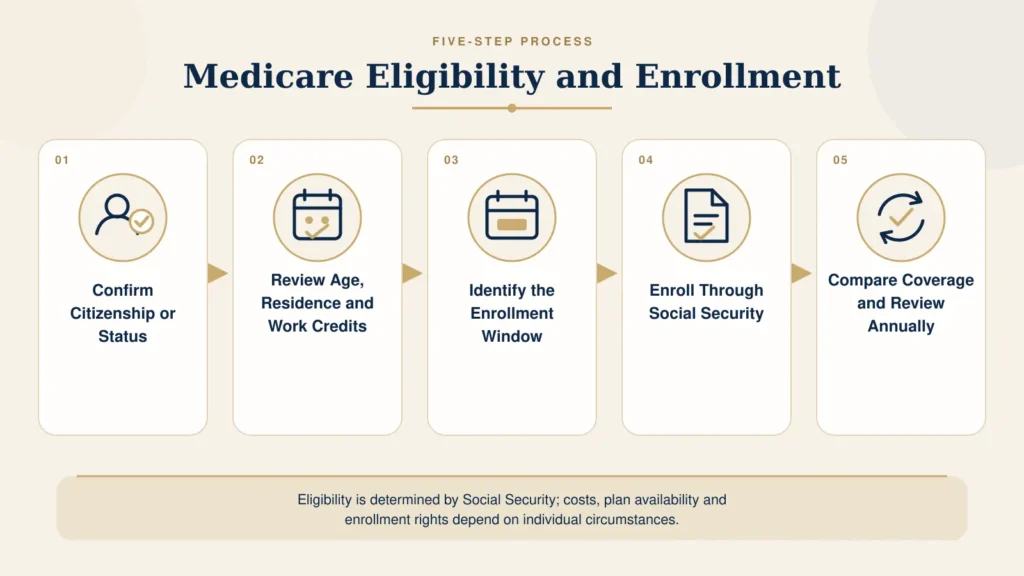
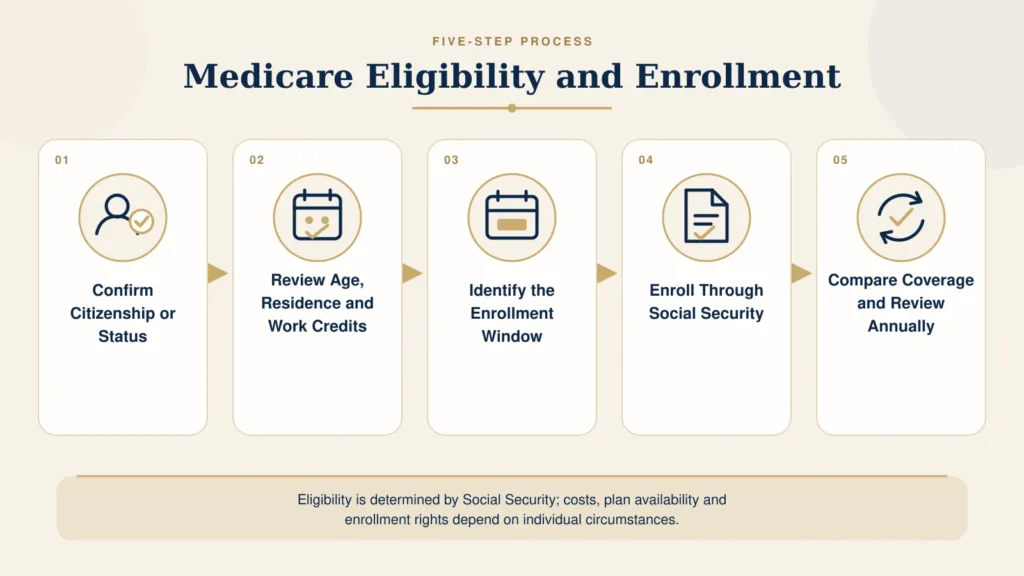
1. Confirm Citizenship or the Current Immigration Category
Confirm whether the person is a US citizen or national, lawful permanent resident or another category recognized by current Medicare law. Ask an immigration attorney—not an insurance agent—to resolve uncertainty involving travel, abandonment concerns, visa classification or a pending status change.
2. Identify the First Possible Medicare Eligibility Month
Review age, disability or other qualifying basis. If the person is using the premium buy-in route, document continuous US residence for the five years immediately before the possible enrollment month.
3. Check the US Medicare-Covered Work Record
Review the individual’s Social Security earnings record and any potentially qualifying spouse, former spouse or deceased spouse record. Do not add Italian credits to the Medicare quarter count.
4. Identify the Enrollment Window
Confirm the Initial, Special or General Enrollment Period. Collect employer evidence if active-employment group coverage may create a Special Enrollment Period.
5. Compare Medicare and Bridge-Coverage Costs
When premium Part A is required, compare the full monthly cost of Part A, Part B, drug and supplemental coverage with any lawful Marketplace or employer option. Include penalties and future enrollment restrictions—not only the current premium.
6. Enroll Through the Correct Government Channel
Apply for Part A and Part B through Social Security. An insurance professional can explain private-plan options but should not submit or decide the government eligibility determination.
7. Compare Private Coverage Only After Effective Dates Are Known
Evaluate Part D, Medigap or Medicare Advantage options using the person’s prescriptions, providers, pharmacies, service area, travel and budget.
8. Review Coverage Every Year
Medicare costs and private-plan benefits can change annually. Review the Annual Notice of Change, formulary, network and total expected cost before the next plan year.
Practical Medicare Eligibility and Enrollment Examples
US Citizen With 40 Qualifying Quarters
A 65-year-old US citizen with sufficient Medicare-covered employment may qualify for premium-free Part A. The person should still enroll in Part B at the correct time unless current-employment coverage supports a valid delay, and then compare Original Medicare, Part D, Medigap and Medicare Advantage based on actual needs.
Employee Turning 65 at a Company With 50 Employees
Assume a 65-year-old employee remains actively employed and covered by the company group plan, and the employer confirms that the plan has 50 employees and pays before Medicare. The employee may often delay Part B without the ordinary late penalty while that current employment and coverage continue.
Before deciding, the employee should compare the employer premium and benefits with Medicare, confirm whether the drug coverage is creditable, preserve annual notices and coordinate HSA contributions. When the employment or group coverage ends, the person should use the Part B Special Enrollment Period rather than assuming COBRA creates more time.
Employee Turning 65 at a Company With 12 Employees
Assume another employee remains actively employed, but the employer has 12 employees. Medicare generally pays first for an employee age 65 or older in this situation. If the employee keeps only the group plan and does not enroll in Medicare, the group plan may calculate claims as if Medicare had paid first, leaving a large unpaid balance.
The employee should ask the plan administrator for written coordination rules and usually needs to evaluate Part A and Part B during the Initial Enrollment Period. The fact that the employer allows continued enrollment does not prove that Medicare can safely be delayed.
Italian Green Card Holder With No US Work History
Imagine a 67-year-old Italian mother who became a lawful permanent resident and moved to Florida to live near her adult children. She receives an Italian pension, has no US employment record and has maintained her primary home in the United States.
A responsible review would proceed in this order:
- Ask Social Security to confirm whether she has completed the required continuous five-year US residence period and identify her first eligible month.
- Confirm that she has no premium-free Part A entitlement on her own record.
- Review whether a current, former or deceased spouse’s qualifying US work record could help.
- Do not count her Italian pension contributions as Medicare quarters.
- If she must buy Part A, budget the 2026 full Part A premium of $565 plus at least the standard $202.90 Part B premium before considering drug or supplemental coverage.
- Compare any permitted Marketplace or other coverage before Medicare begins, and coordinate the termination date to avoid a gap or repayment of financial assistance.
- After Part A and Part B effective dates are confirmed, compare Original Medicare and Medicare Advantage based on her doctors, prescriptions, language needs, Florida residence and travel to Italy.
The result cannot be predicted from age and a green card alone. The value of the review is replacing assumptions with an official eligibility decision and a documented coverage timeline.
Temporary Visa Holder Who Paid Medicare Taxes
Imagine a 65-year-old Italian executive working in the United States under a temporary work visa. Medicare taxes appear on the person’s payroll record, but the individual has not become a lawful permanent resident or US citizen.
Under current federal law, the temporary visa alone does not place the person in a listed Medicare immigration category. The work record should be preserved because it may matter if the person later becomes eligible under a qualifying status, but current health coverage may need to continue through the employer, spouse or Marketplace. Social Security must provide the Medicare determination.
Common Mistakes to Avoid
Assuming Every Green Card Holder Must Wait Five Years in Every Situation
The five-year rule is central to the premium buy-in route, but a person may have another entitlement path. Ask Social Security to identify the exact basis for eligibility.
Assuming Five Years Automatically Produces Free Medicare
Five years of continuous US residence can support eligibility to buy coverage; it does not create 40 Medicare-covered work quarters.
Counting Italian Work as Medicare-Covered Work
The US–Italy agreement does not allow Italian credits to establish premium-free Part A.
Ignoring a Spouse’s Work Record
A qualifying spouse, former spouse or deceased spouse record may change the Part A premium. Social Security must confirm the relationship and work-record requirements.
Waiting Until the Five-Year Anniversary to Ask About Enrollment
The Initial Enrollment Period may begin three months before the first eligible month. Start the review early enough to collect residence and work-history evidence.
Treating COBRA or Marketplace Coverage Like Active-Employment Coverage
These coverage types do not create the same Part B Special Enrollment Period. Delaying Medicare can create gaps and penalties.
Canceling Existing Coverage Before the Medicare Start Date Is Confirmed
Marketplace coverage does not end automatically. Coordinate the dates only after Social Security confirms when Medicare will begin.
Choosing a Private Plan Before Checking Providers and Prescriptions
Plan availability, networks, formularies, costs and supplemental benefits vary by ZIP code and year.
Documents to Organize Before Contacting Social Security
- Proof of US citizenship, green card or other relevant immigration and identity documentation.
- Social Security number, if assigned.
- Date US residence began and a timeline of significant travel or absences.
- Proof of US residence, such as leases, property records, utility bills, employment records or other documents requested by Social Security.
- Social Security earnings record.
- Current, former or deceased spouse information when a spouse’s work record may apply.
- Employer coverage dates and proof of current employment when requesting a Special Enrollment Period.
- Existing Marketplace, COBRA, retiree, Medicaid or private policy information.
- Prescription list, preferred physicians and hospitals for the later plan-comparison stage.
- Written questions for Social Security, Medicare, the current insurer and any licensed professional.
Send sensitive immigration, identity, health or financial documents only through a secure method provided by the appropriate organization.
Questions to Ask Social Security
- What is the exact basis for my Medicare eligibility?
- Am I entitled to premium-free Part A on my own record or a spouse’s record?
- How many Medicare-covered quarters are on the relevant record?
- Does the five-year continuous US residence rule apply to my enrollment path?
- Which month is my first eligible month?
- What is my Initial Enrollment Period?
- Do I qualify for a Special Enrollment Period based on current-employment coverage?
- What Part A and Part B premiums will I pay?
- Which residence documents are required?
- When will coverage begin if I enroll now?
Frequently Asked Questions About Medicare Eligibility
Who is eligible for Medicare?
Medicare generally covers people age 65 or older and certain younger people with qualifying disabilities, ALS or ESRD. Citizenship or immigration category, US residence, Medicare-covered work and enrollment timing can also affect eligibility and cost.
Is Medicare mandatory when I turn 65?
Medicare is not a general legal requirement, but delaying it can cause claim gaps, restricted enrollment windows and lasting penalties. A delay is often safer when the person or spouse is actively working and covered by a qualifying large-employer group plan. Marketplace, COBRA, retiree and individual coverage generally do not provide the same Part B enrollment protection.
How many months before 65 can I apply for Medicare?
The ordinary Initial Enrollment Period opens three months before the month of the 65th birthday and ends three months after the birthday month. Applying before the birthday month generally allows coverage to start in the month the person turns 65.
Can I delay Medicare if I am still working?
Often, if coverage is based on the person’s or spouse’s current employment. For someone age 65 or older, a group plan from an employer with 20 or more employees generally pays first, and Part B can often be delayed. When the employer has fewer than 20 employees, Medicare generally pays first, so delaying can leave unpaid claims. Confirm the plan’s rules in writing.
What happens if I keep regular health insurance instead of Medicare?
It depends on the coverage. A qualifying current-employment group plan may permit a delay. Paying for a Marketplace, COBRA, retiree or individual plan generally does not stop the Part B penalty clock or create the ordinary Special Enrollment Period. Some secondary plans may also reduce claims as if Medicare had paid first.
What happens if I never applied for Medicare?
Check first whether enrollment happened automatically. If not, Social Security must determine whether a Special Enrollment Period is available. Otherwise, the person may need to enroll during January 1–March 31, wait until the following month for coverage and pay a late-enrollment penalty.
What happens if Medicare ends because I did not pay the premium?
Part B or premium Part A can terminate after required notices and the federal grace period. Good-cause reinstatement may be available if circumstances beyond the person’s control caused nonpayment and all arrears are paid promptly. Otherwise, the person may have to wait for a valid enrollment period and could face penalties and uncovered bills. Medicare Advantage and Part D plans use separate notice, grace-period and re-enrollment rules.
Can I cancel Medicare and rejoin later?
Part B and premium Part A can generally be dropped through Social Security, but rejoining is not automatic. Without a Special Enrollment Period, the person may have to wait for the General Enrollment Period and pay late penalties. Review the employer, HSA, Medigap, prescription and claim consequences before canceling.
Can a US citizen get Medicare without ever working?
A US citizen age 65 or older who resides in the United States may generally enroll in Part B and may be able to buy Part A when premium-free Part A is unavailable. In 2026, premium Part A can cost $311 or $565 per month depending on qualifying work history, in addition to the applicable Part B premium.
Can a green card holder get Medicare at age 65?
Possibly. Eligibility depends on the person’s Medicare-covered work entitlement or, for the premium buy-in route, age, US residence, lawful permanent resident status, five years of continuous US residence and timely enrollment. Age 65 alone does not guarantee Medicare.
Do green card holders get Medicare for free?
Not automatically. Premium-free Part A generally requires sufficient Medicare-covered work by the person or a qualifying spouse. Part B generally has a monthly premium for almost everyone.
Can a green card holder get Medicare without 40 work credits?
An eligible permanent resident may be able to buy Part A and enroll in Part B after meeting the applicable age, residence and enrollment requirements. In 2026, premium Part A is $311 or $565 per month depending on qualifying quarters, and the standard Part B premium is $202.90.
Can I get Part B without buying Part A?
If you are not eligible for premium-free Part A, you may be able to enroll in Part B without buying Part A when you meet the citizenship or LPR residence requirements. Part B alone does not provide Part A hospital coverage and limits other Medicare coverage choices.
Does a spouse’s work history count for Medicare Part A?
A qualifying spouse’s Medicare-covered work record may help determine entitlement to premium-free Part A or the reduced premium rate. Marriage, divorce, age and other requirements can affect the result, so Social Security must review the record.
Do Italian work credits count toward premium-free Medicare?
No. The official Social Security agreement between the United States and Italy says Italian credits cannot be counted to establish entitlement to premium-free Medicare Part A, even though the agreement may combine credits for certain retirement, disability or survivor benefits.
Does the five-year rule mean I must hold a green card for five full years?
The official rule focuses on lawful permanent resident status and continuous US residence during the five years immediately before the qualifying month. Do not calculate eligibility only from the card’s issue date. Ask Social Security which periods count in your case.
What if I turned 65 before completing five years of US residence?
If you are relying on the premium buy-in path, your first eligible month may occur after age 65. Social Security policy generally provides a seven-month Initial Enrollment Period beginning three months before that later first eligible month.
Can a visa holder enroll in Medicare?
Generally, not based on a temporary visa alone. Ordinary work, student, dependent and visitor visas are not among the immigration categories listed in the 2025 Medicare eligibility law. Medicare-covered work may create credits that could matter after a future qualifying status change, but paying Medicare taxes does not by itself make a visa holder eligible. Verify the exact case with Social Security.
Can an undocumented immigrant get Medicare?
Generally no. An undocumented person does not meet the Medicare citizenship or qualifying immigration-category requirements. The person also cannot obtain Marketplace coverage for themselves through HealthCare.gov, although they may apply for eligible family members. Emergency Medicaid, state or local programs, community health centers and hospital financial assistance may be available depending on the circumstances.
Can I keep Marketplace coverage instead of buying premium Part A?
HealthCare.gov states that someone who must pay a Part A premium may be able to choose Marketplace coverage instead of Medicare. However, delaying Medicare can create later enrollment restrictions and penalties, and Marketplace financial-assistance rules change when Medicare is available or begins. Review both systems before deciding.
Can I use Marketplace coverage while waiting for Medicare?
Lawfully present immigrants may obtain Marketplace coverage and may qualify for financial assistance under current rules. Coordinate the Marketplace end date with the confirmed Medicare start date to avoid a gap or an incorrect subsidy.
Does Medicare cover medical care in Italy?
Medicare generally does not cover routine care outside the United States, and Part D does not cover prescriptions purchased abroad. Limited geographic exceptions and certain Medigap or Medicare Advantage foreign-emergency benefits may apply. Review the contract and consider separate travel-medical coverage.
Should I review my Medicare plan every year?
Yes. Review the Annual Notice of Change, premiums, cost sharing, formulary, pharmacies, provider network and supplemental benefits each fall. Open Enrollment runs October 15–December 7. A review does not require a switch; if the current coverage still fits and remains available, it can generally continue.
Is Medicare the same as Medicaid?
No. Medicare is a federal health-insurance program tied mainly to age, disability or certain medical conditions. Medicaid is a federal-state program based on state-specific eligibility, including income, resources, residence and immigration rules. Their five-year concepts should not be treated as interchangeable.
Final Takeaway: Verify the Eligibility Path Before Comparing Plans
Medicare eligibility is not determined by age alone. First identify whether the person is a US citizen or belongs to a qualifying immigration category. Then determine whether the person qualifies for premium-free Part A through a Medicare-covered work record or needs the premium buy-in route. Finally, verify residence, the correct enrollment period and the total cost of Part A, Part B and any private coverage.
For visa holders, payment of Medicare payroll taxes does not by itself create current eligibility. For Italian families, keep Social Security totalization and Medicare entitlement separate: Italian work credits do not create premium-free Part A. Social Security should confirm eligibility before any Marketplace coverage is ended or any Medicare Advantage, Part D or Medigap option is selected.
Request a Medicare Eligibility and Coverage Review
Medicare eligibility is not determined by age alone. First identify whether the person is a US citizen or belongs to a qualifying immigration category. Then determine whether the person qualifies for premium-free Part A through a Medicare-covered work record or needs the premium buy-in route. Finally, verify residence, the correct enrollment period and the total cost of Part A, Part B and any private coverage.
For visa holders, payment of Medicare payroll taxes does not by itself create current eligibility. For Italian families, keep Social Security totalization and Medicare entitlement separate: Italian work credits do not create premium-free Part A. Social Security should confirm eligibility before any Marketplace coverage is ended or any Medicare Advantage, Part D or Medigap option is selected.