

Voluntary Employee Benefits for Small Businesses: Employee Supplemental Benefits Explained
Employee supplemental benefits can help a business give workers more ways to protect their health, income and families without forcing every employee into the same package. Depending on the program, benefits may include accident insurance, critical illness coverage, hospital indemnity insurance, supplemental life insurance, disability insurance, dental insurance and vision coverage.
These benefits can be employer-paid, employee-paid or funded by both. The right design depends on the workforce, budget, state, insurer, tax structure and administrative responsibilities—not on how many products can be placed on an enrollment screen.

SAG helps employers review available benefit categories, compare general plan structures and identify questions to ask before enrollment. Final eligibility, premiums, benefit amounts, exclusions and policy availability are determined by the insurer and the governing plan documents.
Complete the employer review form to request an educational assessment of possible benefit categories. This is not a quote, guarantee of coverage or legal or tax advice.
Table of Contents
What Are Employee Supplemental Benefits?
Employee supplemental benefits are workplace benefits designed to add protection or services beyond an employer’s core compensation and primary medical coverage. They may help address specific risks, such as a covered accident, a qualifying critical illness, a hospital stay, a period of disability or the death of an insured employee.
The terms supplemental benefits, voluntary benefits and worksite benefits overlap, but they are not always identical:
- Supplemental describes the benefit’s role. It adds to another layer of protection or addresses a specific need.
- Voluntary generally describes employee choice and funding. The employee elects the benefit and often pays some or all of the premium through payroll deduction.
- Worksite benefits is a broad industry term for benefits made available through the workplace.
A supplemental benefit does not automatically have to be employee-paid. An employer may pay the full premium, share the cost or make an employee-paid option available. The funding arrangement can affect participation, taxes, administration and the laws that apply.
Why Small Businesses Consider Voluntary Employee Benefits
Smaller employers often compete for talent with organizations that have larger benefits budgets. Supplemental benefits may allow a business to broaden employee choice while controlling how much it contributes toward premiums.
The coverage gap is measurable. In March 2025, the U.S. Bureau of Labor Statistics reported that among private-industry establishments with fewer than 100 workers, 30% of workers had access to dental care benefits, 21% had access to vision care, 31% had access to short-term disability plans and 42% had access to life insurance. Access was higher in larger establishments. This does not prove that every small business should add these benefits, but it shows why a carefully designed program may help a smaller employer present a more complete package. See the BLS Employee Benefits in the United States report.
Potential business objectives include:
- Giving employees additional ways to manage financial risk.
- Offering more choice across different life stages and family situations.
- Supporting recruiting and retention conversations.
- Adding benefit categories without necessarily paying every premium in full.
- Creating a more organized enrollment and communication experience.
- Filling specific gaps that employees identify through a confidential needs survey.
These benefits should remain additive. A long list of limited-benefit products does not repair weak core coverage, unclear compensation or an enrollment process employees cannot understand.
What Types of Employee Supplemental Benefits Are Available?
Availability varies by insurer, state, employer size, industry and employee eligibility. The certificate or policy—not a marketing summary—controls what is covered.
| Benefit category | General purpose | Important limitation to review |
|---|---|---|
| Supplemental life insurance | Adds employee, spouse or dependent life coverage beyond any basic employer-paid amount | Guaranteed-issue limits, evidence of insurability, age reductions, exclusions, portability and conversion rules vary |
| Accidental death and dismemberment | Pays specified benefits after a covered accidental death or qualifying loss | It is narrower than life insurance and does not cover every cause of death or injury |
| Short-term disability | Replaces part of income for a limited period after a qualifying illness, injury or pregnancy, subject to the contract | Elimination periods, benefit duration, pre-existing-condition rules and tax treatment matter |
| Long-term disability | Replaces part of income after a longer waiting period when a qualifying disability continues | Definitions of disability, offsets, maximum duration and return-to-work provisions differ |
| Accident insurance | Pays scheduled benefits after covered accidental injuries or services | It is limited-benefit coverage and does not replace medical insurance or workers’ compensation |
| Critical illness or specified-disease insurance | Pays a defined benefit after diagnosis of a covered condition that meets the policy definition | The list of covered conditions, recurrence rules, survival periods and benefit percentages vary |
| Hospital indemnity insurance | Pays fixed benefits tied to covered hospital events or periods | It is not comprehensive health insurance and may pay much less than the actual hospital bill |
| Dental insurance | Helps pay for covered preventive, basic and major dental services | Networks, waiting periods, annual maximums, deductibles and exclusions can limit value |
| Vision coverage | Helps with covered exams, lenses, frames or contacts | Allowances, frequency limits and provider networks vary |
| Other voluntary services | May include legal services, identity protection, financial wellness or pet-related benefits | Some are not insurance; terms, privacy practices, fees and cancellation rules require separate review |
Supplemental Life Insurance and AD&D
An employer may provide a basic amount of group life insurance and allow employees to elect additional coverage. A plan may also offer coverage for a spouse or eligible dependents. Some amounts may be available on a guaranteed-issue basis during an eligible enrollment period; higher amounts may require health questions or evidence of insurability.
Employees should compare the amount of protection, beneficiary rules, age-based reductions, exclusions, premium changes and what happens after employment ends. Accidental death and dismemberment coverage is not a substitute for life insurance because it responds only to losses that meet the policy’s accidental-event definition.
Short-Term and Long-Term Disability Insurance
Disability insurance is designed to replace part of income when a covered sickness or injury prevents an employee from working under the contract’s definition of disability. It generally does not pay medical providers or reimburse every lost dollar.
Important items include:
- The percentage of income the plan replaces.
- The maximum weekly or monthly benefit.
- The elimination period before payments may begin.
- How long benefits can continue.
- Whether the definition is based on the employee’s own occupation or another standard.
- Pre-existing-condition provisions and exclusions.
- How workers’ compensation, Social Security disability or other income may offset benefits.
- Whether benefits may be taxable based on who paid the premium and how it was paid.
Short-term disability is also different from employer-paid sick leave, state paid-leave programs and workers’ compensation. These programs may interact, but they are not interchangeable.
Accident Insurance
Accident insurance typically pays scheduled amounts for covered injuries, services or treatments, such as an emergency visit, fracture, diagnostic test or follow-up care. The employee should verify the exact benefit schedule, exclusions, time limits and claim requirements.
An accident policy may provide a useful cash cushion, but it does not guarantee that the benefit will equal the medical bill or lost wages. It also does not replace comprehensive health insurance or legally required workers’ compensation coverage.
Critical Illness Insurance
Critical illness insurance may pay a lump sum or specified percentage after a covered diagnosis satisfies the policy definition. Commonly marketed conditions can include cancer, heart attack or stroke, but covered conditions and medical definitions differ substantially.
Before enrollment, review:
- Which conditions are included.
- Whether partial benefits apply to certain diagnoses.
- Waiting or survival periods.
- Pre-existing-condition provisions.
- Recurrence and subsequent-diagnosis rules.
- Maximum lifetime benefits.
- Whether dependent coverage has different limits.
Hospital Indemnity Insurance
Hospital indemnity insurance generally pays a fixed amount for a covered hospital admission, day of confinement or other defined event. The benefit is based on the policy schedule, not necessarily on the amount the hospital charges.
The Centers for Medicare & Medicaid Services states that hospital indemnity and other fixed-indemnity insurance is not a substitute for comprehensive coverage. Federal rules require prominent consumer notices for qualifying fixed-indemnity excepted benefits coverage so people can distinguish it from major medical insurance. Read the CMS fixed-indemnity coverage fact sheet.
Dental and Vision Benefits
Dental and vision plans are frequently used benefits, but the premium alone does not show their value. Employers and employees should examine provider access, negotiated rates, deductibles, copayments, waiting periods, frequency limits, annual maximums and services excluded from coverage.
An employee who expects only preventive care may evaluate a plan differently from someone anticipating crowns, implants, orthodontia, specialty lenses or frequent vision services.
What Employee Supplemental Benefits Do Not Replace
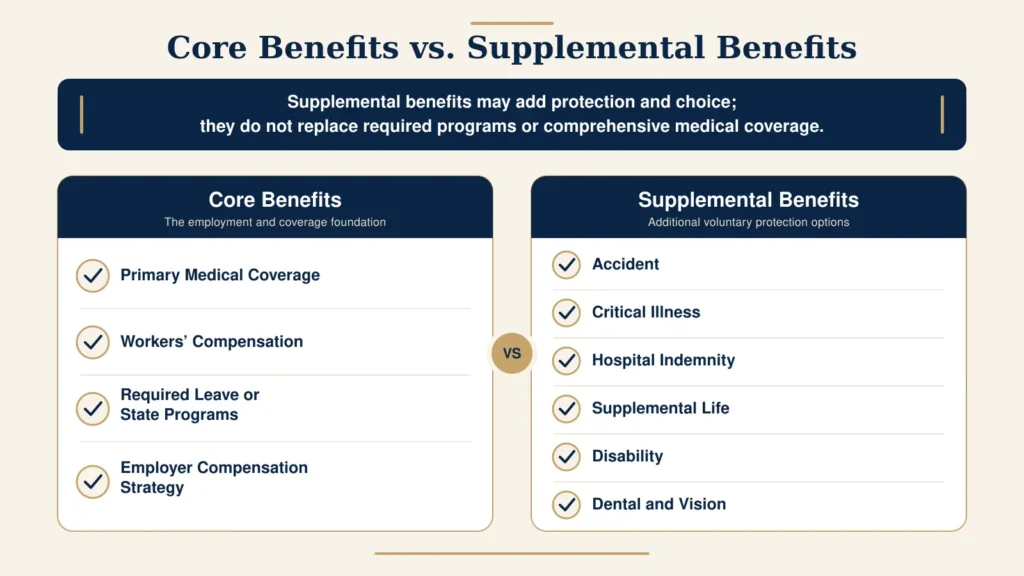
Clear positioning protects both the employer and the employee.
- Accident, critical illness and hospital indemnity insurance do not replace comprehensive medical insurance.
- Disability coverage replaces only part of qualifying income and does not pay every medical or household expense.
- AD&D does not replace broad life insurance.
- Voluntary accident insurance does not replace workers’ compensation.
- Short-term disability does not automatically replace statutory paid leave, sick leave or family and medical leave obligations.
- Dental and vision plans do not provide major medical coverage.
- An employee-paid product is not automatically exempt from federal or state benefit-plan requirements.
Marketing and enrollment materials should explain what each product does and what it does not do in equally visible language.
Employer-Paid vs. Employee-Paid Supplemental Benefits
| Funding design | How it generally works | Employer consideration | Employee consideration |
|---|---|---|---|
| Employer-paid | The business pays all or most of the premium for an eligible class | Higher direct cost; stronger need for budgeting, eligibility rules and compliance review | Lower payroll cost, but benefit amounts and tax consequences still require review |
| Employee-paid voluntary | Eligible employees choose whether to enroll and typically pay through payroll deduction | Lower direct premium expense, but administration, communication and compliance are not “free” | More choice and convenient payment; employee bears most or all of the premium |
| Shared or contributory | Employer and employee divide the premium | Can balance budget and participation goals; contribution rules should be consistent | Lower cost than fully employee-paid coverage, subject to the plan design |
There is no universally best funding method. The employer should model total cost, payroll administration, participation requirements, nondiscrimination considerations and employee affordability before selecting a design.
How Do Employee Supplemental Benefits Work Step by Step?
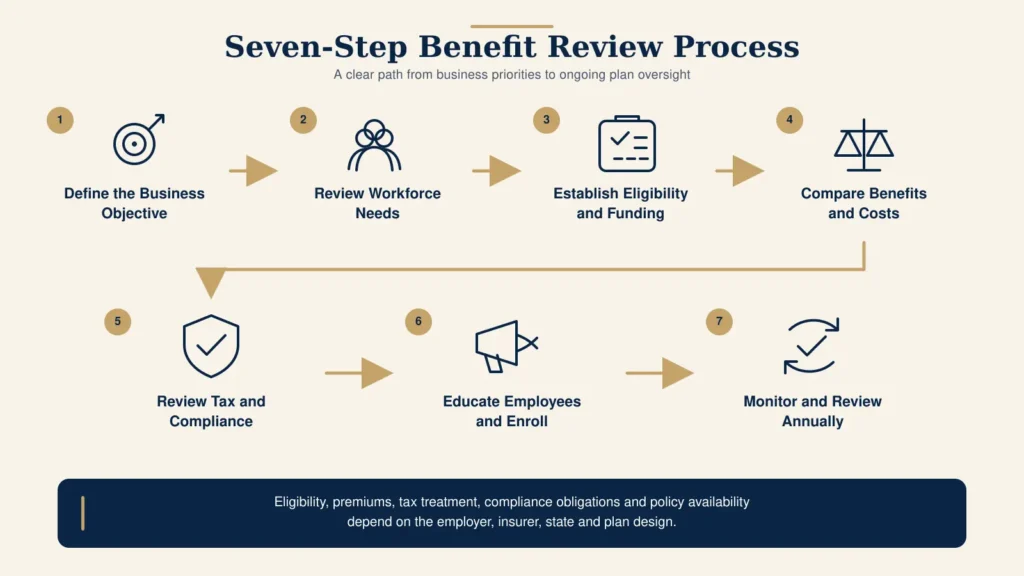
1. Define the Business Objective
Start with the problem the employer wants to solve. Is the priority income protection, family financial security, dental and vision access, support for a high-deductible health plan or a broader recruiting package?
2. Review the Workforce Without Collecting Unnecessary Medical Information
Use an anonymous interest survey and nonmedical workforce information, such as employee count, locations, job classes and general budget preferences. Employers should not ask employees to disclose diagnoses to decide which products to offer.
3. Establish Eligibility and Funding
Determine which bona fide employee classes may participate, whether dependents can enroll, when coverage begins and how the premium will be divided. Eligibility terms must be consistent with the policy, plan documents and applicable law.
4. Compare Benefits, Not Just Premiums
Compare definitions, exclusions, waiting periods, benefit schedules, maximums, networks, rate structures, underwriting rules, portability and claims procedures. Two products with similar names may respond very differently.
5. Review Tax, ERISA and State Requirements
Decide whether deductions will be pre-tax or after-tax only after professional review. Confirm plan documents, notices, enrollment materials, payroll procedures and any federal or state obligations.
6. Educate Employees and Document Elections
Provide plain-language materials that show cost per pay period, what triggers a benefit, what is excluded and whether coverage can continue after employment. Keep signed or electronic elections and waivers according to the applicable requirements.
7. Monitor Administration and Review Annually
Reconcile payroll deductions, confirm eligibility changes, evaluate participation, review employee questions and compare renewal terms. A benefit remains useful only when employees understand it and the administration works correctly.
Can a Small Business Offer Supplemental Benefits?
Potentially, yes. Some insurers offer voluntary or employer-sponsored arrangements to smaller groups, but minimum group size, participation, contribution and eligibility rules vary. The business’s state, industry, employee locations and payroll structure may also affect availability.
An employee-paid design may reduce the employer’s direct premium contribution, but it still can involve:
- Product and insurer due diligence.
- Enrollment communication.
- Payroll setup and reconciliation.
- Eligibility administration.
- Required plan documents and notices.
- Handling new hires, terminations and status changes.
- Coordination with the payroll provider, benefits administrator, insurer and licensed professional.
For that reason, “no employer premium contribution” should not be advertised as “no responsibility” or “no cost.”
How Much Do Employee Supplemental Benefits Cost?
There is no reliable universal price. Premiums and total program cost can depend on:
- Benefit type and coverage amount.
- Employee and dependent enrollment.
- Age bands, tobacco status or other rating factors permitted for the product.
- Employer size, industry and location.
- Employer contribution.
- Guaranteed-issue limits and underwriting.
- Benefit duration, waiting period and policy options.
- Dental or vision network and service area.
- Insurer rate structure and renewal changes.
- Administrative or technology services associated with the program.
Employers should request a complete cost presentation showing the employer amount, employee payroll deduction, rate basis, rate-guarantee period, commissions or fees when disclosure is required, and which services are included.
Are Voluntary Benefits Pre-Tax or After-Tax?
The answer depends on the product and how the employer’s benefit arrangement is structured. A Section 125 cafeteria plan can allow eligible employees to choose between taxable compensation and certain qualified benefits, but it requires a written plan and compliance with tax rules. Not every product belongs in a cafeteria plan.
Tax treatment can also affect benefits. The IRS explains that when accident or health premiums are excluded from an employee’s income through a cafeteria plan, certain benefit payments may be taxable; when the employee paid the premiums with after-tax income, treatment can differ. Disability benefits also may be taxable when the employer paid the premium or the employee paid with pre-tax dollars. See IRS Publication 525.
Employer-provided group-term life insurance has separate rules. The 2026 IRS guidance generally excludes the cost of up to $50,000 of qualifying group-term life coverage from an employee’s wages, while the imputed cost of employer-provided coverage above that level is generally included in wages under the applicable rules. See IRS Publication 15-B for 2026.
Employers should coordinate the funding and payroll treatment with a qualified tax professional, benefits counsel and payroll provider. SAG does not provide tax advice.
Do ERISA and Other Benefit Laws Apply?
They may. Private-sector employer benefit plans can be subject to the Employee Retirement Income Security Act, commonly called ERISA. The exact result depends on the benefit, the employer’s involvement, funding and other facts.
Federal regulations include a narrow safe harbor for certain completely voluntary insurance arrangements when all conditions are satisfied. Broadly, the employer cannot contribute, participation must be voluntary, the employer’s functions must remain limited and the employer cannot receive consideration beyond reasonable compensation for payroll-deduction administration. Employers should not assume that employee payment alone automatically places a program outside ERISA. Review the current text of 29 CFR § 2510.3-1.
When ERISA applies, plan documents, participant disclosures, claims procedures, fiduciary duties and reporting rules may apply. The U.S. Department of Labor explains that ERISA-covered plans require written documents, recordkeeping and information for participants; fiduciary status depends on the functions performed, not merely a person’s title. See the Department of Labor guide to fiduciary responsibilities.
Other requirements may involve federal tax law, nondiscrimination rules, state insurance law, privacy, leave programs and continuation rights. The EEOC also provides guidance on nondiscrimination in employee benefits. See EEOC guidance on employee benefits.
This page is educational and is not a substitute for legal, tax, payroll or human-resources advice.
What Happens to Supplemental Benefits When an Employee Leaves the Job?
Coverage does not always continue automatically. Depending on the benefit and contract, one of several outcomes may apply:
- Coverage ends on the termination date or at the end of the applicable coverage period.
- The former employee may be able to port coverage and pay premiums directly.
- A group life policy may offer conversion to an individual policy.
- Continuation rights may apply to certain benefits under federal or state law.
- A new application or evidence of insurability may be required.
- The cost, benefit amount or contract may change after portability or conversion.
Employees should receive instructions before the deadline whenever possible. They should not assume that a payroll-deducted policy is portable, that conversion will preserve the same premium or that every benefit qualifies for COBRA.
How to Compare Voluntary Employee Benefit Programs
Use the same written comparison for every finalist.
Coverage and Contract
- What event triggers a benefit?
- What definitions, exclusions and pre-existing-condition provisions apply?
- Are benefits fixed, percentage-based or tied to actual expenses?
- Are there waiting periods, elimination periods or survival periods?
- What are the maximums, reductions and termination ages?
Eligibility and Enrollment
- Which employees and dependents are eligible?
- Are there minimum participation or employer-contribution rules?
- What amounts are guaranteed issue?
- When is evidence of insurability required?
- Which life events permit an election change?
Cost and Administration
- Who pays the premium?
- Is the rate guaranteed for a period or subject to renewal changes?
- How are payroll deductions transmitted and reconciled?
- Who handles eligibility files, billing errors and terminations?
- What compensation, technology cost or administrative fee applies?
Employee Experience
- Are materials clear and available in the languages employees use?
- Can employees compare cost per paycheck with the actual benefit schedule?
- How are claims filed and tracked?
- What customer-service support is available?
- Are portability or conversion instructions easy to obtain?
Compliance
- Which party prepares plan documents and notices?
- Is the arrangement intended to fall under ERISA or a regulatory safe harbor?
- Has the pre-tax or after-tax decision been reviewed?
- How are privacy and nondiscrimination obligations handled?
- Who monitors regulatory and state-specific changes?
Why Review Employee Supplemental Benefits Every Year?
An annual review is advisable because premiums, benefits, employee needs, insurer availability and regulatory requirements can change. A review can identify:
- Rate increases or benefit reductions.
- Low participation caused by poor communication or weak product fit.
- Payroll deductions that do not match enrollment records.
- Employees who no longer satisfy eligibility rules.
- New locations or employee classes that affect availability.
- Better options or service improvements in the market.
- Outdated plan documents, notices or beneficiary information.
- Portability and termination procedures that employees do not understand.
Keeping the same program without review does not guarantee continuity. The employer may continue paying for underused coverage, employees may misunderstand benefits, or an administrative error may remain undiscovered until a claim occurs.
A Hypothetical Small-Business Example
Imagine a 28-employee professional-services firm that already offers group medical insurance but has limited room to increase its employer contribution.
An anonymous survey shows three recurring concerns: protecting income during a disability, obtaining more life insurance for dependents and handling the out-of-pocket impact of a hospital stay. Instead of selecting a broad catalog immediately, the employer reviews three benefit categories: voluntary disability, supplemental life and hospital indemnity.
The employer then compares eligibility, guaranteed-issue amounts, exclusions, portability, payroll integration and employee cost per pay period. Benefits counsel and the payroll provider review the plan structure and deduction method. Enrollment materials state clearly that hospital indemnity coverage is limited and does not replace the company’s medical plan.
After the first year, the employer reviews participation, employee questions, payroll accuracy, claims-support experience and renewal rates. If one product has very low enrollment or employees repeatedly misunderstand it, the business can reconsider the design or communication strategy.
This example is educational. It does not recommend a particular insurer, product or funding arrangement.
Potential Advantages and Trade-Offs
Potential Advantages for Employers
- Broader benefit choice without necessarily paying every premium in full.
- A more competitive and personalized benefits conversation.
- Access to group or worksite enrollment arrangements when available.
- An organized way to address specific workforce concerns.
- Potential integration with payroll and annual enrollment.
Potential Trade-Offs for Employers
- Administrative work remains even when employees pay the premium.
- Compliance obligations may apply.
- Poorly selected products can damage employee trust.
- Low participation can make the program inefficient.
- Payroll or eligibility errors may create disputes.
- Too many choices can reduce understanding and enrollment quality.
Potential Advantages for Employees
- Convenient access through the workplace.
- Choice to elect benefits that match personal priorities.
- Possible guaranteed-issue opportunities during eligible enrollment periods.
- Payroll-deduction convenience.
- Additional financial protection after a qualifying event.
Potential Trade-Offs for Employees
- Premiums reduce take-home pay.
- Limited-benefit policies may pay less than expected.
- Exclusions, waiting periods and maximums apply.
- Rates may change.
- Coverage may not continue after employment.
- Tax treatment can affect the net benefit received.
Frequently Asked Questions About Employee Supplemental Benefits
What are voluntary employee benefits?
Voluntary employee benefits are workplace benefits that eligible employees may choose to purchase, often through payroll deduction. Common categories include supplemental life, disability, accident, critical illness, hospital indemnity, dental and vision coverage.
Who pays for employee supplemental benefits?
The employer, employee or both may pay. “Voluntary” commonly means the employee elects the benefit and pays some or all of the premium, but the exact funding structure varies.
Are voluntary benefits worth it for a small business?
They can be useful when they respond to genuine employee needs, are explained clearly and can be administered correctly. They are less useful when products are added only to make the benefit list look longer.
Do supplemental benefits replace health insurance?
No. Accident, critical illness and hospital indemnity policies are limited-benefit products. They do not replace comprehensive medical coverage.
Can an employer offer voluntary benefits without paying the premium?
Some arrangements allow employees to pay the full premium. However, the employer may still have administrative, payroll, communication and compliance responsibilities.
Can voluntary benefits be paid pre-tax?
Certain qualified benefits may be offered through a properly structured Section 125 cafeteria plan. The product, plan document and tax consequences must be reviewed because not every benefit qualifies and pre-tax treatment can affect how benefits are taxed.
When can employees enroll?
Common opportunities include initial eligibility, annual open enrollment and certain life events permitted by the plan. Special enrollment or guaranteed-issue rules vary by benefit and insurer.
Can an employee be declined for supplemental coverage?
Possibly. Some amounts may be guaranteed issue during a qualifying enrollment period, while other amounts or late applications may require evidence of insurability. Product rules vary.
What happens when an employee misses open enrollment?
The employee may need to wait until the next enrollment period, experience a permitted life event or apply with additional underwriting. The governing plan and insurer rules control.
What happens to coverage when an employee leaves the company?
Coverage may end, continue temporarily or offer portability or conversion. Deadlines and costs vary, so employees should request written instructions before separation whenever possible.
Are independent contractors eligible?
Do not assume so. Group policies and benefit plans define eligible classes, and worker-classification rules also matter. The employer should confirm eligibility with the insurer and professional advisers.
Does hospital indemnity insurance pay the hospital bill?
It generally pays fixed benefits according to the policy schedule after a covered event. It is not designed to pay the full hospital bill and is not comprehensive medical insurance.
Is disability income taxable?
It can be. Tax treatment often depends on who paid the premium and whether employee contributions were made pre-tax or after-tax. Employees and employers should obtain tax advice for their specific arrangement.
Should voluntary employee benefits be reviewed every year?
Yes. An annual review can identify rate changes, outdated documents, low participation, payroll discrepancies, service problems and benefits that no longer match the workforce.
Request an Employee Supplemental Benefits Review
The right program begins with the workforce-not with a preselected product list.
Complete the employer review form to help SAG understand your company size, employee locations, current benefits, renewal timing, funding preferences and the areas employees may want to protect. We can provide an educational review of possible benefit categories and general trade-offs.
We do not promise that a product will be available, approved, suitable or less expensive. Final premiums, eligibility, underwriting, benefit terms and policy issuance are controlled by the insurer and applicable plan documents. Employers should obtain legal, tax, payroll and human-resources advice where appropriate.