


Health Insurance in the USA: How It Works, Costs & Coverage Options
Health insurance in the United States can feel complicated — especially if you are self-employed, buying coverage for your family, moving from another country, or navigating the American system for the first time.
Understanding the monthly premium is only the beginning.
A health plan can also affect which doctors and hospitals you can use, how much you pay before coverage begins sharing costs, what you pay for prescriptions, whether referrals are required, and how much financial exposure you could face during a serious medical event.
This guide explains how health insurance in the USA works, where individuals and families can obtain coverage, how ACA Marketplace and private options differ, what HMO, EPO and PPO mean, and what to review before choosing a plan.
Coverage availability, eligibility, enrollment periods, provider networks, premiums and benefits vary by state, insurer, household and plan.

Quick Answer: How Does Health Insurance Work in the USA?
Health insurance helps share the cost of covered medical care between you and an insurance plan.
You generally pay a monthly premium to keep the coverage active. When you receive care, you may also pay deductibles, copayments or coinsurance depending on the service and your plan.
Your plan may then pay part or all of the remaining covered cost according to its contract.
The amount you ultimately spend therefore depends on much more than the monthly premium.
You should compare:
- Premium
- Deductible
- Copayments
- Coinsurance
- Out-of-pocket maximum
- Doctor and hospital network
- Prescription coverage
- Referral rules
- Out-of-network coverage
- Enrollment eligibility
The cheapest monthly premium is not automatically the least expensive health plan for the entire year.
Table of Contents
What Is Health Insurance?
Health insurance is a contract that helps pay for covered healthcare services in exchange for a premium.
Depending on the plan, coverage may include doctor visits, preventive services, hospitalization, emergency care, prescription drugs, laboratory testing, mental-health services and other medical care.
But not every health plan works the same way.
In the United States there is no single universal health insurance program that automatically covers everyone. People may receive health coverage from different sources depending on employment, age, income, household circumstances and eligibility.
Common sources include:
Employer-sponsored coverage
Health insurance provided through an employer.
ACA Marketplace coverage
Individual or family coverage obtained through the federal or a state Health Insurance Marketplace.
Individual coverage outside the Marketplace
Private individual insurance purchased directly through an insurer, agent, broker or other authorized enrollment channel.
Medicaid and CHIP
Government programs for eligible individuals and families, with eligibility varying by state and household circumstances.
Medicare
Federal health coverage primarily for people age 65 and older and certain younger individuals who meet specific eligibility requirements.
Each system has different rules.
How Does Health Insurance Work Step by Step?
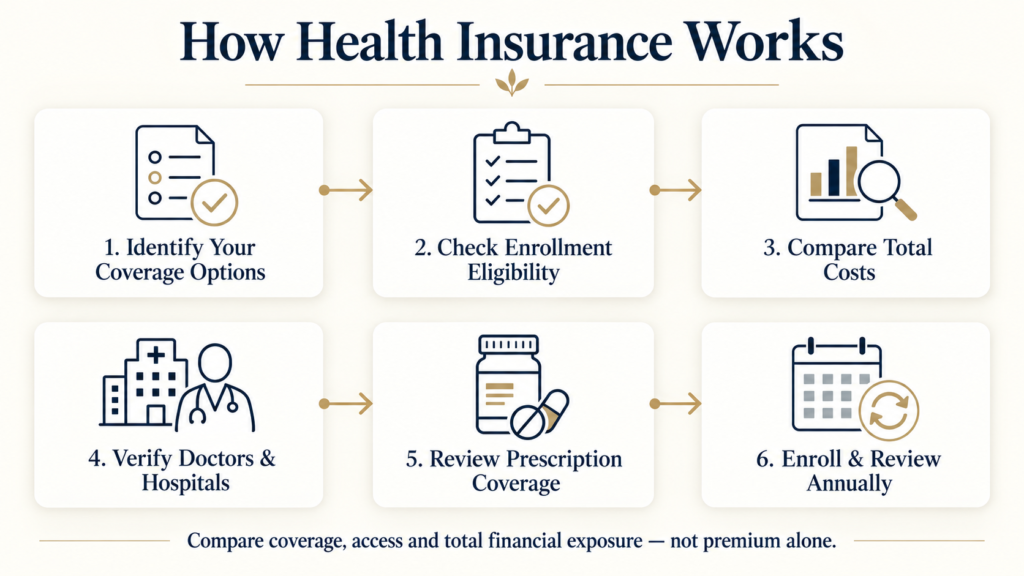
1. Determine Where Your Coverage May Come From
Begin by identifying which coverage paths may be available to you.
For example, you may have access through:
- Your employer
- Your spouse’s employer
- The Health Insurance Marketplace
- An individual private plan
- Medicaid or CHIP
- Medicare
- COBRA or another continuation arrangement after losing job-based coverage
Your available options may be very different from another person’s even if you are the same age.
2. Determine When You Can Enroll
Some types of individual comprehensive medical insurance have defined enrollment periods.
Marketplace coverage generally has an annual Open Enrollment Period, while certain qualifying life events can create a Special Enrollment Period.
Employer plans have their own enrollment rules.
Medicaid and CHIP generally permit enrollment throughout the year for people who qualify.
3. Compare the Total Cost — Not Only the Premium
A $300 monthly plan is not automatically less expensive than a $450 plan.
You also need to evaluate what happens when you actually use healthcare.
Important numbers include:
Premium: what you pay to keep the insurance active.
Deductible: the amount you may have to pay for certain covered services before the plan begins sharing those costs.
Copayment: a fixed dollar amount for certain services.
Coinsurance: a percentage of covered costs that you pay.
Out-of-pocket maximum: the maximum amount you are required to pay during the plan year for qualifying covered in-network services under the applicable plan rules.
HealthCare.gov specifically recommends evaluating your estimated total yearly healthcare costs, rather than choosing coverage based only on the monthly premium.
Compare total health care costs on HealthCare.gov
4. Check the Provider Network
Before enrolling, verify whether your:
- Primary-care physician
- Specialists
- Preferred hospital
- Urgent-care center
- Pharmacy
- Other important facilities
participate in the exact plan network, not simply with the insurance company generally.
Two plans from the same company can have different provider networks.
5. Review Prescription Coverage
Check the plan’s prescription-drug formulary.
Ask:
- Is my medication covered?
- What tier is it in?
- Does a deductible apply?
- Is prior authorization required?
- Is there a preferred pharmacy?
- Are specialty medications handled differently?
A plan with a lower premium may become expensive if an important medication is poorly covered.
6. Review the Summary of Benefits and Coverage
The Summary of Benefits and Coverage, or SBC, helps consumers compare plans using standardized information about costs and benefits.
Do not rely only on a marketing brochure or a monthly premium quote.
7. Enroll and Pay the First Premium
Being approved or selecting a plan does not necessarily mean coverage is active.
Follow the insurer’s instructions and make any required initial premium payment by the applicable deadline.
8. Review Your Coverage Every Year
Health plans can change.
Review:
- Premium
- Deductible
- Network
- Prescription formulary
- Copays
- Coinsurance
- Out-of-pocket maximum
- Benefits
- Household income
- Family size
before automatically renewing.
What Does Comprehensive Health Insurance Typically Cover?
ACA-compliant Marketplace plans include ten categories of Essential Health Benefits.
These include areas such as:
- Ambulatory patient services
- Emergency services
- Hospitalization
- Pregnancy, maternity and newborn care
- Mental-health and substance-use-disorder services
- Prescription drugs
- Rehabilitative and habilitative services
- Laboratory services
- Preventive and wellness services
- Pediatric services
Specific benefits, networks, cost sharing and covered services vary by plan and state.
Preventive services may also be covered without cost sharing when applicable federal requirements are satisfied.
Dental and vision coverage for adults may be offered separately.
Premium vs. Deductible vs. Copay vs. Coinsurance
These four terms are among the most misunderstood parts of American health insurance.
| Term | What It Means |
|---|---|
| Premium | The amount you pay regularly to keep coverage active |
| Deductible | What you may pay toward certain covered care before the plan begins sharing costs |
| Copay | A fixed amount for a covered service |
| Coinsurance | A percentage of an allowed covered cost that you pay |
| Out-of-Pocket Maximum | The annual limit on qualifying covered in-network cost sharing under the plan |
Simple Example
Imagine a hypothetical plan with:
Monthly premium: $450
Deductible: $2,500
Coinsurance: 20%
Out-of-pocket maximum: $8,000
Paying the $450 premium each month does not mean that all medical care is free.
Depending on the service and plan rules, you may still pay toward the deductible, copayments and coinsurance until applicable limits are reached.
This example is for education only and is not a quote or representation of any particular plan.
What Is an Out-of-Pocket Maximum?
The out-of-pocket maximum is an important measure of potential financial exposure.
After you reach the applicable maximum through qualifying covered in-network expenses, the plan generally pays 100% of additional covered in-network benefits for the remainder of that plan year.
However, the limit generally does not include:
- Monthly premiums
- Non-covered services
- Certain out-of-network costs
- Amounts above allowed charges when applicable
For Marketplace plans, federal law places annual limits on allowable out-of-pocket maximums. The limits can change each year.
Do not confuse the deductible with the out-of-pocket maximum. They are not the same thing.
HMO vs. EPO vs. PPO: What Is the Difference?
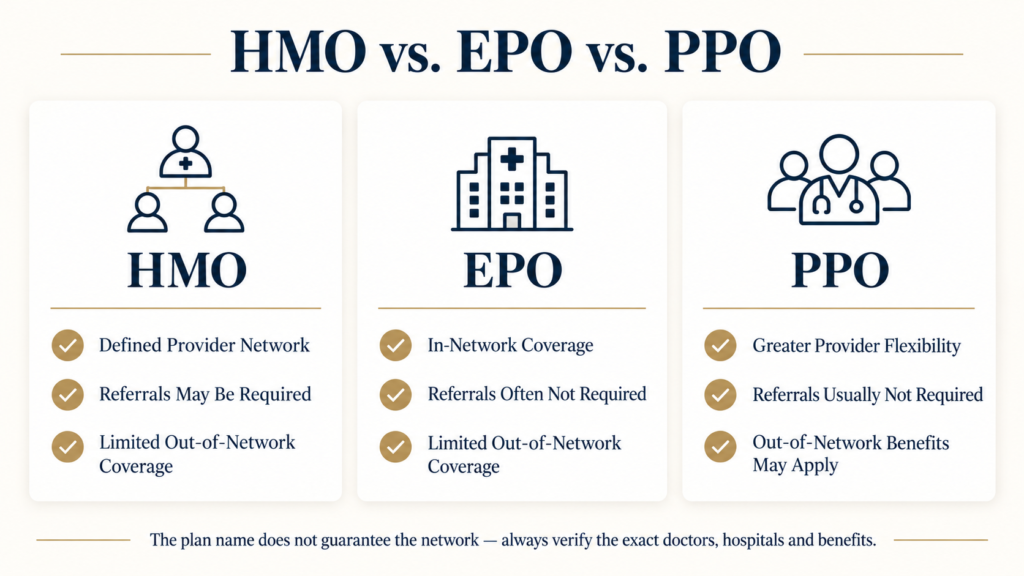
Plan type can be just as important as premium.
HMO — Health Maintenance Organization
An HMO generally emphasizes care within a defined provider network.
Non-emergency out-of-network services are usually not covered, and some HMO plans require members to coordinate specialist care through a primary-care physician.
An HMO may work well for someone comfortable using a defined local provider network.
EPO — Exclusive Provider Organization
An EPO generally requires members to use participating providers for non-emergency services.
Unlike many HMOs, referrals to specialists may not always be required.
The important issue is that routine out-of-network services generally are not covered.
PPO — Preferred Provider Organization
A PPO generally provides greater flexibility.
Members can typically use both in-network and out-of-network providers, although out-of-network care may involve significantly higher costs.
PPO availability varies considerably by market and geographic area.
POS — Point of Service
POS plans combine certain characteristics of HMO and PPO arrangements.
They commonly use primary-care coordination while providing some access to out-of-network care at additional cost.
The exact rules always depend on the specific plan.
See HealthCare.gov’s official guide to HMO, PPO, EPO and other network types
Quick Comparison
| Feature | HMO | EPO | PPO |
|---|---|---|---|
| In-network care emphasized | Yes | Yes | Yes |
| Routine out-of-network coverage | Usually no | Usually no | Generally available at higher cost |
| Specialist referral | Often | Often not | Usually not |
| Flexibility | More limited | Moderate | Generally greater |
These descriptions are typical characteristics, not guarantees. Always check the actual plan documents.
Bronze vs. Silver vs. Gold vs. Platinum
Marketplace plans are also grouped into metal categories.
The categories indicate how costs are generally shared between the member and the plan.
They do not represent quality ratings.
Bronze
Usually lower monthly premiums with greater member cost sharing when care is used.
Silver
Generally falls between Bronze and Gold.
Silver is also particularly important because eligible Marketplace consumers may qualify for cost-sharing reductions only when enrolled in a qualifying Silver plan.
Gold
Generally involves higher monthly premiums with the plan paying a larger share of covered healthcare costs.
Platinum
Generally has the highest premium structure and lower member cost sharing, although availability varies considerably by location.
Do not assume that Bronze is “bad” or Gold is automatically “better.”
The correct comparison depends on expected healthcare use, budget and plan availability.
Marketplace Health Insurance vs. Private Health Insurance
The phrase private health insurance can create confusion because Marketplace plans are also issued by private insurance companies.
The important distinction is often where the coverage is purchased and what type of plan it is.
ACA Marketplace Coverage
Marketplace plans:
- Are offered by private insurers
- Follow applicable ACA individual-market requirements
- Cover Essential Health Benefits
- Cannot exclude applicants based on pre-existing medical conditions
- May provide eligibility for Premium Tax Credits and other applicable savings
Individual Coverage Outside the Marketplace
Individuals may also purchase health insurance outside the Marketplace.
Some off-Marketplace plans provide comprehensive qualifying coverage.
However, Premium Tax Credits are not available for coverage purchased outside the Marketplace.
Consumers should verify exactly what a plan covers before purchasing it.
Do not assume that every product marketed as “private health insurance” provides the same protections as ACA-compliant comprehensive medical coverage.
What About Supplemental or Limited-Benefit Health Insurance?
Supplemental insurance can help with specific expenses or risks.
Examples can include:
- Accident coverage
- Hospital indemnity
- Critical illness coverage
- Fixed-benefit medical products
- Other limited-benefit arrangements
These products can serve legitimate purposes, but they generally should not be presented as substitutes for comprehensive major-medical insurance.
Benefits, exclusions, waiting periods, underwriting and availability vary.
This distinction is particularly important when a product advertises a low monthly premium.
Always ask what the policy does not cover.
Can You Get Health Insurance Through the ACA Marketplace?
Marketplace eligibility depends on federal requirements and individual circumstances.
Generally, a person must live in the United States, meet applicable citizenship or lawful-presence requirements, and satisfy other Marketplace eligibility rules.
Eligibility for financial assistance is a separate determination.
Being eligible to purchase Marketplace coverage does not automatically mean you qualify for a Premium Tax Credit.
How Do Health Insurance Subsidies Work?
The Premium Tax Credit, or PTC, can reduce the cost of eligible Marketplace coverage for qualifying individuals and families.
Eligibility depends on factors that can include:
- Household income
- Household size
- Tax filing circumstances
- Access to qualifying employer coverage
- Eligibility for government coverage
- Marketplace enrollment
The credit may be paid in advance to the insurer to reduce monthly premiums.
However, advance Premium Tax Credits are based on estimated household information.
The amount is later reconciled with the consumer’s actual tax information.
If income or household circumstances change, the Marketplace should generally be updated.
As of 2026, the temporary enhanced Premium Tax Credit expansion that applied through 2025 has ended, and current federal rules again generally use the statutory income eligibility range, subject to applicable exceptions and other requirements.
Never intentionally underestimate or misrepresent household income to obtain a larger subsidy.
Read the IRS Premium Tax Credit guidance
Tax consequences should be discussed with a qualified tax professional.
When Can You Enroll in Health Insurance?
Enrollment depends on the type of insurance.
Marketplace Open Enrollment
Marketplace coverage has an annual Open Enrollment Period.
A significant change takes effect for plan year 2027.
For Exchanges using the federal platform, CMS finalized an Open Enrollment Period running November 1 through December 15, 2026 for coverage beginning in 2027.
State-based Exchanges are permitted to establish their own enrollment windows within federal parameters, but their Open Enrollment periods must end no later than December 31 and may not exceed nine weeks.
Because enrollment rules can change, current federal and state deadlines should always be confirmed before applying.
Special Enrollment Period
You may be able to enroll outside annual Open Enrollment after certain qualifying events.
Examples can include:
- Loss of qualifying health coverage
- Marriage
- Birth or adoption
- Certain household changes
- Certain moves
- Other qualifying circumstances
Eligibility must be verified for the specific event.
Medicaid and CHIP
Medicaid and CHIP generally permit applications throughout the year for individuals who meet applicable eligibility rules.
Health Insurance for Self-Employed People
If you are a freelancer, independent contractor, consultant or business owner without employees, you may be able to obtain coverage through the individual Marketplace.
Marketplace eligibility can also determine whether you qualify for Premium Tax Credits or other savings.
HealthCare.gov specifically identifies the individual Marketplace as a coverage option for self-employed individuals without employees.
If your business has eligible employees, group health insurance options may become relevant instead.
This distinction is why individual health insurance and small-business group health insurance should be evaluated separately.
Health Insurance for New U.S. Residents and Immigrants
If you have recently moved to the United States, the health insurance system may be very different from the system you previously used.
For Italian families and other newcomers in particular, terms such as deductible, coinsurance, provider network and out-of-pocket maximum can be unfamiliar.
The first questions should be:
- What is my current immigration and residency status for insurance eligibility purposes?
- Do I have access to employer coverage?
- Am I eligible to use the Marketplace?
- Am I within an enrollment period?
- Does the plan include the doctors and hospitals I may need?
- What would I actually pay during a serious medical event?
- Is the policy comprehensive major-medical coverage or a limited-benefit product?
Marketplace eligibility for immigrants depends on immigration status and other federal requirements.
Do not assume that being physically present in the United States automatically creates Marketplace eligibility.
Likewise, do not assume that someone who cannot use the Marketplace has no healthcare or insurance options at all. Available alternatives depend on state, status and product.
Health Insurance in the USA: How Much Does It Cost?
There is no meaningful universal health-insurance price.
The cost can depend on:
- Age
- State and geographic rating area
- Household size
- Coverage level
- Tobacco use where permitted
- Plan network
- Available insurers
- Marketplace eligibility
- Premium Tax Credit eligibility
- Employer contributions
- Type of coverage
A quotation for one family cannot be safely used to estimate another family’s price.
The better question is:
What is my expected total annual cost under each available plan?
Consider:
Annual premium
Monthly premium × 12.
Expected routine healthcare costs
Doctor visits, specialists, medications and testing.
Potential major-event exposure
Deductible, coinsurance and out-of-pocket maximum.
Network risk
Whether important providers are actually participating.
That produces a much more useful comparison than monthly premium alone.
How to Compare Health Insurance Plans Step by Step
Before enrolling, compare each plan using the same criteria.
Monthly Premium
What will you actually pay after any confirmed financial assistance?
Deductible
Does one deductible apply to everything, or are certain services covered before the deductible?
Out-of-Pocket Maximum
What is your maximum qualifying in-network financial exposure for the year?
Doctor Network
Are your existing doctors participating in the exact network?
Hospitals
Which hospitals and medical systems are included?
Prescription Coverage
Are your medications covered and at what tier?
Specialist Access
Do you need referrals?
Out-of-Network Benefits
Does the plan provide them at all?
Emergency Coverage
Understand how emergency services are handled.
Family Coverage
Review both individual and family deductibles and out-of-pocket limits.
Expected Healthcare Use
Someone who rarely needs care may evaluate a plan differently from a family that regularly uses specialists or prescriptions.
The right choice is not simply the plan with the lowest premium.
Advantages of Comprehensive Health Insurance
Health insurance may provide:
- Access to negotiated provider rates
- Protection from very large covered medical expenses
- Preventive care benefits
- Prescription coverage
- Hospital and emergency coverage
- Access to contracted medical networks
- Greater financial predictability
- Coverage for pre-existing conditions under applicable ACA-compliant plans
Actual benefits depend on the specific plan.
Important Trade-Offs
Every plan involves compromises.
Lower Premiums Can Mean More Financial Exposure
A lower monthly premium can be paired with a higher deductible or higher cost sharing.
Broader Networks Can Cost More
Plans offering greater provider flexibility may carry higher premiums.
Not Every Doctor Accepts Every Plan
The insurer name alone is not enough.
You must verify the exact network.
Prescription Formularies Differ
A medication covered by one plan may have different cost sharing or requirements under another.
Coverage Can Change at Renewal
Premiums, benefits, formularies and provider networks can change from year to year.
That is why annual review matters.
When a Lower-Premium Plan May Not Be the Best Fit
A lower-premium plan may deserve closer evaluation if you:
- Use specialists regularly
- Have important prescriptions
- Expect surgery or frequent treatment
- Want specific hospitals
- Travel frequently
- Need broader provider access
- Would struggle financially with a large deductible
This does not mean that a higher-premium plan is automatically better.
It means that total expected cost and access to care should be compared together.
Practical Example
Consider a hypothetical couple purchasing individual health insurance.
Plan A
Premium: $550 per month
Deductible: $7,500
Narrower HMO network
Higher out-of-pocket exposure
Plan B
Premium: $730 per month
Deductible: $2,500
Broader network
Lower cost sharing for certain services
Plan A initially appears less expensive because it saves $180 per month.
But one spouse regularly sees specialists and takes a brand-name medication.
After checking the network and prescription formulary, the couple discovers that Plan B may provide better access to the specialists and medication they expect to use.
This does not automatically make Plan B the right plan.
It demonstrates why premium alone is insufficient.
This example is hypothetical and does not represent a quote, recommendation, guarantee of coverage or guarantee of savings.
Questions to Ask Before Choosing Health Insurance
Before enrolling, ask:
- What is the monthly premium?
- What is the deductible?
- What is the out-of-pocket maximum?
- Are my doctors in the exact plan network?
- Is my preferred hospital included?
- Are my prescriptions covered?
- Will I need specialist referrals?
- Does the plan cover routine out-of-network care?
- What services are covered before the deductible?
- What will urgent care cost?
- What will an emergency-room visit cost?
- How does the plan handle hospitalization?
- Are there separate prescription deductibles?
- What happens when I travel?
- Am I eligible for Marketplace financial assistance?
- What happens if my income changes?
- When can I enroll?
- Is this comprehensive major-medical coverage or a limited-benefit plan?
These questions make plan comparisons far more meaningful.
Frequently Asked Questions
What is the best health insurance in the USA?
There is no single best health insurance plan for everyone.
The appropriate plan depends on location, budget, healthcare use, doctors, prescriptions, enrollment eligibility and available coverage.
Is ACA insurance the same as Obamacare?
“Obamacare” is the common name for the Affordable Care Act. Marketplace health insurance is one way individuals and families obtain coverage under the ACA framework.
Is Marketplace insurance private insurance?
Yes. Marketplace plans are offered by participating private insurance companies but are sold through a federal or state Marketplace and must follow applicable Marketplace and ACA requirements.
Can I buy private health insurance outside the Marketplace?
Yes, individual plans may be available outside the Marketplace. However, Premium Tax Credits and income-based Marketplace savings are available only through qualifying Marketplace enrollment.
What is more important: premium or deductible?
Neither should be considered alone.
Premium determines the recurring cost of maintaining the policy, while the deductible and other cost sharing influence what you may pay when you use healthcare.
Is the deductible the most I can pay during the year?
No.
The deductible and out-of-pocket maximum are different.
After meeting the deductible, copayments or coinsurance may continue until applicable plan limits are reached.
Is a PPO always better than an HMO?
No.
A PPO generally provides greater provider flexibility, but it may cost more. An HMO can work very well when its provider network meets your needs.
Does health insurance cover pre-existing conditions?
ACA-compliant individual and small-group major-medical plans cannot deny coverage or charge higher premiums based on pre-existing health conditions.
Other types of insurance products may operate under different rules.
Can I get health insurance if I am self-employed?
Yes. Self-employed people without employees may generally evaluate individual Marketplace coverage and other eligible individual options.
Can immigrants get health insurance in the USA?
Some immigrants can qualify for Marketplace health insurance depending on lawful-presence and other eligibility requirements. Medicaid and other options vary by status and state.
Can I buy Marketplace health insurance at any time?
Usually not.
Marketplace coverage generally requires enrollment during Open Enrollment or through a qualifying Special Enrollment Period. Medicaid and CHIP have different enrollment rules.
Should I automatically renew my health plan every year?
It is usually wise to compare again.
Premiums, networks, prescription formularies, benefits, household circumstances and available plans may change.
Compare Your Options With Clear Guidance
Health insurance should do more than provide an insurance card.
The goal is to understand how your premium, deductible, network, prescriptions and potential out-of-pocket costs work together before you enroll.
A careful comparison can help you evaluate ACA Marketplace coverage, individual private options and other available health-insurance solutions based on your actual circumstances.
Important Disclosure
This material is provided for general educational purposes only and is not legal, tax, medical or individualized insurance advice.
Insurance availability, premiums, benefits, provider networks, formularies, enrollment periods, underwriting, eligibility requirements and financial-assistance rules vary by plan, insurer, state and individual circumstances.
Marketplace, tax and federal health-insurance rules may change. Information that depends on annual federal or state rules should be reviewed before publication and periodically thereafter.
Premium Tax Credit eligibility depends on actual tax and household circumstances. Consumers should provide accurate information and promptly report applicable changes.
Supplemental and limited-benefit products generally are not substitutes for comprehensive major-medical coverage.
Insurance products and services should be offered only in jurisdictions in which the applicable insurance professional or agency is properly licensed and authorized.