

Indexed Universal Life Insurance Explained: How IUL Works
Indexed universal life insurance explained in plain English begins with one important distinction: an IUL policy is permanent life insurance, not a direct stock-market investment. It may provide a death benefit and build cash value that can receive interest credits based partly on the performance of an external market index.
The policyowner does not purchase shares of the S&P 500 or another index. Interest credits are calculated according to the policy’s crediting method and may be limited by caps, participation rates, spreads, and other contractual terms.
Although an indexed account may include a 0% crediting floor, insurance charges, policy expenses, loans, and withdrawals can still reduce the account value. Premium flexibility also does not mean that any payment amount will keep the policy active indefinitely.

Table of Contents
How Indexed Universal Life Insurance Works
Indexed universal life insurance combines permanent death-benefit protection with an account value that may receive interest credits through one or more options offered by the insurer. Every premium payment must first support the insurance contract before it can contribute to potential cash-value accumulation.
Fund the Policy
The policyowner pays premiums according to a planned funding strategy. A portion of each payment may cover premium charges, administrative expenses, the cost of insurance, and optional riders. The remaining amount can contribute to the policy’s account value.
Flexible premiums do not mean that premiums are optional. The policy must contain enough value to cover its continuing charges.
Receive Index-Linked Interest Credits
The policyowner may allocate available value to a fixed account, an indexed account, or a combination of available options. Interest credited to an indexed account is calculated partly by reference to an external index, such as the S&P 500.
The money is not invested directly in the index, and the policyowner does not receive index dividends or own stocks.
Maintain the Death Benefit
Insurance charges are deducted from the policy value according to the contract. When premiums and accumulated value remain sufficient to cover these charges, the policy may continue providing death-benefit protection.
If the available value becomes insufficient, the policyowner may need to pay additional premiums, adjust the coverage, or take other action to prevent the policy from lapsing.
Premium flexibility should therefore be understood as funding flexibility-not as a guarantee that the coverage will remain active without adequate payments.
How IUL Index Crediting Works
An indexed universal life policy can offer one or more indexed crediting strategies. Each strategy uses a formula defined in the insurance contract to determine whether interest will be credited for a particular period.
The calculation generally follows three steps:
- A crediting segment begins. Available policy value is allocated to an indexed strategy for a defined period, commonly one year. The insurer records the index level at the beginning of that segment.
- The index change is measured. At the end of the crediting period, the insurer compares the ending index level with its starting level. The policyowner does not receive the index’s actual investment return and generally does not receive dividends paid by companies in the index.
- The policy’s crediting rules are applied. The insurer applies the contract’s cap, participation rate, spread, floor, or other formula to calculate the interest credit. The resulting credit may be lower than the index’s percentage increase.
For example, if the S&P 500 rises during a crediting period, the policy does not automatically receive the full increase. The final interest credit depends on the specific formula in force for that indexed strategy.
If the index declines, a strategy with a 0% floor may receive a 0% interest credit for that period instead of a negative index credit. However, policy expenses and insurance charges are still deducted and can cause the account value or cash surrender value to decrease.
Caps, participation rates, spreads, index options, and crediting methods vary by insurer and policy. Some non-guaranteed crediting terms may also change within the limits of the contract.
The S&P 500, Caps, Participation Rates, Spreads, and the 0% Floor
Many indexed universal life insurance policies offer a crediting strategy connected to the S&P 500 or another external market index. The selected index is used only as a reference for calculating potential interest credits. The policyowner does not purchase shares, own securities, or receive the index’s complete investment return.
Each indexed strategy follows a formula defined in the insurance contract. Understanding the following terms is essential before evaluating an IUL illustration.
The S&P 500 Index Account
The S&P 500 is a widely followed index representing large U.S. companies. An IUL strategy may measure the change in the index over a particular crediting period, commonly one year.
Many IUL calculations use changes in the index level and do not include dividends. The exact index, calculation period, and treatment of dividends depend on the contract.
Cap
A cap establishes the maximum interest credit available during a crediting period.
For example, if an index increases by 14% but the applicable cap is 10%, the interest credit generally cannot exceed 10% before considering any other policy provisions. Caps may change according to the terms and guaranteed limits of the contract.
Participation Rate
The participation rate determines how much of a calculated index increase is considered when determining the interest credit.
For example, if the measured index increase is 10% and the participation rate is 80%, the preliminary credited amount would be 8% before applying any cap, spread, or other contractual limitation.
A participation rate can be below, equal to, or—in some strategies—above 100%. A rate above 100% does not remove the effect of caps, spreads, charges, or other policy terms.
Spread
A spread is an amount subtracted from the calculated index increase.
For example, if the measured increase is 10% and the strategy applies a 2% spread, the preliminary interest credit may be 8%, subject to the floor and other policy provisions.
Not every strategy uses a spread. Some use a cap, participation rate, or a combination of different crediting features.
What the 0% Floor Actually Protects
A 0% floor generally means that a negative index result will not produce a negative indexed interest credit for that crediting period. If the applicable index declines, the indexed strategy may receive a 0% interest credit instead of a negative credit.
The floor does not guarantee that the policy’s total account value or cash surrender value will remain unchanged. Insurance costs, administrative expenses, rider charges, withdrawals, and loan activity may still reduce policy values—even during a period credited at 0%.
Crediting terms, index options, caps, participation rates, spreads, floors, and guaranteed minimums vary by insurer and contract. Historical index performance does not predict future policy results.
For additional technical information about illustrations for index-based life insurance products, review the National Association of Insurance Commissioners’ Actuarial Guideline 49-A.
How IUL Cash Value Builds-and Why Early Values May Be Low
Indexed universal life insurance can build account value over time, but not every dollar paid becomes immediately available cash value. Premiums must first support the cost of the insurance contract.
The amount and timing of potential cash-value accumulation depend on the insured’s age and health, death-benefit amount, premium schedule, policy charges, rider costs, index credits, fixed-account interest, withdrawals, loans, and surrender provisions.
Premiums Enter the Policy
The policyowner makes premium payments according to the selected funding strategy. The insurer may first deduct premium loads, state-related charges, and other expenses described in the contract.
Paying only a minimum amount may keep a policy active temporarily but may not provide the cash-value accumulation shown under a higher planned-premium scenario.
Policy Charges Are Deducted
The insurer deducts the cost of insurance, administrative charges, rider costs, and other contractual expenses from the policy’s account value.
The cost of insurance generally increases as the insured becomes older. A policy therefore needs sufficient premiums and accumulated value to support its continuing charges.
Remaining Value May Receive Interest Credits
Value allocated to a fixed account may receive interest according to the fixed-account terms. Value allocated to an indexed strategy may receive an interest credit after the applicable crediting period.
Indexed credits are not guaranteed to be positive every year. A period with a 0% indexed credit can still be followed by deductions for insurance and policy expenses.
Account Value vs. Cash Surrender Value
| Policy Value | What It Generally Means |
|---|---|
| Account Value | The internal policy value before subtracting certain surrender charges, outstanding loans, and other applicable amounts. |
| Cash Surrender Value | The net amount potentially available if the policyowner fully surrenders and terminates the coverage after applicable deductions. |
It is not accurate to assume that every IUL policy has no cash value for exactly its first two years. Some contracts may show account value earlier, while the net cash surrender value may remain low or even zero because of early expenses and surrender charges.
Early policy values may also be substantially lower than the total premiums paid. Indexed universal life insurance is generally designed as a long-term contract, not a short-term savings account.
Funding the policy above its bare minimum may improve its ability to accumulate value and withstand future charges, but funding must remain within the contract’s insurance and tax limits. Excessive funding can create a Modified Endowment Contract and change the taxation of distributions.
Always review an illustration that separately identifies premiums, account value, cash surrender value, guaranteed assumptions, non-guaranteed assumptions, policy charges, and the year in which coverage could lapse.
For official consumer guidance about premiums, internal charges, and lapse risk, review the New York State Department of Financial Services’ consumer alert on universal life insurance.
Why Indexed Universal Life Insurance Is a Long-Term Strategy
Indexed universal life insurance is generally designed for long-term protection and accumulation—not as a short-term savings account. A portion of each premium may be used for insurance costs, policy expenses, administrative charges, and optional riders before the remaining value can receive interest credits.
Surrender charges may also apply during the early policy years. As a result, the cash surrender value may initially be substantially lower than the total premiums paid.
The Early Policy Years
During the first several years, the policy is establishing its account value while charges continue to be deducted. Cash value may be limited or even zero during part of this period, depending on the policy design, premium funding, expenses, and surrender-charge schedule.
There is no universal rule that every IUL begins producing usable cash value after exactly two years. The guaranteed and non-guaranteed illustration should be reviewed year by year.
Why Ten Years Is a Planning Horizon, Not a Promise
Ten years is often used as a practical review horizon because an IUL generally needs time to absorb early expenses and experience multiple crediting periods. However, reaching year ten does not guarantee that the policy will have broken even, produced a particular return, or accumulated enough value to support policy loans.
The actual result depends on premiums paid, insurance charges, index credits, caps, participation rates, spreads, withdrawals, loans, and the insured’s age and health classification when the policy was issued.
Long-Term Policy Management
An IUL should not be purchased and then ignored. Insurance costs continue throughout the life of the policy and may increase as the insured ages.
At least once a year, the policyowner should review:
- Actual account value and cash surrender value.
- Current caps, participation rates, spreads, and crediting options.
- Insurance charges and rider costs.
- Outstanding loans and accumulated loan interest.
- The premium needed to keep the policy in force.
- Whether actual performance is ahead of or behind the original illustration.
Requesting an updated in-force illustration can show how the policy may perform under current assumptions rather than the assumptions used when it was originally purchased.
An IUL is generally better suited to someone who can fund it consistently, maintain adequate emergency savings outside the policy, tolerate years with little or no indexed interest credit, and avoid taking excessive loans too early. An underfunded or poorly monitored policy can lose value or lapse—even after experiencing positive index credits.
The National Association of Insurance Commissioners’ Life Insurance Buyer’s Guide advises consumers not to purchase life insurance unless they intend to maintain the plan, because leaving a policy during its early years may be costly.
IUL Death-Benefit Options and Optional Living Benefits
Indexed universal life insurance can provide two different layers of protection: a death benefit for beneficiaries and optional living-benefit riders that may allow the insured to access a portion of that benefit while still alive after a qualifying event.
The death benefit, cash value, policy loans, and living benefits are related, but they are not the same feature.
With a level death-benefit option—often called Option A—the benefit is generally based on the policy’s stated face amount. The cash value supports the policy internally, but beneficiaries do not ordinarily receive the stated death benefit plus a separate payment of the accumulated cash value.
As the cash value grows, the insurer’s net amount at risk may decrease. This structure may result in lower insurance charges than an increasing death-benefit option, although the exact calculation depends on the contract.
Policy loans, withdrawals, accelerated benefits, and tax-law requirements may affect the amount ultimately payable.
Increasing Death Benefit
With an increasing death-benefit option—often called Option B—the benefit is generally calculated using the stated face amount plus the policy’s account value, subject to the contract’s formula and applicable tax-law requirements.
This option may provide a larger benefit and more room for cash-value accumulation, but it may also produce higher insurance charges because the insurer may remain responsible for a larger net amount at risk.
The names and formulas used for death-benefit options vary by insurer. Some policies permit the owner to change options later, but a change may affect costs, cash value, coverage, and the policy’s tax classification.
Living Benefits: Access After a Qualifying Event
Living benefits are commonly provided through optional accelerated death-benefit riders. They may allow the insured to receive part of the death benefit during life after meeting the rider’s contractual requirements.
Depending on the policy and state, qualifying conditions may include:
Terminal Illness
A terminal-illness rider may permit acceleration of part of the death benefit when the insured is diagnosed with an illness expected to result in death within the period defined by the contract.
Chronic Illness
A chronic-illness rider may provide access when the insured cannot perform a specified number of activities of daily living or experiences severe cognitive impairment, as defined by the rider.
A chronic-illness rider should not automatically be described as long-term-care insurance. The qualification requirements, benefit calculation, and permitted uses may be different.
Critical Illness
A critical-illness rider may provide a benefit following a qualifying condition identified in the contract, such as a heart attack, stroke, cancer, or major organ failure. Covered conditions and medical definitions differ substantially among insurers.
Not every IUL includes all three riders, and approval of the life insurance policy does not guarantee that every optional rider will be available.
Living Benefits Are Not Additional Free Coverage
An accelerated living benefit is generally an advance of part of the policy’s death benefit-not an extra payment added on top of it.
Receiving a living benefit may:
- Reduce the remaining death benefit.
- Reduce the policy’s cash value or account value.
- Affect future premiums and policy loans.
- Involve administrative charges, actuarial discounts, or interest.
- Affect eligibility for Medicaid or other government benefits.
- Create tax considerations depending on the circumstances.
Before accepting an accelerated benefit, request a written statement showing its effect on the remaining death benefit, account value, cash value, premiums, loans, and policy guarantees.
The NAIC Accelerated Benefits Model Regulation explains that accelerated benefits are paid during the insured’s lifetime following a qualifying event and generally reduce the death benefit otherwise payable under the policy.
How IUL Tax-Deferred Growth Works
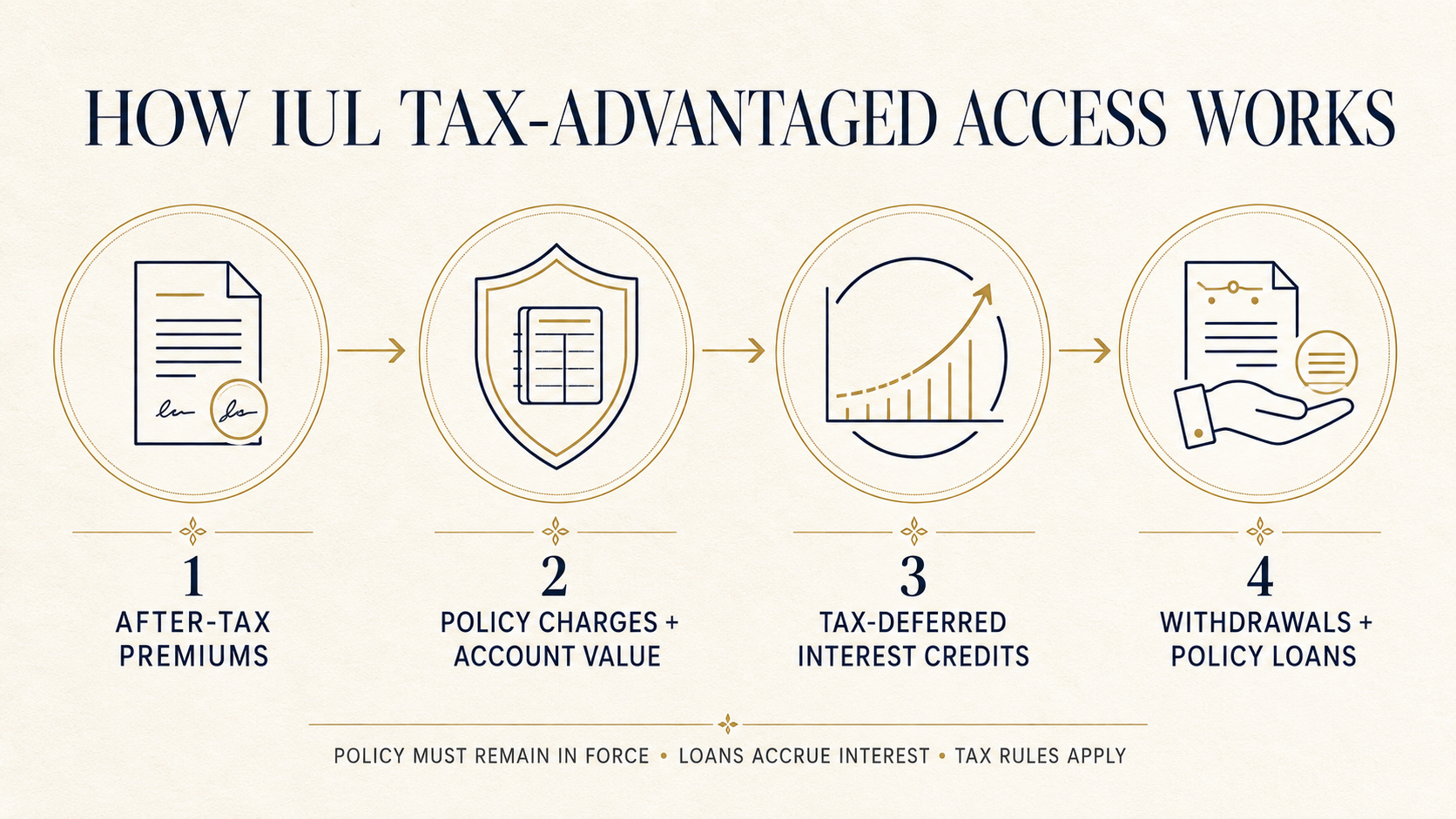
One of the most discussed features of indexed universal life insurance is tax-deferred growth. When the policy qualifies as life insurance under federal tax law and remains in force, interest credited inside the contract is generally not reported as taxable income to the policyowner each year.
Tax-deferred does not mean that the premiums are tax-deductible or that every future distribution will automatically be tax-free. It means that taxation on credited growth is generally postponed while the value remains inside a qualifying policy.
Premiums Are Generally Paid With After-Tax Dollars
For an individually owned personal policy, IUL premiums are generally paid with money that has already been subject to income tax. Personal life insurance premiums ordinarily do not produce an income-tax deduction.
After policy expenses and insurance charges are deducted, the remaining account value may receive interest credits according to the policy’s fixed or index-linked crediting options.
Interest Credits Remain Inside the Policy
When interest is credited to an IUL account, the policyowner generally does not receive a tax form simply because the account value increased during that year.
This allows credited value to remain inside the contract rather than being reduced by annual income taxes. Future interest credits may then be calculated using a larger account value, creating the potential for growth to build upon previously credited value.
However, the result is not equivalent to a guaranteed compound-interest account. Caps, participation rates, spreads, policy charges, loans, withdrawals, and years with a 0% index credit can all affect future accumulation.
Tax Deferral Can Support Long-Term Accumulation
Consider a simplified example. If an account receives an interest credit and the credited amount remains inside the policy, that value may become part of the account balance used during future crediting periods.
The basic policy movement can be understood as:
Premiums paid − policy charges + interest credits − withdrawals and loan effects = changing account value
The actual calculation is more complex and is determined by the contract. Interest-crediting rules and policy charges can also change within the limits established by the policy.
Tax-Deferred Does Not Mean Tax-Free
Taxable income may arise if:
- The policy is completely surrendered for more than its remaining cost basis.
- Withdrawals exceed the policyowner’s investment in the contract.
- A policy with gain lapses or is surrendered while a loan is outstanding.
- The contract becomes a Modified Endowment Contract.
- A transaction fails to qualify for the intended tax treatment.
Tax deferral is therefore a feature that must be preserved through proper policy design, funding, distribution planning, and ongoing monitoring.
The IRS Instructions for Form 1099-R explain that certain payments and taxable surrenders involving life insurance contracts may be reportable. Policyowners should consult a qualified tax professional before taking a significant distribution or allowing a policy with gain and outstanding loans to lapse.
How IUL Withdrawals and Policy Loans May Provide Tax-Advantaged Access
An indexed universal life policy may provide access to available value through withdrawals and policy loans. When properly structured and managed, these features can potentially create tax-advantaged access—but they do not make the policy a tax-free bank account.
The tax treatment depends on several factors, including the policy’s cost basis, whether it is a Modified Endowment Contract, the amount withdrawn or borrowed, and whether the policy remains in force.
Withdrawals: Recovering the Policy’s Cost Basis
The policyowner’s cost basis—also called the investment in the contract—is generally based on premiums paid, adjusted for previous distributions and other applicable transactions.
For a life insurance policy that is not a Modified Endowment Contract, withdrawals are generally treated as a return of the policyowner’s basis first. This means that a withdrawal may not create current taxable income while unrecovered basis remains.
Once total withdrawals exceed the remaining basis, additional amounts may be treated as taxable gain.
Withdrawals can also:
- Reduce the account value and cash surrender value.
- Reduce the death benefit.
- Change future policy charges or tax-law calculations.
- Increase the risk of a future lapse if insufficient value remains.
The owner should request the current cost basis directly from the insurance company before making a withdrawal.
Policy Loans: Borrowing Against the Policy’s Value
A policy loan is money borrowed from the insurance company using the policy’s available value as collateral. It is not the same as withdrawing earnings from an investment account.
A loan from a non-MEC life insurance policy is generally not treated as current taxable income when received, provided the policy remains in force. However, the insurance company charges interest, and the loan balance does not disappear simply because fixed monthly repayments may not be required.
An outstanding policy loan may:
- Accumulate interest.
- Reduce available cash value.
- Reduce the death benefit paid to beneficiaries.
- Affect the amount available for future withdrawals or loans.
- Require additional premiums to prevent a lapse.
- Create taxable income if the policy later lapses or is surrendered with a gain.
If the insured dies while a policy loan remains outstanding, the insurer generally subtracts the loan balance and accrued interest from the death benefit payable to beneficiaries.
Can IUL Value Be Accessed Before Age 59½?
A non-MEC life insurance policy is not a 401(k), IRA, or other qualified retirement plan. Therefore, it does not generally impose the same federal age-59½ restriction that applies to many qualified retirement-account distributions.
Available value may potentially be accessed before age 59½, subject to:
- The policy’s available cash value.
- Surrender charges.
- Withdrawal and loan provisions.
- The policy’s MEC status.
- The effect on future policy performance.
- Applicable federal and state tax rules.
Age 59½ becomes especially important when a policy is classified as a Modified Endowment Contract.
What Is a Modified Endowment Contract?
A life insurance policy may become a Modified Endowment Contract when premiums exceed federal funding limits under the seven-pay test or following certain material policy changes.
With a MEC:
- Taxable gain is generally distributed before cost basis.
- Policy loans may be treated as taxable distributions.
- The taxable portion of a distribution received before age 59½ may be subject to an additional 10% federal tax unless an exception applies.
- Once a policy becomes a MEC, it generally remains a MEC.
The IRS Instructions for Form 5329 explain that a Modified Endowment Contract is not a qualified retirement plan and that the taxable portion of certain distributions before age 59½ may be subject to the additional 10% tax.
Using IUL for Supplemental Retirement Income
Some policyowners plan to access value later through a combination of withdrawals up to the available basis followed by policy loans. This may create potential tax-advantaged supplemental income, but it is not guaranteed lifetime income and should not be described as automatically tax-free retirement income.
Before beginning distributions, request an updated in-force illustration showing:
- The planned withdrawal and loan amounts.
- Loan interest assumptions.
- The remaining account value.
- The projected death benefit.
- Future premium requirements.
- The age through which the policy is projected to remain in force.
- The result under less favorable crediting assumptions.
Five Conditions Behind a Tax-Advantaged IUL Strategy
The intended tax strategy generally depends on all five conditions remaining intact:
- The contract continues to qualify as life insurance.
- The policy is not a Modified Endowment Contract.
- Withdrawals are coordinated with the remaining cost basis.
- Policy loans and interest remain manageable.
- The policy stays in force until the insured’s death.
If the policy lapses or is surrendered with taxable gain and outstanding loans, the owner may receive a tax bill even without receiving new cash at that time.
Tax treatment depends on individual circumstances and future tax law. A licensed tax professional should review the strategy before substantial withdrawals or loans begin.
IUL vs. 401(k): What Is the Difference?
Indexed universal life insurance and a 401(k) can both play a role in long-term financial planning, but they are fundamentally different products.
A 401(k) is a qualified employer-sponsored retirement plan. An IUL is an individually owned life insurance contract designed primarily to provide a death benefit, with the potential to accumulate cash value.
| Feature | Indexed Universal Life Insurance | 401(k) Plan |
|---|---|---|
| Primary purpose | Permanent life insurance protection with potential cash-value accumulation | Employer-sponsored retirement savings |
| Funding | Premium payments made by the policyowner | Employee payroll deferrals and possible employer contributions |
| Underwriting | Usually requires financial and health underwriting | Generally does not require medical underwriting |
| Tax treatment | Premiums are generally paid with after-tax dollars; qualifying policy value may grow tax-deferred | Traditional contributions may be made pre-tax; Roth contributions are made after tax |
| Growth | Interest credits may be linked to an external index but are limited by policy terms | Account value depends directly on selected investments and market performance |
| Employer match | No employer match for a personally owned policy | Employer matching or other contributions may be available |
| Contribution rules | Funding is limited by insurance design, underwriting, and federal life-insurance and MEC rules | Annual contribution limits are established under federal tax law |
| Access | Withdrawals and policy loans may be available when sufficient policy value exists | Distribution restrictions and possible taxes or penalties may apply |
| Death benefit | Provides a contractual life insurance death benefit while coverage remains in force | Beneficiaries generally receive the remaining account balance |
| Costs | Insurance charges, administrative expenses, rider costs, loan interest, and possible surrender charges | Plan administration, investment-management, advisory, and fund expenses may apply |
| Market losses | A 0% indexed crediting floor may protect against a negative index credit, but policy charges can still reduce value | Investments can directly gain or lose value with the market |
| Policy management | Requires ongoing funding and policy monitoring | Requires contribution and investment-allocation decisions |
Is an IUL a Personal 401(k)?
An IUL should not be described as a personal 401(k). It is not a qualified retirement plan, does not provide an employer match, and does not have the same contribution, investment, distribution, or creditor-protection rules.
However, a properly designed IUL may serve as one component of a broader financial strategy by providing:
- Permanent life insurance protection.
- Optional living-benefit riders.
- Tax-deferred cash-value growth.
- Potential tax-advantaged access.
- Flexibility that is not tied to an employer.
- An additional source of supplemental retirement income.
For someone who has access to an employer match, contributing enough to receive the available match may be an important consideration before funding other long-term strategies. An IUL may complement—not automatically replace—a 401(k), IRA, Roth IRA, emergency fund, or diversified investment portfolio.
The IRS 401(k) Plan Overview explains that a 401(k) is a qualified employer plan that allows employees to defer part of their wages and may permit employer contributions.
The appropriate combination depends on income, insurance needs, employment benefits, tax situation, investment objectives, risk tolerance, and the ability to maintain long-term premiums.
How an IUL Policy Loan Works in Real Life
Once an indexed universal life policy has accumulated sufficient available value, the policyowner may be able to request a loan from the insurance company.
The owner is not withdrawing money directly from the S&P 500 or selling an investment. The insurance company lends the money and uses the policy’s value as collateral.
Build Sufficient Available Value
A policy loan is not normally available simply because premiums have been paid. The policy must first accumulate enough value to support the requested loan while maintaining sufficient value to cover policy charges and keep the coverage in force.
The maximum available loan amount depends on the contract, current account value, surrender charges, previous withdrawals, existing loans, and any amount the insurer requires to remain inside the policy.
Request the Loan From the Insurance Company
The policyowner submits a loan request to the insurer. A traditional bank application, income verification, or credit approval may not be required because the policy value serves as collateral.
Access is still subject to the insurer’s procedures and the policy’s loan provisions. Receiving the loan does not mean the policyowner is borrowing personal money from the account without cost.
Loan Interest Begins to Accumulate
The insurance company charges interest at the rate specified or described in the policy. The rate may be fixed, variable, or based on another contractual method.
If the owner does not pay the interest out of pocket, it may be added to the outstanding loan balance. The larger balance may then generate additional interest.
Some policies credit loaned value differently from unloaned value. The effect depends on whether the contract uses a standard, participating, indexed, variable, or other loan structure. Statements claiming that the owner can borrow money while the “same money continues growing untouched” should be checked against the actual contract.
Repay or Carefully Manage the Loan
Many policy loans do not require a fixed monthly repayment schedule. The owner may be able to repay all, part, or none of the loan during life.
However, the debt remains attached to the policy. An unpaid balance and accumulated interest generally reduce the amount available to the beneficiary and can increase the risk that the policy will lapse.
A Practical IUL Policy-Loan Example
Assume an IUL has sufficient value and the policyowner requests a $30,000 loan.
If the applicable loan interest rate were hypothetically 5% for one year, approximately $1,500 of interest would accrue before considering any policy-specific calculations.
If the owner does not pay that interest, the loan balance could increase to approximately $31,500. Additional interest may then accrue on the larger balance.
Meanwhile:
- Policy charges continue to be deducted.
- Index credits are not guaranteed.
- The treatment of loaned value depends on the contract.
- The remaining death benefit may be reduced.
- Additional premiums could become necessary.
- A future lapse could create taxable income if the policy contains a gain.
This example is hypothetical and does not represent the performance, loan rate, charges, or results of any specific policy.
Why Policyowners Use IUL Loans
Depending on their financial situation, policyowners may use a loan for:
- Supplemental retirement income.
- A temporary emergency.
- Education expenses.
- A business opportunity.
- A home purchase or major expense.
- Short-term cash-flow needs.
The absence of a traditional credit check or mandatory monthly repayment schedule can provide flexibility. That flexibility should not be confused with free access or guaranteed tax-free income.
The Three Major Policy-Loan Risks
Accumulating Interest
An unpaid loan can grow faster than expected, particularly when interest is added to the balance over many years.
Reduced Policy Benefits
Loans and interest generally reduce available value and the net death benefit. They may also limit the owner’s ability to take future distributions.
Policy Lapse and Possible Taxation
If the loan becomes too large relative to the remaining policy value, the contract may lapse. A lapse or surrender involving gain and an outstanding loan can generate taxable income—even when the owner receives no additional cash at the time of the lapse.
Before taking a loan, request an updated in-force illustration showing the loan amount, interest assumptions, future premiums, projected cash value, death benefit, and lapse age under both current and less favorable assumptions.
The New York State Department of Financial Services explains the general mechanics of cash-value policy loans: the policy value serves as collateral, interest is charged, and outstanding debt is deducted from the death benefit or surrender value.
Policy loans should be reviewed at least annually with the insurer and qualified insurance and tax professionals.
Indexed Universal Life Insurance Explained for Children: What Parents Should Consider
Indexed universal life insurance explained for a child begins with the purpose of the policy. It is permanent life insurance designed to provide a death benefit while also offering cash-value accumulation based partly on the performance of a market index, subject to caps, participation rates, spreads, policy charges, and contractual guarantees.
Purchasing an IUL policy for a child is not automatically the best way to save for college or build wealth. Families should first evaluate the need for life insurance, the affordability of maintaining premiums over many years, the amount of coverage carried by parents or caregivers, and the availability of other savings options.
Potential Reasons Families Consider It
- It may provide permanent death-benefit protection if the policy remains adequately funded and in force.
- Applying while the child is young may establish coverage based on the child’s current health and insurability.
- A long time horizon may allow cash value to accumulate gradually.
- The policy may offer future access through withdrawals or policy loans, subject to the contract.
- Some policies may include optional riders or provisions that provide additional flexibility.
Important Questions and Limitations
- Premiums, insurance charges, and administrative expenses can reduce cash-value growth.
- Index credits are not direct investments in stocks or a market index.
- Cash value may be limited during the early policy years.
- Caps, participation rates, spreads, and crediting methods may change within contractual limits.
- Policy loans accrue interest and can reduce cash value and the death benefit.
- Insufficient funding can increase the risk of lapse later in life.
- Ownership, beneficiary arrangements, and coverage limits for minors vary by state and insurer.
Before purchasing coverage for a child, compare the guaranteed and non-guaranteed illustration values, surrender charges, loan provisions, premium requirements, and the protection already in place for parents or caregivers. The policy should be evaluated primarily as life insurance-not as a guaranteed college fund or stock-market investment.
Potential Advantages and Trade-Offs of Indexed Universal Life Insurance
Indexed universal life insurance explained fairly requires examining both its potential benefits and the risks that can reduce policy value or cause coverage to lapse. The policy should be judged using its contractual guarantees, realistic funding assumptions, and the owner’s ability to monitor it over many years.
Potential Advantages
- Permanent death-benefit protection may remain available when the policy is adequately funded and all contractual requirements are satisfied.
- Interest credits may be linked to the performance of a market index without directly investing the policy’s account value in that index.
- A 0% crediting floor may prevent a negative index credit during a market decline, although policy charges can still reduce account value.
- Flexible premiums may allow the owner to adjust payments within the policy’s contractual limits.
- Cash value may be accessible through withdrawals or policy loans.
- Some policies offer optional accelerated death-benefit or living-benefit riders.
- Cash value generally accumulates on a tax-deferred basis under current federal tax rules.
Potential Trade-Offs
- Caps, participation rates, and spreads can limit the amount of an index gain credited to the policy.
- Insurance costs and policy charges continue even when the index credit is 0%.
- Flexible premiums are not the same as optional premiums; inadequate funding may increase lapse risk.
- Non-guaranteed illustration results may not be achieved.
- Policy loans accrue interest and generally reduce available value and the net death benefit.
- A heavily borrowed or underfunded policy may lapse and potentially create taxable income.
- Premiums may be substantially higher than premiums for comparable term insurance.
- The policy requires long-term monitoring and updated in-force illustrations.
The appropriate comparison is not IUL versus doing nothing. It is IUL versus other ways of meeting the same financial objective, including term insurance, guaranteed permanent insurance, retirement accounts, emergency savings, and taxable investments.
If you are still comparing policy types, review our guide to compare types of life insurance policies before deciding which structure may fit your needs.
Indexed Universal Life Insurance Explained: Death-Benefit Options and Living Benefits
Indexed universal life insurance explained correctly requires separating the policy’s death benefit, account value, loans, withdrawals, and optional living-benefit riders. These features may affect one another, but they are not interchangeable.
Level Death Benefit
With a level death-benefit option-often called Option A-the amount payable to beneficiaries is generally based on the policy’s stated face amount, subject to the contract and applicable tax requirements. The account value supports the policy internally, but beneficiaries do not ordinarily receive the stated death benefit and the entire account value as two separate payments.
As the account value grows, the insurer’s net amount at risk may decline. This structure may result in lower insurance charges than an increasing death-benefit option, although calculations and terminology vary by insurer.
Policy loans, withdrawals, accelerated benefits, and other policy changes may reduce the amount ultimately payable.
Increasing Death Benefit
With an increasing death-benefit option-often called Option B-the benefit is generally calculated using the stated face amount plus some or all of the policy’s account value, according to the contract’s formula.
This option may provide a larger benefit and additional room for cash-value accumulation, but it may also produce higher insurance charges because the insurer may remain responsible for a larger net amount at risk.
Some policies allow the owner to change death-benefit options later. A change may affect charges, cash value, premium requirements, coverage, and the policy’s tax classification. Request an updated in-force illustration before making a change.
Optional Living-Benefit Riders
Living benefits are commonly offered through accelerated death-benefit riders. After a qualifying event, these riders may allow the insured to access part of the policy’s death benefit while still alive.
The available riders, qualification requirements, benefit calculations, charges, and permitted uses vary by insurer, policy, and state.
Terminal Illness
A terminal-illness rider may permit acceleration of part of the death benefit when the insured is diagnosed with an illness expected to result in death within the period defined by the contract.
Chronic Illness
A chronic-illness rider may provide access when the insured cannot perform a specified number of activities of daily living or experiences severe cognitive impairment, as defined by the rider.
A chronic-illness rider should not automatically be described as long-term-care insurance. Qualification requirements, benefit calculations, and permitted uses may differ.
Critical Illness
A critical-illness rider may provide a benefit following a qualifying medical condition identified in the contract, such as a heart attack, stroke, cancer, or major organ failure. Covered conditions and medical definitions differ substantially among insurers.
Not every IUL policy includes all these riders, and approval of the life insurance policy does not guarantee that every optional rider will be available.
Living Benefits Are Not Additional Free Coverage
An accelerated living benefit is generally an advance of part of the existing death benefit—not an additional payment placed on top of it.
Receiving a living benefit may:
- Reduce the remaining death benefit.
- Reduce the policy’s account value or cash value.
- Affect future premiums, withdrawals, and policy loans.
- Involve administrative charges, actuarial discounts, or interest.
- Affect eligibility for Medicaid or other government benefits.
- Create tax considerations depending on the circumstances.
Before accepting an accelerated benefit, request a written statement showing its effect on the remaining death benefit, account value, premiums, loans, and policy guarantees.
The NAIC Accelerated Benefits Model Regulation explains that accelerated benefits are paid during the insured’s lifetime following a qualifying event and generally reduce the death benefit otherwise payable under the policy.
How to Review an IUL Illustration Before Buying
An indexed universal life insurance illustration is a projection based on stated assumptions-not a promise of future policy performance. It should help the prospective owner understand how premiums, policy charges, interest credits, withdrawals, and loans may affect the policy over time.
Separate Guaranteed and Non-Guaranteed Values
Begin by identifying which figures are contractually guaranteed and which depend on assumptions that may change.
Guaranteed values are generally calculated using the guarantees stated in the policy. Non-guaranteed values may depend on illustrated interest-crediting rates, current charges, bonuses, or other assumptions selected for the presentation.
A strong illustration should make the difference between these two columns easy to understand. Do not evaluate the policy using only the most favorable projected values.
The NAIC Life Insurance Illustrations Model Regulation requires illustrations to distinguish guaranteed elements from non-guaranteed elements and explains that non-guaranteed assumptions are subject to change.
Test More Conservative Assumptions
Ask to see how the policy may perform under multiple scenarios, including:
- The insurer’s current illustrated assumptions.
- A lower interest-crediting scenario.
- The guaranteed values provided by the contract.
- Higher policy charges when permitted by the policy.
- Reduced or discontinued premiums.
- Years in which the relevant market index produces little or no credited interest.
A policy that appears sustainable only under favorable assumptions may carry more lapse risk than the initial illustration suggests.
Review Premiums, Charges, and Index-Crediting Terms
Confirm whether the proposed premium is guaranteed to keep the policy in force or is merely the premium used in the illustration.
Review the following items carefully:
- Premium schedule and planned funding period.
- Cost-of-insurance charges.
- Administrative and rider charges.
- Surrender-charge period.
- Participation rates, caps, spreads, or other crediting limitations.
- Any bonuses and the requirements needed to receive them.
- Minimum guaranteed interest-crediting terms.
- Death-benefit option and associated insurance costs.
An index increase does not mean the policy receives the index’s full return. Dividends are generally excluded, and caps, participation rates, spreads, charges, and policy terms may limit credited interest.
Model Loans and Withdrawals Separately
If accessing cash value is part of the proposed strategy, request a separate illustration showing the planned loans or withdrawals.
The illustration should explain:
- When distributions begin.
- The amount taken each year.
- The assumed loan-interest rate.
- Whether the loan rate is fixed or variable.
- How outstanding balances affect account value and death benefits.
- The projected age at which the policy could lapse.
- Whether additional premiums might be required.
Avoid treating illustrated policy loans as guaranteed tax-free retirement income. Tax treatment depends on the policy remaining in force and satisfying applicable tax requirements.
Check the Lapse Risk
Examine the age at which the policy is projected to lapse under both current and less favorable assumptions.
A lapse may become more likely when:
- Premiums are lower than originally illustrated.
- Interest credits are weaker than expected.
- Policy charges rise.
- Loans and accrued interest grow.
- Withdrawals reduce the remaining account value.
- The insured lives longer than the illustration’s projected policy duration.
If the policy lapses with an outstanding loan and taxable gain, the owner may face an income-tax obligation even without receiving additional cash at that time.
Questions to Ask Before Signing
Ask the agent or insurer to explain:
- Which premiums and values are guaranteed?
- Which values depend on non-guaranteed assumptions?
- What happens if credited interest is lower than illustrated?
- How long do surrender charges apply?
- What are the maximum contractual policy charges?
- How do loans and withdrawals affect the death benefit?
- Under what circumstances could additional premiums be required?
- At what age does the policy lapse under each scenario?
- Can death-benefit options be changed later?
- Will the insurer provide an updated in-force illustration annually?
The policy contract-not the sales illustration-determines the owner’s rights, guarantees, charges, and obligations. Review both documents carefully and request clarification whenever an assumption or policy provision is unclear.
Frequently Asked Questions About Indexed Universal Life Insurance
Indexed universal life insurance explained clearly should answer the practical questions buyers often have about market exposure, policy costs, loans, premiums, and long-term policy performance.
Is Indexed Universal Life Insurance Invested Directly in the Stock Market?
No. An IUL policy does not directly invest the policyowner’s money in stocks or an external market index. Instead, the insurer may credit interest according to a contractual formula linked to the performance of an index.
The credited amount may be affected by participation rates, caps, spreads, crediting methods, and other policy terms. The policyowner does not own shares of the companies included in the index and generally does not receive index dividends.
Can an IUL Lose Value Even With a 0% Floor?
Yes. A 0% floor generally applies to the indexed-interest credit for a particular crediting period. It does not eliminate monthly insurance costs, administrative expenses, rider charges, surrender charges, or the effects of loans and withdrawals.
Consequently, the policy’s account value may decline even during a period in which the indexed-interest credit does not fall below zero. If the remaining value and premiums are insufficient to cover policy charges, the coverage may lapse.
Are IUL Premiums Guaranteed?
IUL policies generally offer flexible premiums, but flexibility does not mean that any payment amount will keep the coverage active indefinitely.
The premium needed to maintain the policy can depend on credited interest, insurance charges, the insured’s age, the death-benefit option, policy loans, withdrawals, and other contractual factors. If actual results are less favorable than illustrated, additional or higher premiums may be required.
Always distinguish between the planned premium shown in an illustration and any premium amount contractually guaranteed to keep the policy in force.
Are IUL Policy Loans Always Tax-Free?
No tax result should be assumed automatically. Policy loans generally use policy value as collateral and may reduce the available account value and death benefit. Interest also accrues on the outstanding balance.
A policy that lapses or is surrendered with a taxable gain and an outstanding loan may create income-tax consequences. Different tax rules may apply if the policy is classified as a modified endowment contract.
Before borrowing or withdrawing money, request an updated in-force illustration and consult a qualified tax professional about your individual circumstances.
How Often Should an IUL Policy Be Reviewed?
An IUL policy should generally be reviewed at least annually and after any major change involving premiums, loans, withdrawals, death benefits, or policy objectives.
Ask for an updated in-force illustration showing guaranteed and current assumptions, projected values, policy charges, loan balances, future premium requirements, death benefits, and the age at which the policy could lapse under each scenario.
The NAIC’s life insurance illustration guidance explains the distinction between guaranteed and non-guaranteed policy elements and the use of updated in-force illustrations.
Indexed Universal Life Insurance Explained: Final Takeaway
Indexed universal life insurance can provide permanent death-benefit protection, flexible premiums, and interest-crediting potential linked to an external index. However, it is a long-term insurance contract—not a direct market investment, guaranteed retirement account, or source of risk-free income.
An IUL may deserve consideration when permanent coverage is genuinely needed, the planned premiums are comfortably affordable, and the policyowner understands the difference between guaranteed values and illustrated results.
It may be a poor fit when the primary need is temporary, the budget is limited, immediate liquidity is important, or the buyer is unwilling to monitor premiums, charges, loans, and policy performance over time.
Before You Buy, Confirm These Seven Items
- The amount and duration of the death-benefit protection you actually need.
- The guaranteed and non-guaranteed values shown in the illustration.
- The index-crediting formula, including caps, participation rates, spreads, and the floor.
- The maximum contractual insurance and administrative charges.
- The surrender-charge period and available cash surrender values.
- The effects of loans, withdrawals, riders, and changes to the death benefit.
- The premiums and projected lapse age under both current and less favorable assumptions.
The policy contract-not a sales presentation or optimistic illustration-determines the guarantees, costs, benefits, and obligations of the owner.
Review Your IUL Options With Confidence
Every family’s protection needs, budget, and tolerance for policy risk are different. Submit a no-obligation request to compare indexed universal life insurance with term life, whole life, and other available coverage options.
Policy availability, premiums, interest-crediting methods, caps, participation rates, charges, riders, and underwriting requirements vary by insurer, state, applicant, and policy. This information is educational and is not individualized insurance, investment, tax, or legal advice.