


Medicare Supplement Plans Explained: Plan G vs. Plan N, Costs and Enrollment
Medicare Supplement plans-also called Medigap-are private insurance policies designed to help pay certain deductibles, coinsurance and copayments left by Original Medicare. They do not replace Medicare, and they do not work with Medicare Advantage.
The correct comparison begins with more than a plan letter. Enrollment timing, state protections, premium-rating method, future rate increases, travel needs and the ability to pass medical underwriting may all affect the decision. This guide explains how Medigap works, compares Medicare Supplement Plan G vs. Plan N and identifies the questions to review before applying or changing coverage.

Table of Contents
Quick Answer: What Is Medicare Supplement Insurance?
Medicare Supplement Insurance is additional coverage sold by private insurers to people using Original Medicare. Medicare generally processes an approved claim first. The Medigap policy then pays its share according to the standardized benefits of the selected plan letter.
To buy Medigap, a person generally needs Medicare Part A and Part B. The beneficiary continues paying the Part B premium and pays a separate premium to the Medigap insurer. A newly sold Medigap policy does not include outpatient prescription-drug coverage, so someone who wants drug coverage generally considers a separate Part D plan.
Medigap is optional. Its purpose is to make some Original Medicare cost sharing more predictable—not to cover every health or long-term-care expense.
Why Original Medicare May Leave Financial Gaps
Original Medicare includes Part A hospital insurance and Part B medical insurance. It covers a broad range of medically necessary and preventive services, but beneficiaries can still owe deductibles, coinsurance and copayments.
In 2026, the Part A inpatient hospital deductible is $1,736 per benefit period. Part B has a standard monthly premium of $202.90 and an annual deductible of $283, although the Part B premium can be higher based on income. After the Part B deductible, the beneficiary commonly owes 20% of the Medicare-approved amount for many covered Part B services.
Original Medicare also does not impose a general annual out-of-pocket maximum on covered Part A and Part B services. That open-ended cost-sharing exposure is one reason some beneficiaries compare Medigap with other ways of receiving Medicare coverage.
Medigap only helps with the gaps listed in the policy. If Original Medicare does not cover a service, the Medigap policy generally does not make that service covered unless the policy includes a specific additional benefit, such as limited foreign-travel emergency coverage.
For the official current figures, review the CMS 2026 Medicare Parts A and B premiums and deductibles.
How Do Medicare Supplement Plans Work Step by Step?
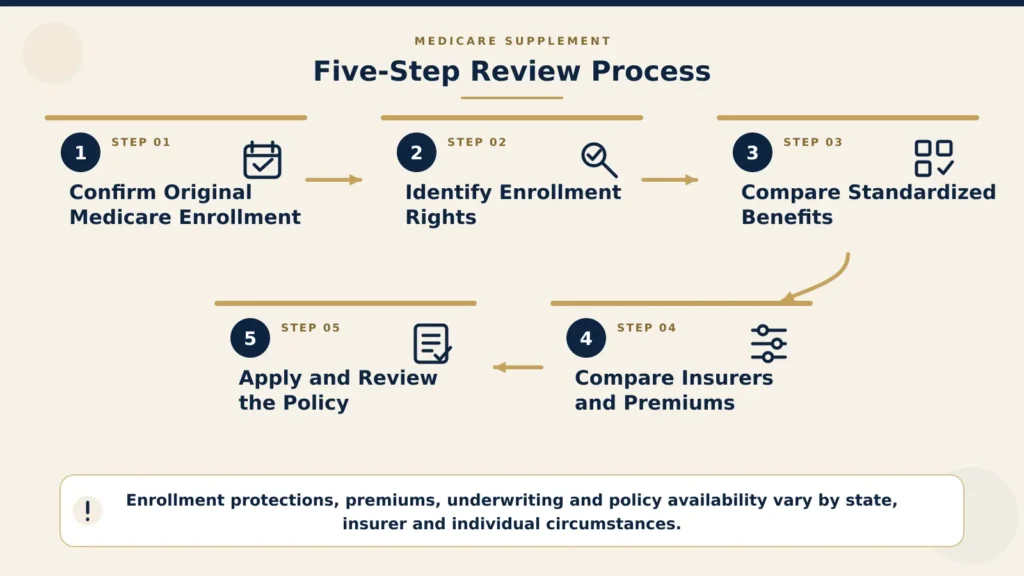
1. Confirm Original Medicare Enrollment
Verify Medicare Part A and Part B effective dates before choosing a Medigap start date. Social Security determines Medicare eligibility and enrollment; the Medigap insurer does not.
2. Identify the Enrollment Right
Determine whether the application falls within the one-time Medigap Open Enrollment Period, a federal guaranteed-issue situation or a broader state protection. If no protection applies, the insurer may use medical underwriting where permitted.
3. Compare Standardized Benefits
Choose the plan letter based on the cost sharing the policy covers. In most states, a Plan G from one insurer has the same standardized medical benefits as Plan G from another insurer. Massachusetts, Minnesota and Wisconsin standardize Medigap differently.
4. Compare Insurers and Premium Structure
For the same plan letter, compare the initial premium, rating method, available discounts, recent rate history, customer service and financial considerations. A lower first-year premium does not establish the lowest long-term cost.
5. Coordinate the Application and Effective Date
Avoid cancelling existing coverage until the new policy is approved, the start date is confirmed and any applicable transition rules are understood. This is especially important when leaving Medicare Advantage or replacing another Medigap policy.
What Do Standardized Medigap Plans Cover?
In most states, insurers may offer standardized Plans A, B, C, D, F, G, K, L, M and N. Every insurer that sells Medigap must offer Plan A, but an insurer is not required to offer every plan letter. Massachusetts, Minnesota and Wisconsin use different standardized structures.
The plan letters are not Medicare parts. For example, Medigap Plan G is a private supplemental policy; Medicare Part G does not exist. A beneficiary keeps Medicare Part A and Part B and adds one Medigap policy with its own plan letter.
All standardized plans include some level of the core benefits established for their plan letter. Depending on the letter, those benefits can include:
- Part A coinsurance and additional hospital days after Medicare benefits are used.
- Part B coinsurance or copayments.
- The first three pints of blood.
- Part A hospice coinsurance or copayments.
- Skilled-nursing-facility care coinsurance.
- The Part A deductible.
- Part B excess charges.
- Limited foreign-travel emergency benefits.
The official Medicare Medigap benefit chart should be the controlling public reference when comparing plan letters.
A Practical Overview of the Plan Letters
| Plan | General structure in most states | Important limitation or note |
|---|---|---|
| A | Core standardized benefits | Does not cover the Part A deductible, skilled-nursing-facility coinsurance, Part B deductible, excess charges or foreign-travel emergency benefit |
| B | Core benefits plus the Part A deductible | Does not cover skilled-nursing-facility coinsurance, Part B deductible, excess charges or foreign travel |
| C | Broad legacy coverage including the Part B deductible | Generally unavailable to people new to Medicare on or after January 1, 2020 |
| D | Broad coverage without the Part B deductible or excess charges | Includes the standardized foreign-travel emergency benefit |
| F | Broad legacy coverage including the Part B deductible and excess charges | Generally unavailable to people new to Medicare on or after January 1, 2020; a high-deductible version may be offered |
| G | Broad coverage including Part B excess charges, but not the Part B deductible | A high-deductible version may be available in some states |
| K | Pays a percentage of several benefits until an annual limit is reached | $8,000 out-of-pocket limit in 2026, plus the Part B deductible under the official rules |
| L | Pays a higher percentage than K until a lower annual limit is reached | $4,000 out-of-pocket limit in 2026, plus the Part B deductible under the official rules |
| M | Covers 50% of the Part A deductible and several other benefits | Does not cover the Part B deductible or excess charges |
| N | Broad coverage with certain Part B office and emergency-room copayments | Does not cover the Part B deductible or Part B excess charges |
This table is a plain-language orientation, not a substitute for the official benefit chart or the policy contract.
Medicare Supplement Plan G Explained
Plan G is one of the broadest standardized options available to people who became newly eligible for Medicare on or after January 1, 2020. In most states, it covers:
- Part A coinsurance and hospital costs for up to an additional 365 days after Medicare benefits are used.
- Part B coinsurance or copayments.
- The first three pints of blood.
- Part A hospice coinsurance or copayments.
- Skilled-nursing-facility care coinsurance.
- The Part A deductible.
- Part B excess charges.
- 80% of qualifying foreign-travel emergency charges, subject to the plan’s deductible and limits.
Plan G does not pay the Part B deductible. In 2026, that annual deductible is $283. The beneficiary must also continue paying the Part B premium and the separate Plan G premium.
Plan G may suit someone who values broad standardized cost-sharing protection and wants coverage for Part B excess charges. It is not automatically the best choice: the premium and long-term rating structure must still be compared with the person’s budget and alternatives.
Medicare Supplement Plan N Explained
Plan N covers many of the same major cost-sharing categories as Plan G, including the Part A deductible and qualifying foreign-travel emergency care. It does not cover the Part B deductible or Part B excess charges.
After the Part B deductible, Plan N pays the Part B coinsurance except for a copayment of up to $20 for certain office visits and up to $50 for an emergency-room visit that does not result in inpatient admission.
Plan N may have a lower premium than Plan G for the same applicant and area, but that is not guaranteed. The beneficiary accepts more point-of-service cost sharing and should verify whether physicians accept Medicare assignment. A doctor who participates in Medicare assignment agrees to accept the Medicare-approved amount for covered services. A nonparticipating provider who still accepts Medicare may be permitted to bill a Part B excess charge, subject to federal and state limits; Plan N does not cover that charge.
Medicare Supplement Plan G vs. Plan N
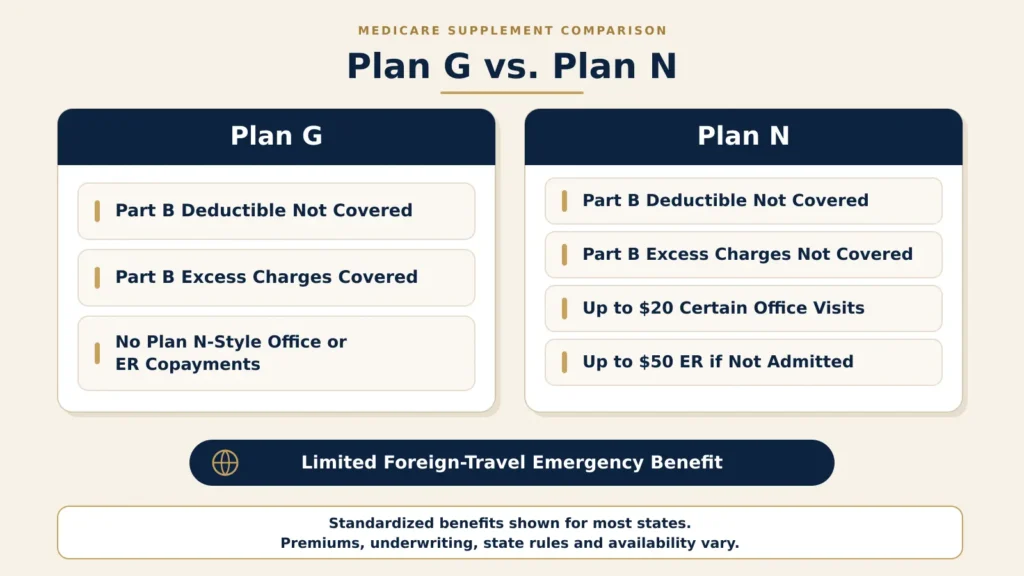
Neither plan is universally better. The decision is a trade-off between premium, predictable cost sharing, provider billing and the applicant’s ability to change coverage later.
| Decision factor | Plan G | Plan N |
|---|---|---|
| Part A deductible | Covered | Covered |
| Part B deductible | Not covered | Not covered |
| Part B coinsurance | Covered after the applicable deductible | Covered, except for certain office and emergency-room copayments |
| Office-visit copayment | No Plan N-style copayment for Medicare-covered services | Up to $20 for certain visits |
| Emergency-room copayment | No Plan N-style copayment for Medicare-covered services | Up to $50 when the visit does not result in inpatient admission |
| Part B excess charges | Covered | Not covered |
| Foreign-travel emergency | 80% after the foreign-travel deductible, up to plan limits | 80% after the foreign-travel deductible, up to plan limits |
| Typical positioning | Broader standardized cost-sharing protection | Potentially lower premium with more cost sharing |
When Plan G May Deserve Consideration
Plan G may be worth comparing when the applicant:
- Wants broad coverage of standardized Original Medicare cost sharing.
- Prefers fewer point-of-service bills after the Part B deductible.
- Uses providers who may not always accept Medicare assignment.
- Is comfortable paying a potentially higher monthly premium for more predictable covered cost sharing.
When Plan N May Deserve Consideration
Plan N may be worth comparing when the applicant:
- Is comfortable with limited copayments in exchange for a potentially lower premium.
- Confirms that preferred physicians accept Medicare assignment.
- Understands the exposure to Part B excess charges.
- Can absorb variable office and emergency-room copayments within the annual budget.
The Question Many Comparisons Miss
Do not compare only this year’s premium. Ask whether changing from Plan N to Plan G later could require medical underwriting. In many states, the annual Medicare Open Enrollment Period does not create a federal right to change Medigap policies without underwriting. A lower premium today should be considered alongside the possibility that future options may be limited.
What About Plan F and Plan C?
Plans C and F cover the Part B deductible, but federal law restricts their availability to people who were eligible for Medicare before January 1, 2020. A person eligible before that date may still be able to buy one if offered and if the applicant meets enrollment and underwriting requirements. Someone who already has Plan C or Plan F can generally keep it as long as the policy remains in force and premiums are paid.
Do not switch from a legacy policy solely because it is closed to newer beneficiaries. Compare current and projected premiums, benefits, health status, underwriting requirements and the ability to return before cancelling it.
How Does High-Deductible Plan G Work?
Some insurers offer a high-deductible version of Plan G. The standardized benefit structure is similar to Plan G, but the policy does not begin paying until the beneficiary has paid Medicare-covered deductibles, copayments and coinsurance up to the high-deductible amount.
The high-deductible Plan G amount is $2,950 in 2026. Foreign-travel emergency coverage has a separate $250 annual deductible. The beneficiary also pays the Part B premium, the Medigap premium and costs for services Medicare does not cover.
High-deductible Plan G may appeal to someone who wants a lower premium and can comfortably fund the deductible if care is needed. Compare the annual premium savings with the additional amount at risk; do not evaluate the monthly premium by itself.
What Is Medicare SELECT?
Medicare SELECT is a type of standardized Medigap policy available in some states. It may require the member to use specific hospitals—and sometimes physicians—for full supplemental benefits, except in qualifying emergencies. Original Medicare still pays its share of Medicare-approved costs, but the SELECT policy may pay less or nothing if its network rules are not followed.
The premium may be lower than a comparable standard Medigap policy. Before enrolling, review the network, travel pattern, emergency rules and the right to switch if the person later moves outside the service area.
How Much Do Medicare Supplement Plans Cost?
There is no single national Medigap price. Premiums can vary significantly even when two companies sell the same standardized plan letter in the same area.
The quote may depend on:
- State, ZIP code or rating area.
- Age and the policy’s pricing method.
- Tobacco-use classification.
- Sex, where state law permits its use.
- Household or spousal discounts.
- When the policy is purchased.
- Whether medical underwriting applies.
- The selected plan letter and high-deductible option.
- The insurer’s approved rate changes.
A Medigap premium is paid to the private insurer in addition to the Part B premium paid to Medicare. Part D, dental, vision, hearing, travel-medical or long-term-care coverage may create additional premiums.
The Three Main Medigap Rating Methods
| Rating method | How the starting premium is generally set | What can happen later |
|---|---|---|
| Community-rated or no-age-rated | People in the rating class generally pay the same premium regardless of age | Premiums may rise because of inflation, healthcare costs and other approved factors, but not simply because the beneficiary gets older |
| Issue-age-rated or entry-age-rated | The premium is based on age when the policy is purchased | It does not rise solely because the beneficiary ages, but it can rise for inflation and other approved factors |
| Attained-age-rated | The premium is based on the beneficiary’s current age | It can rise as the beneficiary ages and for inflation or other approved factors |
Rating terminology does not predict the exact future premium. Ask how long any introductory or household discount lasts, whether it decreases over time and how the block of business has been repriced.
Questions to Ask About Price
- Is the quote for the exact same plan letter and benefit design?
- What pricing method does the policy use?
- Is the premium discounted? If so, when can the discount change or end?
- How often has this policy’s premium changed during the past three years?
- Does the quote assume preferred health, household eligibility or electronic payment?
- Can the insurer re-rate the policy class even though the policy is guaranteed renewable?
- What additional premiums will I pay for Part B and Part D?
When Is the Best Time to Buy Medigap?
Under federal law, the most broadly protected time is the one-time six-month Medigap Open Enrollment Period. It starts on the first day of the month in which both conditions are true:
- The person is age 65 or older.
- The person is enrolled in Medicare Part B.
During this period, an insurer cannot refuse to sell an applicant any Medigap policy it offers because of health problems or charge more because of pre-existing health conditions. A pre-existing-condition waiting period may still apply in limited circumstances, although qualifying prior creditable coverage can reduce or eliminate it.
The official Medicare enrollment guidance explains that this federal six-month opportunity is one-time and does not repeat every year.
If Part B Is Delayed Because of Current Employment
A person age 65 or older who properly delays Part B while covered by an eligible current-employment group health plan generally does not start the federal Medigap Open Enrollment Period until Part B becomes effective. Employer size, whether coverage is based on current employment, and coordination-of-benefits rules matter. COBRA and retiree coverage are not treated the same as active-employment coverage for every Medicare decision.
Coordinate Part B, employer coverage, Part D and Medigap dates before retirement. Do not cancel employer insurance until effective dates are confirmed.
Can I Buy a Medicare Supplement Plan Anytime?
An insurer may accept an application at other times, but the ability to apply is not the same as a guaranteed right to buy.
Outside the one-time Medigap Open Enrollment Period or another protected right, an insurer may use medical underwriting where state law permits. The company may:
- Ask health questions.
- Review medications, treatment history or other underwriting information.
- Charge a different premium where permitted.
- Delay coverage for certain pre-existing conditions when allowed.
- Decline the application.
Some states provide birthday rules, anniversary rules, year-round availability or other protections broader than federal law. The exact rule depends on the state of residence and may limit which plan letters or benefit levels can be selected.
Medicare Open Enrollment Is Not Medigap Open Enrollment
The Medicare Open Enrollment Period from October 15 through December 7 is primarily a period for Medicare Advantage and Part D decisions. It does not create a general federal right to buy or switch Medigap without medical underwriting.
Similarly, the Medicare Advantage Open Enrollment Period from January 1 through March 31 allows certain Medicare Advantage changes, but it does not by itself guarantee acceptance into a Medigap policy. A separate guaranteed-issue, trial or state right must be verified.
What Are Medigap Guaranteed-Issue Rights?
Guaranteed-issue rights—sometimes called Medigap protections—apply in specific situations outside the initial six-month period. When a qualifying federal right applies and the application is timely, the insurer must sell an eligible policy, cannot price it based on health and cannot impose a pre-existing-condition waiting period.
Examples may include:
- A Medicare Advantage plan leaves Medicare, ends coverage in the area or the beneficiary moves outside its service area and returns to Original Medicare.
- Employer, union, retiree or COBRA coverage that pays after Medicare ends.
- A beneficiary uses a qualifying first-year Medicare Advantage trial right to return to Original Medicare.
- A beneficiary dropped Medigap to join Medicare Advantage for the first time and returns within the qualifying trial period.
- A Medigap insurer becomes insolvent or coverage ends through no fault of the beneficiary.
- A plan or insurer materially violated rules or misled the beneficiary.
The available plan letters and deadlines depend on the qualifying event. Many federal rights allow an application beginning 60 days before coverage ends and no later than 63 days after it ends. Preserve termination notices, envelopes, emails and claim denials because the Medigap insurer may request proof.
This is a summary, not a determination of rights. Confirm the event, dates and eligible plan letters with Medicare, the State Health Insurance Assistance Program and the State Insurance Department.
Can People Under 65 Buy Medigap?
Some people qualify for Medicare before age 65 because of disability, End-Stage Renal Disease or another qualifying basis. Federal law generally does not require insurers to offer them Medigap before 65. Many states provide their own access rules, but available plan letters and premiums can differ.
A person who has Medicare before 65 receives a new federal six-month Medigap Open Enrollment Period when turning 65 and enrolled in Part B. Review the under-65 state rules and the age-65 opportunity separately.
Medicare Supplement for Citizens, Green Card Holders and Other Beneficiaries
Medigap does not create Medicare eligibility. A US citizen, green card holder or other eligible beneficiary must first qualify for and enroll in Medicare Part A and Part B. Once those requirements are met, the Medigap analysis focuses on state residence, enrollment protections, plan availability, premium and any permitted underwriting.
A green card alone does not create a right to Medigap, and a visa alone does not create Medicare eligibility. For the underlying age, work-credit, residence and immigration rules, read Who Is Eligible for Medicare? A Guide for Citizens, Green Card Holders and Visa Holders.
How Does Medigap Work With Medicaid or Employer Coverage?
Someone with Medicaid may already receive help with Medicare premiums and cost sharing. An insurer generally cannot sell Medigap to a person who has Medicaid, except in limited circumstances recognized by law. Before giving up Medicaid-related help, confirm how the change would affect premiums, providers, prescription coverage and other benefits.
Current-employer, union and retiree coverage can also pay costs left by Medicare. Adding Medigap may duplicate benefits or create an unnecessary premium. Ask the benefits administrator which coverage pays first, what happens when employment ends and whether a guaranteed-issue right may arise when the supplemental employer or union coverage terminates.
Medicare Supplement vs. Medicare Advantage
Medigap and Medicare Advantage are different coverage paths.
| Feature | Original Medicare plus Medigap | Medicare Advantage |
|---|---|---|
| How Part A and Part B benefits are received | Through Original Medicare | Through a Medicare-approved private plan |
| Supplemental policy | Medigap helps with selected Original Medicare cost sharing | Medigap cannot be used to pay Medicare Advantage cost sharing |
| Provider access | Generally any US provider who accepts Medicare; Medicare SELECT is an exception | Network and service-area rules may apply |
| Prescription drugs | Usually requires a separate Part D plan | Commonly included, but not always |
| Annual changes | Standardized Medigap benefits remain tied to the plan letter; premiums can change | Premiums, networks, formularies, cost sharing and extra benefits may change annually |
| Out-of-pocket structure | Depends on Original Medicare, the Medigap letter and noncovered services | Plan has an annual limit for covered Part A and Part B services |
| International emergency care | Certain Medigap letters include a limited standardized benefit | Depends on the specific Medicare Advantage plan |
The lower monthly premium is not automatically the lower total risk, and the broader provider choice is not automatically the best value. Compare expected care, doctors, prescriptions, travel, cash-flow preference and future switching rights.
Can I Switch From Medicare Advantage to Medigap?
It may be possible, but two separate steps must be coordinated:
- The beneficiary must have a valid opportunity to leave Medicare Advantage and return to Original Medicare.
- The beneficiary must qualify to buy the desired Medigap policy under an open-enrollment, guaranteed-issue, trial, state-law or underwriting path.
A Medicare Advantage election period does not automatically guarantee Medigap acceptance. If underwriting applies, obtain the Medigap decision and confirm all effective dates before relying on the change. The Medigap policy cannot begin while Medicare Advantage coverage remains active.
Someone who joined Medicare Advantage when first eligible at 65 and returns to Original Medicare within the first year may have a federal trial right to buy certain Medigap coverage. Someone who dropped a Medigap policy to try Medicare Advantage for the first time may have a right to recover the former policy within the qualifying 12-month period if it remains available, or to buy certain other policies.
Do not cancel existing coverage based only on an informal quote.
Can I Change Medicare Supplement Plans Every Year?
You may ask to change a Medigap policy, but federal law does not provide a general annual guaranteed-issue period for doing so. Outside a protected right, the new insurer may require underwriting and may decline the application.
If a new policy is approved, Medicare provides a 30-day free-look period when replacing an existing Medigap policy. Keep the old policy until deciding to retain the new one, and expect to pay both premiums during the overlap. Once an older policy is cancelled, it may not be available again.
Never cancel the current Medigap policy before receiving written approval, the policy materials and the confirmed effective date for the replacement.
Does Medigap Include Prescription Drug Coverage?
Medigap policies sold after 2005 do not include prescription-drug coverage. A beneficiary who wants outpatient drug coverage generally enrolls in a separate Part D plan and pays its premium in addition to Part B and Medigap premiums.
Part D enrollment rules and late penalties are separate from Medigap. Compare the formulary, pharmacy network, drug tiers, utilization rules and annual costs. A strong Medigap policy does not compensate for a poorly matched Part D plan.
Does Medicare Supplement Cover Travel?
Travel Within the United States
With Original Medicare, a beneficiary can generally use any physician or hospital in the United States that accepts Medicare. Standard Medigap policies do not usually use local provider networks. Medicare SELECT is the important exception because full supplemental benefits may depend on its network.
Confirm that the provider accepts Medicare and, for Plan N users concerned about excess charges, whether the provider accepts Medicare assignment.
Travel to Italy or Another Country
Original Medicare generally does not cover healthcare outside the United States except in limited situations. Standardized Medigap Plans C, D, F, G, M and N include a limited foreign-travel emergency benefit.
Under the standard benefit, the policy generally:
- Pays 80% of certain medically necessary emergency-care billed charges after a $250 annual deductible.
- Applies when the emergency begins during the first 60 days of the trip and Medicare does not otherwise cover the care.
- Has a $50,000 lifetime foreign-travel limit.
The benefit is not comprehensive international medical insurance. It does not eliminate all costs, and it may not cover routine care, longer stays, medical evacuation or repatriation. A person who spends extended periods in Italy should compare a separate travel-medical or international health policy and read its exclusions carefully.
The current official details appear in Medicare Coverage Outside the United States.
What Medicare Supplement Generally Does Not Cover
Medigap generally does not cover:
- Long-term custodial care.
- Routine dental care.
- Routine vision care, glasses or contact lenses.
- Hearing aids.
- Private-duty nursing.
- Outpatient prescription drugs in newly sold policies.
- Services that Original Medicare does not cover unless the policy includes a specific additional benefit.
- Healthcare outside the United States beyond the standardized foreign-travel emergency limits of eligible plan letters.
For care-planning needs that Medicare and Medigap do not address, review How Does Long-Term Care Insurance Work?.
Should Medicare Supplement Coverage Be Reviewed Every Year?
Yes, an annual review is useful—but it does not mean a beneficiary should change Medigap every year.
A standardized Medigap policy is generally guaranteed renewable as long as premiums are paid and the application was truthful. Its core benefits do not reset through the same annual redesign process used by Medicare Advantage and Part D. The premium, however, may change. Household discounts, financial priorities, residence, insurer service and health can also change.
An annual review should check:
- The new Medigap premium and percentage increase.
- The policy’s rating method and whether a discount is changing.
- Whether the beneficiary still understands the selected plan letter’s cost sharing.
- Whether a move creates different prices or rights.
- Whether switching would require medical underwriting.
- Whether preferred physicians still accept Medicare and assignment.
- The separate Part D Annual Notice of Change, formulary and pharmacies.
- Travel patterns and whether additional international protection is needed.
- Changes to Medicare’s annual deductibles and limits.
The purpose is to identify issues early—not to replace a stable policy automatically. A proposed premium saving is not useful if the replacement cannot be approved, reduces desired benefits or causes a coverage gap.
Four Practical Medicare Supplement Examples
Example 1: Turning 65 and Choosing Between Plan G and Plan N
Maria is enrolling in Part A and Part B at 65 and enters her six-month Medigap Open Enrollment Period. She compares Plan G and Plan N. Plan G has a higher premium but covers Part B excess charges and does not impose Plan N’s office and emergency-room copayments. Plan N has a lower quote, but Maria would accept those copayments and excess-charge exposure.
Because both applications are protected during her window, she compares benefits, premium structure and long-term affordability before the window closes rather than assuming she can upgrade without underwriting later.
Example 2: Retiring After 65 With Employer Coverage
Robert delayed Part B while covered through his current employment. Before retiring, he confirms his Part B Special Enrollment Period and effective date. His six-month Medigap Open Enrollment Period begins when Part B becomes effective because he is already over 65.
He coordinates employer coverage, Part B, Part D and Medigap dates so that one coverage ends when the next begins. He does not treat COBRA as a reason to postpone the review without verifying Medicare rules.
Example 3: Returning From Medicare Advantage to Original Medicare
Lucia wants broader provider access. She has an election opportunity to leave Medicare Advantage, but that does not by itself prove she can buy the Plan G she wants. A review identifies whether she has a first-year trial right, another guaranteed-issue protection, a state right or must complete medical underwriting.
She applies and confirms approval and effective dates before allowing the coverage change to take effect.
Example 4: Spending Part of the Year in Italy
Giovanni has Original Medicare and Plan N. His policy includes the standardized foreign-travel emergency benefit, but it is limited to qualifying emergencies beginning in the first 60 days of a trip, pays 80% after the deductible and has a lifetime maximum.
Because he plans a four-month stay in Italy, he does not rely on Medigap alone. He compares separate travel-medical or international coverage for the period outside the Medigap limit.
Common Medicare Supplement Mistakes
Assuming the Annual Medicare Window Guarantees Medigap
October 15 through December 7 is not a universal Medigap open-enrollment period. A person may be able to change Medicare Advantage or Part D during that period and still face Medigap underwriting.
Comparing Different Plan Letters by Premium Alone
Plan G and Plan N do not transfer the same costs to the beneficiary. First choose the benefit structure, then compare insurers selling the same letter.
Cancelling Coverage Before Approval
An application or quote is not approval. Confirm underwriting, effective dates and required premiums in writing.
Ignoring the Rating Method
The least expensive initial premium may rise differently than another policy. Ask how age, discounts and approved rate changes affect future cost.
Believing Medigap Covers Everything Medicare Excludes
Medigap primarily supplements Original Medicare cost sharing. It generally does not create coverage for routine dental, vision, hearing, custodial long-term care or ordinary foreign medical services.
Forgetting Part D
A new Medigap policy does not include outpatient prescriptions. Part D must be evaluated separately.
Assuming Both Spouses Share One Policy
Medigap is individual coverage. Each spouse needs a separate policy and premium if both want coverage.
Medicare Supplement Review Checklist
Before applying or changing coverage, confirm:
- Medicare Part A and Part B effective dates.
- The exact Medigap Open Enrollment, guaranteed-issue, trial or state-law right.
- The application deadline and proof required.
- The desired standardized plan letter.
- The 2026 Part B deductible and any plan-specific cost sharing.
- Whether preferred providers accept Medicare and Medicare assignment.
- The insurer’s quote, rating method and discount assumptions.
- Recent rate changes and how future rates may be approved.
- Separate Part D coverage and premium.
- Travel length and the policy’s foreign-emergency limits.
- Underwriting approval, policy start date and first premium.
- The end date of employer, Medicare Advantage or prior Medigap coverage.
- The 30-day free-look process when replacing Medigap.
- State-specific rules confirmed with the State Insurance Department when relevant.
Frequently Asked Questions About Medicare Supplement Plans
Is Medicare Supplement the Same as Medigap?
Yes. Medicare Supplement Insurance is commonly called Medigap. It is private coverage that helps pay selected cost-sharing amounts left by Original Medicare.
Do I Need Medicare Part A and Part B Before Buying Medigap?
Generally, yes. Medigap works with Original Medicare, which consists of Part A and Part B. Verify both effective dates before selecting the Medigap start date.
Is Medicare Supplement Mandatory?
No. Medigap is optional. A beneficiary may use Original Medicare alone, add other qualifying supplemental coverage or choose Medicare Advantage instead, depending on eligibility and personal needs.
Which Is the Best Medicare Supplement Plan?
There is no universal best plan. The appropriate choice depends on available plan letters, premium, cost-sharing preference, provider billing, travel, budget, state rules and the likelihood that a later change would require underwriting.
Is Plan G Better Than Plan N?
Plan G generally covers Part B excess charges and avoids Plan N’s specified office and emergency-room copayments. Plan N may have a lower premium. Compare the annual premium difference with expected copayments, excess-charge exposure and future switching risk.
Does Plan G Cover the Medicare Part B Deductible?
No. Plan G does not cover the Part B deductible. The deductible is $283 in 2026.
What Copayments Can Apply Under Plan N?
After the Part B deductible, Plan N can require up to $20 for certain office visits and up to $50 for an emergency-room visit that does not result in inpatient admission.
What Are Medicare Part B Excess Charges?
Where permitted, a nonparticipating provider who accepts Medicare but not assignment may bill above the Medicare-approved amount within applicable limits. Plan G covers standardized Part B excess charges; Plan N does not. A provider who has opted out of Medicare is a different situation and may use private contracts.
Can I Buy Medicare Supplement at Any Time?
You may be able to apply, but acceptance is not always guaranteed. Outside the one-time Medigap Open Enrollment Period, a guaranteed-issue right or broader state protection, medical underwriting may apply.
Does Medigap Open Enrollment Happen Every Year?
No. The federal Medigap Open Enrollment Period is generally a one-time six-month period beginning when the person is both 65 or older and enrolled in Part B. It is different from Medicare’s annual October 15–December 7 period.
Can Medigap Deny Me for a Pre-Existing Condition?
During the protected six-month Medigap Open Enrollment Period, the insurer cannot deny the application or charge more because of health.
Outside protected rights, an insurer may use medical underwriting where permitted. A limited waiting period can apply to certain pre-existing conditions in some situations.
Can I Switch From Medicare Advantage to Medigap?
Possibly. The person must return to Original Medicare and separately qualify to buy Medigap through an open-enrollment, guaranteed-issue, trial, state-law or underwriting path. An Advantage election period alone does not guarantee Medigap acceptance.
Can I Have Medicare Advantage and Medigap at the Same Time?
No. Medigap cannot be used to pay Medicare Advantage premiums, deductibles, copayments or coinsurance. A Medigap insurer generally cannot sell the policy to someone remaining in Medicare Advantage.
Do I Need Medigap if I Have Medicaid or Retiree Coverage?
Possibly not. Medicaid or retiree coverage may already help with costs left by Medicare, and adding Medigap can duplicate protection. An insurer generally cannot sell Medigap to someone who has Medicaid except in limited lawful situations. Confirm the coordination rules before changing existing coverage.
Does Medigap Cover Prescription Drugs?
New Medigap policies do not include outpatient prescription-drug coverage. A separate Part D plan is generally needed for that protection.
Does Medicare Supplement Cover Dental, Vision or Hearing?
Medigap generally does not cover routine dental care, routine vision care, glasses or hearing aids. Separate coverage or direct payment may be required.
Does Medigap Cover Long-Term Care?
No. Medigap generally does not cover long-term custodial care such as ongoing non-skilled assistance in a nursing home or at home.
Does Medicare Supplement Cover Care in Italy?
Plans C, D, F, G, M and N include limited foreign-travel emergency coverage: generally 80% after a $250 annual deductible, when the emergency begins within the first 60 days of the trip, subject to a $50,000 lifetime limit. It is not comprehensive international health coverage.
Can My Spouse and I Use One Medigap Policy?
No. Each Medigap policy covers one person. Each spouse needs a separate application and premium.
Can I Keep Medigap if My Health Changes?
Standardized Medigap policies are generally guaranteed renewable when premiums are paid and the application was truthful. The insurer can terminate coverage only in limited circumstances, such as nonpayment, material misrepresentation or insolvency.
Should I Review My Medicare Supplement Every Year?
Yes, review the premium, rating method, discounts, provider assignment, travel needs and state rules. Also review Part D separately every year. Do not replace Medigap automatically; a new policy may require underwriting.
Final Takeaway: Compare the Right Things in the Right Order
The best Medicare Supplement decision is not simply the cheapest quote or the plan letter with the most benefits. First confirm Original Medicare enrollment and the right to buy. Then compare standardized benefits, total annual exposure, premium structure, provider use, travel and the ability to change later.
For many new beneficiaries, Plan G and Plan N create the central comparison. Plan G generally offers broader cost-sharing protection. Plan N may exchange a lower premium for certain copayments and Part B excess-charge exposure. The correct choice depends on the applicant-not a universal ranking.
Compare Medicare Supplement Options With Clarity
If you are approaching age 65, leaving employer coverage, reviewing an existing Medigap policy or considering a return from Medicare Advantage to Original Medicare, request a no-obligation educational consultation to compare your options.
Sterling Arc Group can help you organize your Medicare dates, identify questions about enrollment protections, compare standardized plan benefits and request available policy information based on your state and circumstances. Completing the form is not an insurance application and does not guarantee eligibility, approval, a premium or savings.