


Life Insurance Premium Financing: How It Works, Risks & Who It May Fit
Large life insurance policies can require substantial annual premiums.
For some high-net-worth families, business owners and individuals with significant but illiquid assets, paying those premiums entirely from current cash flow may create an unwanted liquidity trade-off.
Life insurance premium financing is one possible way to address that issue.
Instead of paying all premiums directly with personal funds, a qualified borrower obtains a loan from a third-party lender. The lender provides funds for the life insurance premiums, while the borrower pays interest and provides collateral according to the lending agreement.
That does not make the insurance free.
Premium financing introduces borrowing costs, collateral requirements, refinancing risk, policy-performance risk and the need for a realistic exit strategy.
For that reason, it should generally be evaluated as an advanced financing strategy — not as a shortcut to purchasing a large life insurance policy.
Products, lender requirements, loan terms, underwriting, collateral requirements and insurance availability vary.

Table of Contents
Quick Answer: What Is Life Insurance Premium Financing?
Life insurance premium financing is an arrangement in which a borrower uses a third-party loan to help pay premiums on a life insurance policy.
The lender may rely on the policy’s cash surrender value as part of its collateral and may also require additional assets to secure the loan.
The borrower remains responsible for:
- Loan interest
- Required collateral
- Insurance-policy obligations
- Loan covenants
- Potential collateral shortfalls
- Refinancing or repayment
- Ongoing policy and loan reviews
The strategy is generally associated with large permanent-life-insurance cases and financially sophisticated borrowers who can satisfy lender, carrier and collateral requirements.
The most important distinction is simple:
Premium financing is not an insurance product. It is a borrowing strategy used to fund an insurance product.
Why Would Someone Finance Life Insurance Premiums?
The purpose should begin with an actual life-insurance need.
Financing should not be the reason to create the need.
Potential planning situations can include:
Preserving Liquidity
A business owner or family may have substantial net worth but prefer not to use a large amount of cash each year for insurance premiums.
Avoiding an Untimely Asset Sale
Some individuals hold concentrated positions in:
- Closely held businesses
- Real estate
- Private investments
- Investment portfolios
- Other long-term assets
Selling those assets simply to fund premiums may conflict with another financial objective.
Business and Succession Planning
Large life-insurance benefits may sometimes be considered in business-continuity, ownership-transition or legacy strategies.
Estate Liquidity
Life insurance may also be considered when an estate could eventually require liquidity.
However, premium financing should not be justified solely by generic estate-tax assumptions.
Tax laws, exemptions and individual circumstances change.
Maintaining Capital Flexibility
Borrowing can allow capital to remain available for other purposes.
But keeping capital invested while borrowing introduces an important comparison:
Will the value of retaining that capital justify the cost and risk of the loan?
That question should be tested — not assumed.
How Does Life Insurance Premium Financing Work Step by Step?
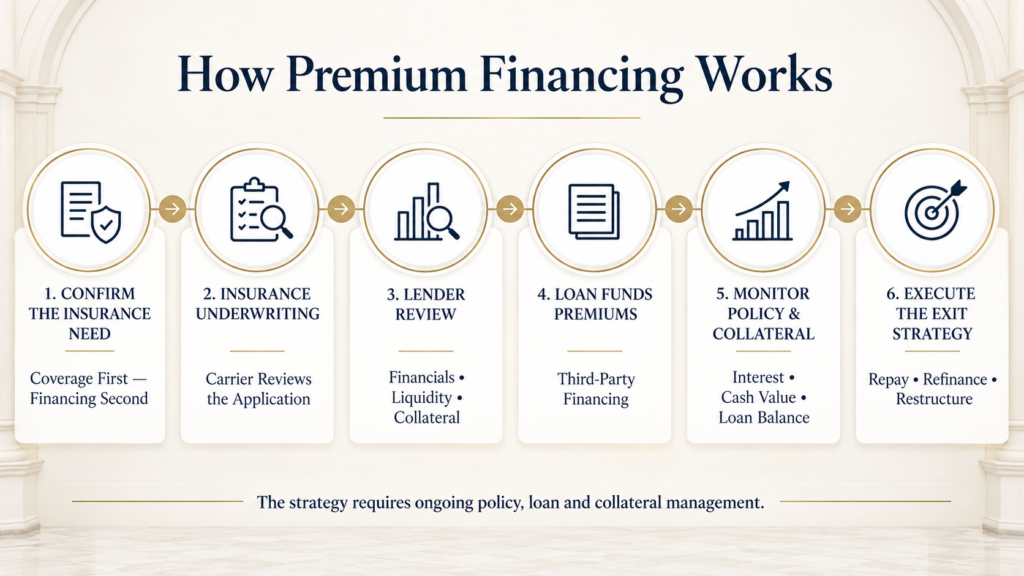
1. Confirm the Life Insurance Need
The first question is not:
“Can I finance a policy?”
It is:
“Would I need this amount and type of life insurance even if I were paying the premiums myself?”
The death-benefit objective, duration of coverage and policy structure should make sense independently of the financing arrangement.
2. Complete Insurance Underwriting
The proposed insured must still qualify for the life insurance itself.
Depending on the case, underwriting may involve:
- Age
- Health
- Medical history
- Financial justification
- Coverage amount
- Ownership structure
- Insurable interest
- Carrier requirements
Financing does not remove insurance underwriting.
3. Complete Lender Underwriting
The bank or financing company performs a separate evaluation.
The lender may review:
- Net worth
- Liquidity
- Income or cash flow
- Credit
- Existing debt
- Assets
- Ownership entities
- Trust documents
- Proposed policy
- Insurance carrier
- Policy illustration
- Collateral availability
Insurance approval and loan approval are therefore two different processes.
A borrower can potentially qualify for one and not the other.
4. Establish the Ownership and Planning Structure
Depending on the planning objective, the policy owner and borrower might involve:
- An individual
- A trust
- A business entity
- Another approved structure
Trust and ownership decisions can create significant estate, tax and legal consequences.
They should be coordinated with qualified legal and tax professionals rather than determined solely by the insurance transaction.
5. The Lender Funds the Premium
Once all requirements are satisfied, the lender provides loan proceeds that are used to pay the applicable policy premium.
The exact payment process depends on the lender, insurance carrier and transaction.
The borrower then owes the lender according to the loan agreement.
6. Collateral Secures the Loan
The lender may receive a collateral assignment against the life-insurance policy.
Because the policy’s cash surrender value may initially be lower than the outstanding loan, the lender can also require outside collateral.
Potential collateral can depend on the lender and may include eligible financial assets or other acceptable property.
Collateral requirements are not static.
They may be reviewed periodically.
7. Interest Must Be Paid or Otherwise Addressed
The loan carries interest.
Depending on the agreement, the interest rate may be:
- Variable
- Based on a benchmark plus a lender spread
- Reset periodically
- Paid currently
- Structured differently under the specific facility
Do not assume that the rate available when the strategy begins will remain unchanged.
If borrowing costs increase, the strategy may become considerably more expensive.
8. The Policy and Loan Are Reviewed Regularly
Premium financing is not a “set it and forget it” arrangement.
Annual or periodic reviews should consider:
- Loan balance
- Interest rate
- Policy cash value
- Policy performance
- Additional premium requirements
- Collateral value
- Collateral shortfall
- Lender requirements
- Updated illustrations
- Exit strategy
If circumstances change, the original strategy may need to change as well.
9. The Loan Eventually Needs an Exit
Every premium-financing strategy should identify how the debt may eventually be repaid.
Potential outcomes depend on the actual documents and circumstances and may include:
- Repayment using outside liquidity
- Repayment following a future liquidity event
- Refinancing
- Using permitted policy values
- Reducing or restructuring the arrangement
- Repayment from death-benefit proceeds under the applicable collateral assignment
None of those outcomes should be assumed to occur automatically.
A strategy without a realistic exit plan is incomplete.
Premium Financing Is Not “Free Life Insurance”
One of the biggest misconceptions surrounding premium financing is the idea that someone can obtain a large life-insurance policy without meaningfully paying for it.
That is not how responsible premium financing should be understood.
There may be:
- Loan interest
- Policy charges
- Financing costs
- Legal expenses
- Tax-advisory expenses
- Collateral requirements
- Opportunity costs
- Additional capital requirements
- Refinancing risk
A lender is providing capital.
The borrower is assuming debt.
The policy is still an insurance contract with its own costs and performance characteristics.
Marketing phrases such as “free insurance,” “zero-cost insurance” or “the bank pays your premiums” should therefore be treated very cautiously.
Who May Consider Life Insurance Premium Financing?
Premium financing is generally associated with financially sophisticated cases rather than ordinary retail life-insurance needs.
A potential candidate may have:
- A legitimate need for substantial life insurance
- Significant net worth
- Strong financial documentation
- Meaningful liquidity
- Assets available for collateral
- A long-term planning horizon
- The ability to tolerate higher borrowing costs
- The ability to meet a collateral call
- A clearly defined repayment strategy
Potential circumstances can include:
High-Net-Worth Families
Particularly when the family has substantial assets but does not want to liquidate them solely to fund insurance premiums.
Business Owners
Especially when wealth is concentrated inside a company rather than held entirely in cash.
Real-Estate Owners
When a meaningful portion of net worth is tied to illiquid property.
Families With Large Legacy Objectives
Where substantial permanent life insurance has been independently determined to be appropriate.
There is no universal net-worth threshold that automatically qualifies someone.
Individual lenders establish their own underwriting and transaction requirements.
When Premium Financing May Not Be a Good Fit
Borrowing to fund life insurance may be inappropriate when:
- The insurance need itself is questionable
- The borrower cannot comfortably pay the premiums without financing
- Available collateral is limited
- A collateral call would create financial stress
- The plan depends on optimistic policy performance
- The plan depends on interest rates remaining low
- There is no credible exit strategy
- The borrower does not understand the financing documents
- Simpler insurance alternatives can solve the problem more efficiently
- The transaction is primarily being promoted as “free insurance”
Premium financing should generally increase flexibility for an already financially strong borrower.
It should not be used to manufacture affordability.
The Five Major Risks of Premium Financing
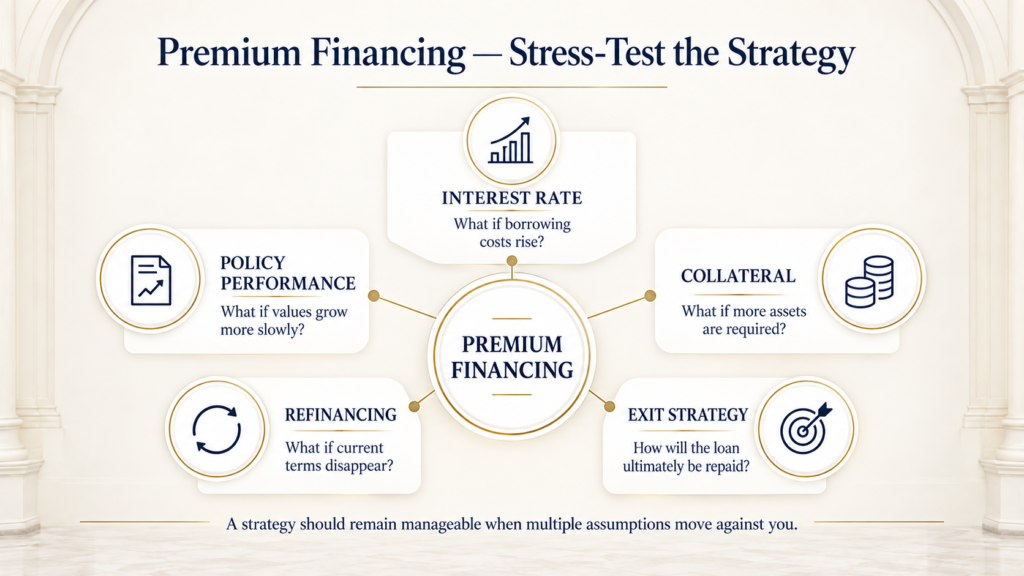
1. Interest-Rate Risk
Most financing arrangements involve borrowing costs that can change.
If the benchmark or lender spread increases, interest expense can rise substantially.
A strategy that looks attractive under one interest-rate assumption may become less attractive when rates are higher.
A responsible analysis should therefore model multiple borrowing-rate environments.
2. Policy-Performance Risk
Permanent life-insurance illustrations often contain both guaranteed and non-guaranteed values.
If actual policy performance is below the original illustration, cash value may grow more slowly than expected.
That can affect:
- Loan-to-value relationships
- Collateral requirements
- Future premiums
- Policy sustainability
- Exit assumptions
An illustration is not a promise that non-guaranteed values will occur.
3. Collateral Risk
A lender wants adequate security for the loan.
If the policy cash value does not provide sufficient collateral relative to the loan balance, the borrower may have to pledge additional assets.
This can occur because:
- Loan balances increase
- Interest accumulates
- Policy values grow more slowly
- Market value of pledged collateral falls
- Lender requirements change under the agreement
A borrower should understand what happens if additional collateral is requested — before the transaction begins.
4. Refinancing and Lender Risk
A borrower should not assume financing will remain available forever on identical terms.
Possible changes include:
- Lender appetite
- Credit standards
- Interest rates
- Loan duration
- Collateral requirements
- Insurance-carrier eligibility
- Borrower circumstances
A future lender may not offer the same terms as the original lender.
5. Exit-Strategy Risk
The loan eventually needs to be addressed.
If the expected exit depends on an uncertain event or unrealistic policy performance, the strategy can become problematic.
Before implementation, ask:
How would we exit if policy performance is lower than expected and borrowing costs are higher than expected at the same time?
That is a much more useful stress test than reviewing only the base illustration.
Guaranteed vs. Non-Guaranteed Policy Values
This distinction is especially important when life insurance is financed.
A policy illustration may contain:
Guaranteed Values
Contractual minimum values determined according to the policy.
Non-Guaranteed Values
Values that depend on assumptions or elements that can change.
Depending on the type of policy, those elements may include:
- Crediting assumptions
- Dividends
- Participation rates
- Caps
- Policy expenses
- Other non-guaranteed factors
The financing analysis should never assume that the most favorable illustrated outcome will occur.
Stress-testing lower policy performance is essential because loan interest and collateral obligations remain real even when policy values disappoint.
Can Premium Financing Be Used With IUL or Whole Life?
Premium financing may be considered with certain permanent-life-insurance designs when accepted by the carrier and lender.
Two commonly discussed categories are:
Indexed Universal Life
IUL policies may have flexible premiums and index-linked crediting methodologies.
They are not direct investments in a stock-market index.
Caps, participation rates, spreads, policy charges and other contract elements can affect performance.
A 0% index-crediting floor does not mean the policy itself cannot lose value because insurance charges and other deductions can continue.
Whole Life Insurance
Whole life policies can provide contractual guarantees along with potential non-guaranteed dividends when offered by the issuing insurer.
Dividends are not guaranteed.
Different policy designs produce different early cash values, guarantees and long-term economics.
The policy should be selected because it appropriately addresses the insurance objective — not simply because it can be financed.
Premium Financing vs. Paying Premiums With Cash
Neither method is universally superior.
| Consideration | Pay Premiums Directly | Premium Financing |
|---|---|---|
| Borrowing | None | Third-party debt |
| Interest cost | None | Yes |
| Collateral | Generally none for premium payment | Usually required |
| Liquidity | Uses current capital | Can preserve current liquidity |
| Complexity | Lower | Significantly higher |
| Rate risk | None from premium borrowing | Yes |
| Lender review | No | Yes |
| Refinancing risk | No | Potentially |
| Ongoing administration | Primarily policy review | Policy + loan + collateral review |
| Exit strategy | Usually simpler | Essential |
The correct comparison is not:
“Which one uses less cash today?”
It is:
“Which structure creates the better risk-adjusted outcome over the entire planning horizon?”
Premium Financing vs. a Policy Loan
These two concepts are frequently confused.
Premium Financing
A third-party lender loans money to help fund policy premiums.
The loan relationship is with the outside lender.
Policy Loan
A policy owner borrows against available policy value according to the insurance contract.
The loan relationship is part of the life-insurance policy.
They have different:
- Lending structures
- Interest rates
- Collateral mechanics
- Documentation
- Risks
- Tax considerations
Do not use the terms interchangeably.
What Does Premium Financing Cost?
The true cost is broader than the stated loan rate.
Consider:
Loan Interest
The primary financing expense.
Lender Spread
The rate may be expressed relative to a benchmark plus a lender margin.
Financing Fees
Depending on the lender, there may be documentation, legal, commitment or other facility-related expenses.
Insurance Policy Costs
The underlying life-insurance policy still contains its normal contractual charges.
Collateral Opportunity Cost
Assets pledged as collateral may have limitations or opportunity costs.
Professional Fees
Advanced cases can require coordination among:
- Insurance professionals
- Lenders
- Attorneys
- CPAs
- Trust and estate professionals
- Financial advisors
Exit Costs
Refinancing, restructuring or terminating a strategy may create additional costs.
The quoted loan rate therefore should never be viewed as the entire cost of the strategy.
Is Premium Financing Interest Tax Deductible?
Do not assume that it is.
The tax treatment of interest related to life-insurance financing can be complicated and depends on how the loan, borrower, policy and transaction are structured.
Federal tax law contains specific limitations involving deductions for interest connected to life-insurance contracts.
Tax deductibility should therefore be evaluated by a qualified tax professional using the actual facts of the case.
Premium financing should never be presented with a blanket statement that interest is deductible.
Does Premium Financing Create Tax-Free Life Insurance?
Premium financing does not itself create special tax treatment.
Life-insurance taxation depends on the underlying policy, ownership, transfers, loans, withdrawals, policy status and other circumstances.
Life-insurance death benefits are generally treated differently from other forms of income under federal tax law, but exceptions exist.
The existence of a financing loan does not eliminate those tax rules.
Similarly, policy loans should not automatically be described as “tax-free income.”
If a policy lapses or is surrendered with outstanding loans and taxable gain, significant tax consequences may potentially occur.
Tax professionals should review individualized circumstances.
Premium Financing and Estate Planning
Premium financing is sometimes discussed together with estate planning because life insurance can potentially provide liquidity at death.
But three concepts should remain separate:
Life insurance is an insurance contract.
Premium financing is a lending arrangement.
Estate planning is a legal and financial planning process.
They may interact, but one does not automatically accomplish the others.
For 2026, the federal estate-tax basic exclusion is substantial, and future rules may change.
That makes individualized estate analysis more important than using a generic assumption that every wealthy family will owe federal estate tax.
State estate or inheritance taxes can also differ.
Legal and tax professionals should determine the actual planning need.
What Is a Collateral Assignment?
A collateral assignment gives a lender specified rights in a life-insurance policy as security for a debt.
Generally, the lender’s interest is limited to the amount owed according to the assignment and loan documents.
If the insured dies while the loan is outstanding, applicable policy proceeds may first be used to satisfy the lender’s secured interest before remaining benefits are distributed according to the policy and ownership structure.
The exact rights of the lender depend on the documents.
A collateral assignment should not be confused with transferring full policy ownership.
What Happens if the Policy Underperforms?
Policy underperformance can affect the financing strategy even when the death benefit remains in force.
Potential consequences include:
- Lower cash surrender value
- Greater collateral requirements
- Increased need for outside assets
- Revised premium requirements
- Longer financing period
- Less attractive exit economics
The correct response is not to rely on the original illustration indefinitely.
Request updated in-force illustrations and evaluate actual policy performance against the original assumptions.
What Happens if Interest Rates Rise?
Higher borrowing rates can:
- Increase annual interest expense
- Increase the loan balance
- Reduce projected economic benefits
- Increase collateral requirements
- Change refinancing options
- Make paying premiums directly more attractive
This is why premium financing should be stress-tested at higher interest rates before implementation.
If the strategy only works when rates remain unusually low, the margin for error may be too small.
What Is a Premium Financing Exit Strategy?
The exit strategy explains how the loan will ultimately be reduced or repaid.
Questions include:
- Will outside assets repay the debt?
- Is there an expected business liquidity event?
- Will financing be reduced over time?
- Could refinancing be required?
- Are policy values expected to be used?
- What happens at death?
- What if the exit needs to occur earlier than expected?
- What if the policy performs below expectations?
The exit plan should be documented conceptually before the first premium is financed.
Practical Example
Consider a hypothetical business owner with significant net worth concentrated in a privately held company and real estate.
A legitimate long-term life-insurance need has already been identified.
The required premiums are substantial.
The owner could pay the premiums with cash but prefers to preserve liquidity for the business.
A lender approves a financing facility and requires:
- The insurance policy as part of the collateral
- Additional approved assets
- Annual interest payments
- Periodic collateral reviews
The strategy initially works as expected.
Several years later, however, borrowing rates increase and policy values are lower than originally illustrated.
Instead of assuming the original plan will recover automatically, the owner and professional team review:
- Current loan balance
- Current collateral
- Updated policy illustration
- Higher-rate scenarios
- Additional capital needs
- Refinancing alternatives
- Early-repayment alternatives
They may decide to continue, partially repay or restructure the financing.
The important point is that the strategy remains actively managed.
This hypothetical example is educational only and does not represent a quote, recommendation, projected return or guarantee.
Questions to Ask Before Financing Life Insurance Premiums
Before entering a premium-financing strategy, ask:
- Would I still need this policy if I paid the premiums myself?
- What exactly is guaranteed in the policy?
- Which values are non-guaranteed?
- What is the current loan rate?
- What benchmark determines future rates?
- How often can the rate change?
- What assets must be pledged?
- How is collateral valued?
- What triggers a collateral call?
- Can the lender change collateral requirements?
- What happens if policy cash value grows more slowly than illustrated?
- What happens if rates rise significantly?
- What happens if the lender does not renew the facility?
- What is the planned exit?
- What is the backup exit?
- Can I repay the loan with outside assets if necessary?
- What professional fees apply?
- What happens if I want to terminate the strategy early?
- What are the potential tax consequences?
- Who is responsible for monitoring the policy and loan each year?
If those questions do not have understandable answers, the strategy deserves additional review.
Frequently Asked Questions
What is life insurance premium financing?
It is a strategy in which a third-party lender provides funds used to pay qualifying life-insurance premiums, while the borrower pays interest and satisfies collateral and loan requirements.
Is premium financing free life insurance?
No.
It involves borrowing and can create interest expense, collateral requirements, policy costs and other financial obligations.
Who qualifies for premium financing?
Requirements vary by lender. Premium financing is generally associated with financially sophisticated borrowers who have substantial insurance needs, strong financial resources and acceptable collateral.
Do I need to be a high-net-worth individual?
Premium financing is most commonly used in high-net-worth or large-case planning because the complexity and costs usually require substantial financial resources.
There is no single universal net-worth requirement.
How much collateral is required?
It depends on lender terms, loan balance, policy cash value and eligible pledged assets.
Collateral needs can also change over time.
Can I finance an IUL policy?
Certain IUL policies may be considered in premium-financing strategies when acceptable to the insurer and lender.
Policy suitability and financing suitability should be evaluated separately.
What happens if interest rates rise?
Interest costs can increase, potentially reducing the attractiveness of the strategy and increasing collateral or cash-flow requirements.
What happens if the policy underperforms?
Lower-than-illustrated policy values can increase collateral pressure and alter the expected exit strategy.
Is premium financing interest tax deductible?
Do not assume so.
Tax rules involving borrowing and life-insurance contracts are complex. A qualified tax professional should evaluate the actual arrangement.
Can the bank take the life insurance proceeds?
A lender may hold a collateral assignment giving it rights to repayment from policy proceeds up to the applicable outstanding secured obligation, depending on the loan and assignment documents.
Is premium financing the same as borrowing from my policy?
No.
Premium financing uses third-party lending to fund premiums.
A policy loan is borrowing against available values within the life-insurance contract.
Can premium financing be used with an ILIT?
Some transactions involve an irrevocable life insurance trust, but the appropriate ownership structure depends on legal, estate, tax, carrier and lender considerations.
An attorney should evaluate trust planning.
What if the lender refuses to renew the loan?
The borrower may need to repay, refinance or restructure the arrangement depending on the contract.
This is why refinancing risk and backup liquidity should be considered before the strategy begins.
Is premium financing right for everyone with significant wealth?
No.
Even financially qualified individuals may find that paying premiums directly or using a different insurance structure provides a simpler or more appropriate result.
Evaluate the Strategy Before You Borrow
Premium financing can provide financial flexibility in the right circumstances.
It also introduces an additional layer of debt, collateral, interest-rate exposure and ongoing management.
The correct starting point is not the loan.
It is the insurance need, followed by a comparison of:
- Paying premiums directly
- Financing some or all premiums
- Alternative policy structures
- Liquidity needs
- Collateral capacity
- Interest-rate scenarios
- Exit strategies
Understanding those trade-offs before implementation is far more important than trying to maximize the size of a financed policy.
Evaluate Premium Financing With Clear Guidance
Understand the lending structure, collateral requirements, interest-rate risk, policy performance, and exit strategy before deciding whether premium financing fits your planning goals.