
Group Health Insurance for Small Business: Costs, Requirements & Options
Offering health insurance can be one of the most meaningful benefits a business provides – but choosing a plan is rarely as simple as comparing monthly premiums.
A small business may need to consider employee eligibility, employer contributions, provider networks, deductibles, prescription coverage, participation requirements, state rules, tax considerations, and whether a traditional group plan is even the most appropriate structure for its workforce.
This guide explains how group health insurance for small business works, what employers should compare, how federal rules change as a company grows, and how traditional group coverage compares with alternatives such as ICHRA and QSEHRA.
Plan availability, eligibility, employer requirements, networks and costs vary by state, insurer and plan.

Quick Answer: How Does Small Business Group Health Insurance Work?
Group health insurance is employer-sponsored health coverage offered to eligible employees and, when available, their dependents. The employer selects one or more plans, determines eligibility and its contribution strategy, and employees decide whether to enroll.
For SHOP coverage, a business generally must have between 1 and 50 full-time-equivalent employees and at least one eligible employee other than owners, spouses, certain family members of owners or partners. Some states may permit SHOP participation for businesses with up to 100 employees.
Businesses with fewer than 50 full-time employees, including full-time equivalents, generally are not subject to the federal ACA employer shared-responsibility provisions. Employers averaging at least 50 full-time employees, including FTEs, during the previous calendar year are generally considered Applicable Large Employers, or ALEs, and different requirements apply.
There is no single plan or funding arrangement that is best for every company.
What Is Group Health Insurance?
Group health insurance is health coverage sponsored by an employer for eligible employees. For a broader overview of health coverage, visit our Health Insurance guide.
Instead of each employee independently selecting unrelated employer-sponsored coverage, the business establishes a benefits program and offers eligible workers one plan or a selection of plans.
Depending on the market and employer, options may include:
- HMO plans
- EPO plans
- PPO plans
- HSA-qualified high-deductible health plans
- Fully insured plans
- Level-funded arrangements
- Self-funded arrangements
- SHOP coverage for eligible small employers
The right structure depends on factors such as workforce size, employee locations, budget, provider access, contribution strategy and the employer’s willingness to manage additional administrative responsibilities.
Group medical insurance should also be distinguished from employee supplemental benefits such as accident, critical illness, hospital indemnity, disability, dental, vision and life insurance. Supplemental benefits can strengthen an employee benefits package, but they generally do not replace comprehensive major-medical coverage.
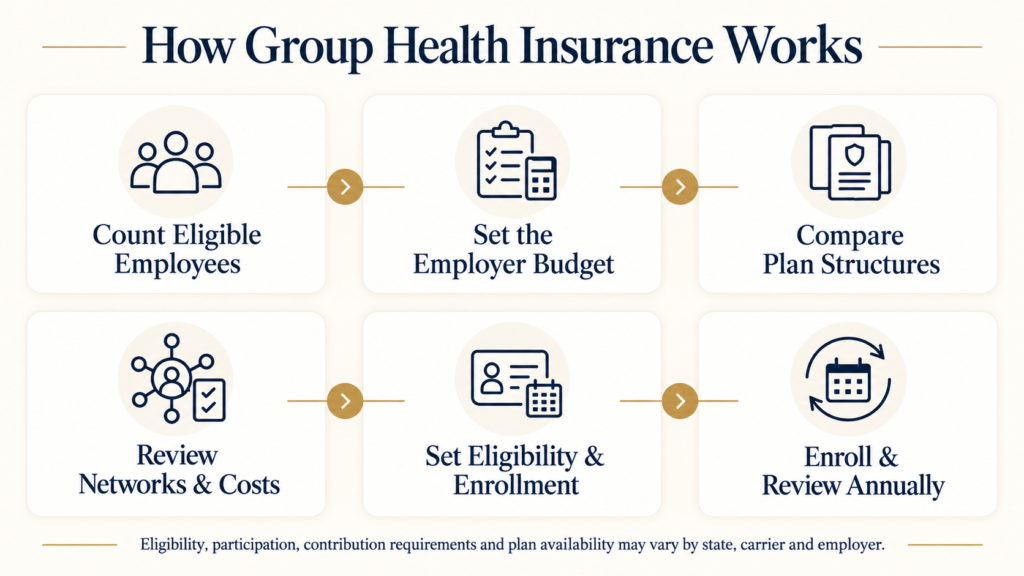
How Does Group Health Insurance Work Step by Step?
1. Determine Who Is Eligible
Start by identifying owners, full-time employees, part-time employees, seasonal workers and any employees located in other states.
Employee classification matters because different rules use different definitions of full-time employees and full-time equivalents.
For SHOP purposes, full-time employees generally work 30 or more hours per week, while part-time hours can be relevant when calculating the company’s number of FTEs.
2. Establish a Realistic Employer Budget
The employer decides how much it is prepared to contribute toward employee premiums.
Do not compare plans using the total premium alone. Model:
- Employer monthly cost
- Employee payroll contribution
- Employee-only coverage
- Spouse coverage
- Child coverage
- Family coverage
- Deductibles
- Copayments
- Coinsurance
- Out-of-pocket maximums
A lower-premium plan may shift substantially more cost to employees when they actually need healthcare.
3. Prepare the Employee Census
Insurers and benefits professionals generally need workforce information to determine available options and rates.
The information required depends on the plan and state, but the process may consider items such as employee age, ZIP code, dependent enrollment and employment status.
Avoid collecting unnecessary medical or sensitive information unless it is legitimately required for a specific arrangement and handled through an appropriate secure process.
4. Compare More Than the Premium
Compare the complete employee experience:
- Provider network
- Hospitals
- Primary-care access
- Specialist access
- Prescription drug formulary
- Deductible
- Copays
- Coinsurance
- Out-of-pocket maximum
- Emergency coverage
- Out-of-area access
- Telehealth
- HSA eligibility
- Dependent coverage
A cheaper plan is not necessarily better if the providers or medications employees actually use are outside the network or formulary.
5. Compare Funding Structures
Employers may have access to fully insured, level-funded or self-funded arrangements depending on their location, workforce and eligibility.
These structures handle claims risk differently and should not be compared using premium alone.
6. Establish Eligibility and Enrollment Rules
Determine:
- Which employee classes are eligible
- When new hires become eligible
- Whether dependents can enroll
- Employee contribution amounts
- Enrollment deadlines
- Required notices and plan documents
Federal law generally prohibits a group health plan from imposing a waiting period longer than 90 days once an employee is otherwise eligible for coverage.
7. Enroll Employees
Eligible employees receive plan information and choose whether to enroll.
For SHOP coverage, eligible small employers can generally begin coverage during the year rather than waiting for the individual Marketplace Open Enrollment Period.
8. Review the Plan at Every Renewal
The plan that worked last year may not remain the best fit.
Review:
- Renewal premium
- Employee contribution
- Network changes
- Prescription formulary
- Plan design
- Employee participation
- Workforce geography
- Alternative funding structures
The objective should be sustainable coverage for both the employer and employees — not simply accepting the existing plan automatically.
Who Can Offer Group Health Insurance?
The answer depends partly on company size and state rules.
Small Employers
SHOP generally serves businesses with 1–50 FTEs, although some states may extend eligibility to businesses with up to 100 employees. A SHOP-eligible business must generally have at least one FTE employee who is not an owner, owner’s spouse, certain family member or partner.
A business owner with no employees generally uses the individual health insurance market rather than SHOP.
Group coverage available outside SHOP can have additional state and carrier eligibility rules.
Applicable Large Employers
An employer averaging at least 50 full-time employees, including full-time-equivalent employees, during the previous calendar year is generally an Applicable Large Employer under the ACA.
ALE status carries additional employer shared-responsibility and reporting obligations.
This distinction is one reason a company should count its workforce carefully rather than assuming that “fewer than 50 people on payroll” automatically resolves the question.
What Does Small Group Health Insurance Cover?
Non-grandfathered health insurance coverage in the individual and small-group markets must cover the Affordable Care Act’s Essential Health Benefits.
Those categories include:
- Ambulatory patient services
- Emergency services
- Hospitalization
- Maternity and newborn care
- Mental-health and substance-use-disorder services
- Prescription drugs
- Rehabilitative and habilitative services
- Laboratory services
- Preventive and wellness services
- Pediatric services, including pediatric oral and vision care
Specific covered services are influenced by each state’s Essential Health Benefits benchmark and the particular plan.
Adult dental and vision benefits may be offered separately rather than being included in the medical plan.
Large-group and self-funded arrangements can operate under different benefit requirements, so employers should always review the actual plan documents.
How Much Does Group Health Insurance Cost for a Small Business?
There is no reliable national quote that applies to every small company.
For ACA-regulated individual and small-group coverage, federal rating rules generally limit premium variation to factors such as age, tobacco use within applicable limits, family size and geography. States can impose stronger protections. Health status, pre-existing conditions and claims history cannot be used as premium rating factors in the same way they were before the ACA in the fully insured small-group market.
Actual employer and employee costs also depend on:
- Plan design
- Provider network
- Carrier and product
- Geographic rating area
- Employee ages
- Dependent enrollment
- Employer contribution strategy
- Funding arrangement
- Deductible and cost-sharing structure
National Cost Context
The latest KFF Employer Health Benefits Survey available at the time of this review reported that, in 2025, average annual premiums for firms with 10–199 workers were approximately:
| Coverage | Average Annual Premium |
|---|---|
| Single coverage | $9,211 |
| Family coverage | $26,054 |
These figures are national averages, not quotes, and should not be used to predict the cost for a specific company. KFF also changed its 2025 methodology and no longer included employers with fewer than 10 workers in this portion of its survey, which is especially important when evaluating very small businesses.
The correct way to evaluate cost is to compare actual options using the company’s location and employee census.
How Much Does the Employer Have to Pay?
There is not one universal federal rule requiring every small employer to pay exactly the same percentage of every employee’s health insurance premium.
Contribution requirements can depend on:
- Carrier rules
- State rules
- SHOP requirements
- Plan structure
- Tax-credit eligibility
- Employer strategy
However, employers seeking the federal Small Business Health Care Tax Credit generally must pay at least 50% of the employee-only premium under a qualifying arrangement.
This is why statements such as “every employer must always pay 50%” are too broad.
What Are Employee Participation Requirements?
Participation rules matter because an employer can select a plan and still be unable to implement it if too few eligible employees enroll.
For SHOP, at least 70% of employees offered coverage must generally enroll or have qualifying coverage elsewhere in most states. Some states use different minimum participation rates. See the current HealthCare.gov SHOP eligibility guidance.
SHOP also provides an annual period from November 15 through December 15 when the minimum participation requirement does not apply.
Private carriers and non-SHOP arrangements can use different participation rules.
Before choosing a plan, employers should therefore determine how many employees genuinely intend to enroll.
Does a Small Business Have to Offer Health Insurance?
At the federal level, a business averaging fewer than 50 full-time employees, including full-time equivalents, during the preceding year generally is not subject to the ACA employer shared-responsibility provisions.
Businesses that reach ALE status generally face different responsibilities.
An ALE may potentially owe an employer shared-responsibility payment if it fails to offer minimum essential coverage to at least 95% of its full-time employees and their dependents and at least one full-time employee receives a Marketplace premium tax credit. Different potential payments can also apply when the offered coverage is not affordable or does not provide minimum value.
For plan years beginning in 2026, the ACA affordability percentage used for determining affordability is 9.96%, subject to the applicable affordability rules and safe harbors. This percentage is adjusted annually and must be checked again before future publication updates. See the IRS affordability guidance.
State laws and insurance requirements may add other obligations.
HMO vs. EPO vs. PPO vs. HDHP: What Should a Business Compare?
Plan labels matter, but employers should look beyond the acronym.
| Plan Type | Typical Network Approach | Out-of-Network Coverage | Main Consideration |
|---|---|---|---|
| HMO | More structured network | Generally limited except emergencies | Often emphasizes coordinated in-network care |
| EPO | In-network provider network | Generally limited except emergencies | Network access should be checked carefully |
| PPO | Broader provider flexibility | Often available at higher member cost | Usually greater flexibility but potentially higher premiums |
| HSA-Qualified HDHP | Depends on underlying network | Depends on plan | Higher deductible structure with potential HSA eligibility |
Individual plans can differ considerably even when they share the same network label.
Before selecting a plan, verify:
- Which doctors participate?
- Which hospitals participate?
- Are referrals required?
- Are employees spread across multiple geographic areas?
- What is the prescription formulary?
- What happens when an employee needs care outside the service area?
- Is the plan HSA-qualified?
Do not choose an HMO, EPO or PPO solely because one acronym sounds better.
Fully Insured vs. Level-Funded vs. Self-Funded Health Plans
One of the most important decisions may be how the plan is funded, not simply which insurance company appears on the card.
| Structure | Basic Approach | Employer Risk | Administration |
|---|---|---|---|
| Fully Insured | Employer pays a premium and insurer assumes covered claims risk | More predictable transfer of claims risk | Generally simpler |
| Level-Funded | Monthly amount generally combines projected claims funding, administration and stop-loss protection | More employer involvement than traditional fully insured coverage | More complex |
| Self-Funded | Employer finances covered claims, typically using administrative services and often stop-loss protection | Greater direct claims exposure | Greater administration and compliance responsibility |
Fully Insured
Fully insured coverage is the traditional arrangement.
The employer pays the required premium and the insurance carrier assumes responsibility for covered claims according to the contract.
For many small employers, the simplicity and predictability can be attractive.
Level-Funded
Level-funded arrangements combine features of traditional insurance and self-funding.
A monthly payment may include:
- Expected claims funding
- Administrative expenses
- Stop-loss coverage
Depending on the contract, unused claims funding may be handled differently at the end of the plan period.
Level-funded plans should never be presented as guaranteed savings. Eligibility, underwriting, contract terms, stop-loss provisions and potential refunds vary.
Self-Funded
With a self-funded plan, the employer assumes greater responsibility for financing employee claims, usually with a third-party administrator and often stop-loss insurance.
This approach can provide more control but introduces additional financial, administrative and compliance considerations.
Employers should compare the complete contract and risk structure — not merely the initial monthly number.
Traditional Group Health Insurance vs. ICHRA vs. QSEHRA
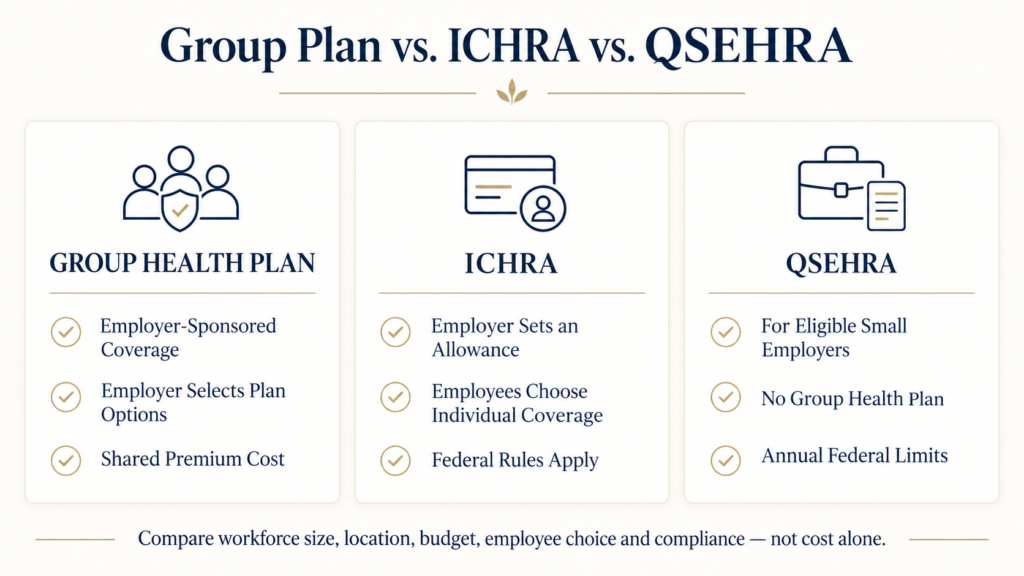
A traditional group plan is no longer the only formal way an employer may help employees obtain health coverage.
Traditional Group Health Plan
The employer selects group coverage and contributes toward the premium.
This can make sense when employees share similar geographic and network needs and the employer wants a standardized benefits program.
ICHRA
An Individual Coverage Health Reimbursement Arrangement allows an employer to reimburse eligible employees, tax-free within applicable rules, for individual health insurance premiums and qualifying medical expenses up to the amount established by the employer.
Employers of different sizes may establish an ICHRA when eligibility requirements are satisfied. Employees must have qualifying individual health coverage to use the arrangement.
ICHRA rules can also affect an employee’s eligibility for Marketplace premium tax credits, so the interaction should be evaluated carefully.
QSEHRA
A Qualified Small Employer Health Reimbursement Arrangement is available to certain small employers that are not Applicable Large Employers and that do not offer a group health plan.
For 2026, the federal maximum permitted benefit is:
- $6,450 for self-only coverage
- $13,100 when family reimbursements are available
The limits are adjusted periodically.
Quick Comparison
| Feature | Group Health Plan | ICHRA | QSEHRA |
|---|---|---|---|
| Coverage purchased | Employer-sponsored group coverage | Individual coverage | Individual coverage |
| Employer approach | Contributes toward group premium | Sets reimbursement allowance | Sets reimbursement allowance within annual limit |
| Employee plan choice | Employer-selected options | Individual-market options | Individual-market options |
| Employer size | Depends on market and plan | Generally employers of any size subject to rules | Eligible small employers |
| Can coexist with traditional group coverage? | — | Possible for different eligible employee classes under applicable rules | No group health plan can be offered |
| Federal reimbursement cap | Not applicable in same way | No general ICHRA dollar cap, subject to plan rules | Annual federal limit |
None of these structures is universally better.
The comparison should consider cost, employee choice, Marketplace subsidy interactions, workforce geography, administrative requirements and compliance.
What About Remote Employees in Different States?
A growing business may have employees in Florida, New York, Texas, California or several other states.
That creates additional questions:
- Does the group plan have usable networks in every employee location?
- Is the plan’s service area limited?
- Are separate state arrangements necessary?
- Do employees need national provider access?
- Are state continuation laws different?
- Would an ICHRA create more individual choice?
- Does the employer have a worksite in the state where it wants SHOP coverage?
SHOP requires the employer to have an office or employee worksite within the state whose SHOP coverage it wants to use. HealthCare.gov also provides separate guidance for employers operating in multiple states.
A plan that works extremely well for employees near the company’s headquarters can be frustrating for a remote employee if the provider network does not extend effectively to that employee’s area.
Network geography should therefore be reviewed before enrollment — not after an employee needs care.
New Hires, Waiting Periods and COBRA
Waiting Periods
Once an employee is otherwise eligible for the plan, federal rules generally prohibit a waiting period longer than 90 days.
This does not mean every employee must automatically be eligible for coverage from the first day of employment. Eligibility conditions and employee classifications must still comply with applicable law.
COBRA
Federal COBRA generally applies to group health plans sponsored by private-sector employers that had at least 20 employees on more than half of their typical business days during the previous calendar year, as well as most state and local governmental plans. See the U.S. Department of Labor COBRA guidance.
COBRA allows qualified beneficiaries to continue group coverage temporarily after certain qualifying events, generally at their own expense.
Smaller employers may be subject to state continuation or “mini-COBRA” requirements even when federal COBRA does not apply.
State-specific rules should always be reviewed.
Can a Small Business Receive a Health Insurance Tax Credit?
Some small employers may qualify for the federal Small Business Health Care Tax Credit.
Eligibility generally involves several requirements, including:
- Fewer than 25 full-time-equivalent employees
- Average employee wages below an inflation-adjusted threshold
- Employer payment of at least 50% of employee-only premium costs under a qualifying arrangement
- Qualifying SHOP coverage in most circumstances
For eligible taxable employers, the maximum credit can be up to 50% of qualifying employer premium payments. For qualifying tax-exempt employers, the maximum can be up to 35%.
The credit is generally available for two consecutive taxable years.
Eligibility and the actual credit should be confirmed with a qualified tax professional.
Potential Advantages of Group Health Insurance
A properly structured plan may help a business:
- Build a more competitive employee benefits package
- Support recruiting and retention
- Give employees access to employer-sponsored coverage
- Share premium costs between employer and employees
- Offer a standardized benefit program
- Integrate medical coverage with dental, vision, life and supplemental benefits
- Potentially use tax-advantaged benefit structures when properly established
Benefits should be evaluated against actual cost and employee needs rather than assumed.
Trade-Offs Employers Should Consider
Group health insurance also introduces responsibilities and potential limitations.
Ongoing Employer Cost
Health insurance can represent a significant and recurring employee-benefit expense.
Renewal Changes
Premiums, networks, formularies and plan designs can change at renewal.
Participation Requirements
A small group may have difficulty meeting participation rules if several employees already receive insurance elsewhere.
Employee Contribution
A plan can technically be available but still feel unaffordable to employees if their payroll contribution is too high.
Provider Network
A narrow network can substantially affect the value employees receive from the plan.
Administration
Enrollment, new hires, terminations, notices, COBRA or state continuation, payroll deductions and annual renewals require ongoing management.
Multi-State Complexity
Remote employees can make network and state compliance issues more complicated.
One Plan May Not Fit Everyone
Employees differ in doctors, prescriptions, family structures and financial preferences.
That is why employers should compare both traditional group coverage and legitimate alternative benefit structures when appropriate.
Who May Consider Group Health Insurance?
Group coverage may be worth evaluating for businesses that:
- Have eligible common-law employees
- Want to compete for employees through benefits
- Can support a recurring health-benefit budget
- Prefer an employer-sponsored plan structure
- Have employees concentrated in a usable provider-network area
- Want to integrate medical insurance into a broader employee benefits package
- Are approaching ACA employer-size thresholds and need stronger benefits planning
The decision should be based on actual workforce data rather than a generic rule.
When Might a Traditional Group Plan Not Be the Best Fit?
A traditional plan may deserve additional comparison when:
- The business has no eligible employees other than the owner
- Employee participation is very low
- Employees are widely dispersed across states
- Available group networks do not serve the workforce well
- The employer needs a more defined reimbursement budget
- Individual-market choices differ significantly across employee locations
- The company is evaluating an ICHRA or QSEHRA strategy
“Not the best fit” does not automatically mean that an alternative will cost less.
Each option should be modeled before a decision is made.
Practical Example
Consider a hypothetical professional-services company with 12 employees.
Most employees work in Florida, but several work remotely in other states. The company wants to begin offering health benefits to improve recruiting and retention while maintaining a manageable employer budget.
Instead of selecting the plan with the lowest premium immediately, the company compares:
- A fully insured small-group option
- Available HMO, EPO or PPO networks
- A level-funded alternative, if eligible
- An ICHRA strategy
- Employer contributions under each structure
- Employee payroll costs
- Deductibles and out-of-pocket maximums
- Prescription coverage
- Provider access for remote employees
- Administrative responsibilities
The least expensive group plan has a narrower provider network.
Another group option costs more but better serves the employees’ geographic locations.
An ICHRA provides employees with greater individual-market choice but changes how employees select and manage their own coverage.
There is no automatic winner.
The employer compares the total cost, employee experience, network access and compliance requirements before choosing.
This example is hypothetical and does not represent a quote, recommendation, guarantee of savings or guarantee of coverage.
Questions to Ask Before Choosing a Small Business Health Plan
Before enrolling, ask:
- How many employees are eligible?
- How many are likely to enroll?
- What percentage of the premium will the employer pay?
- What will employees pay for employee-only coverage?
- What will employees pay to cover dependents?
- Which doctors and hospitals are in network?
- Are the most commonly used prescriptions covered?
- What are the deductible and out-of-pocket maximum?
- Does the network work for remote employees?
- Are referrals required?
- Is out-of-network care covered?
- Is the plan HSA-qualified?
- What changes at renewal?
- What administrative responsibilities does the employer have?
- Do COBRA or state continuation requirements apply?
- Could the business qualify for the Small Business Health Care Tax Credit?
- Should a fully insured plan be compared with level-funded coverage?
- Should the business compare a traditional group plan with ICHRA or QSEHRA?
The best comparison is not simply “Which premium is lowest?”
It is:
Which structure creates the most sustainable balance between employer cost, employee cost, coverage and access to care?
Frequently Asked Questions
How many employees do you need for group health insurance?
For SHOP, an employer generally needs 1–50 FTEs and at least one FTE employee other than owners, spouses, certain family members of owners or partners. Other small-group eligibility rules can vary by state and carrier.
Can a business with only one employee get group health insurance?
Potentially, depending on who the employee is, the state and the market. For SHOP, the business must have at least one qualifying FTE employee other than an owner, owner’s spouse, certain family member or partner. An owner-only business generally looks to the individual market instead.
Does a small business have to pay 50% of employee health insurance?
There is no single federal 50% contribution rule that applies identically to every small-group arrangement. However, paying at least 50% of employee-only premiums is one of the requirements associated with the federal Small Business Health Care Tax Credit. Carrier and state requirements may differ.
Can a small business start group health insurance at any time?
Eligible employers can generally start SHOP coverage during the year without waiting for the individual Marketplace Open Enrollment Period. Other plan effective-date and enrollment requirements vary.
Can pre-existing conditions increase small-group premiums?
For ACA-regulated fully insured small-group coverage, health status, medical history and claims experience cannot be used as premium rating factors. Premium rules for other funding structures can operate differently.
Do part-time employees count?
Part-time employees can affect FTE calculations used for SHOP eligibility and ALE determinations. Under SHOP rules, employers generally do not have to offer coverage to employees averaging fewer than 30 hours per week, although they may choose to do so when the plan permits.
Can remote employees participate in group health insurance?
They may be able to, but the plan’s service area, provider network, state availability and employer structure must be reviewed. Multi-state employers should evaluate coverage where employees actually live and obtain care.
Is ICHRA the same as group health insurance?
No. A traditional group plan is employer-sponsored group coverage. With an ICHRA, eligible employees generally obtain their own individual health coverage and the employer reimburses eligible expenses up to an established allowance under applicable rules.
Is group health insurance always cheaper than individual insurance?
No. Costs depend on the employer, employees, location, plan design, available individual-market options, possible Marketplace assistance, employer contributions and other factors.
Neither market should automatically be assumed to be cheaper.
Compare Your Options With Clear Guidance
Choosing employee health benefits should start with your workforce, budget and coverage priorities — not with a predetermined product.
A careful review can compare traditional group health insurance, plan networks, employer contributions and other available benefit structures so you can understand the trade-offs before making a decision. For more educational resources, visit our Learning Center.
Important Disclosure
This material is provided for general educational purposes only and is not legal, tax, accounting or individualized insurance advice.
Insurance availability, eligibility, benefits, premiums, underwriting, funding arrangements, provider networks, employer contribution requirements and participation requirements vary by insurer, plan, employer size and state.
Federal and state rules may change. Employers should consult appropriate insurance, legal, tax, payroll and employee-benefits professionals regarding their specific circumstances.
Insurance products and services should be offered only in jurisdictions where the applicable professional or agency is properly licensed and authorized.