
Private Health Insurance Outside the Marketplace: Options, Costs & What to Know
Private health insurance can give individuals and families additional ways to obtain health coverage — but the phrase “private health insurance” is often misunderstood.
A plan purchased outside the Health Insurance Marketplace is not automatically a PPO, it is not automatically available year-round, and it is not automatically cheaper or better than an ACA Marketplace plan.
Some private plans sold outside the Marketplace are ACA-compliant comprehensive major-medical plans. Others may be short-term, medically underwritten or limited-benefit products with very different protections.

Understanding that distinction is essential before comparing price.
This guide explains how private health insurance outside the Marketplace works, which types of coverage may be available, how ACA-compliant and non-ACA options differ, what happens with pre-existing conditions, when underwriting may apply and what to verify before enrolling.
Availability, eligibility, underwriting, networks, benefits, enrollment periods and plan types vary by state and insurer.
Table of Contents
Quick Answer: What Is Private Health Insurance Outside the Marketplace?
Private health insurance outside the Marketplace is individual health coverage purchased directly from an insurance company or through an authorized agent, broker or private enrollment platform rather than through HealthCare.gov or a state-based ACA Marketplace.
But there are two important distinctions.
A private plan sold outside the Marketplace may be:
ACA-compliant individual major-medical coverage, with many of the same federal consumer protections that apply to Marketplace coverage;
or
non-ACA or limited coverage, which may operate under very different rules concerning underwriting, pre-existing conditions, benefits, renewability and enrollment.
HealthCare.gov confirms that private plans can be purchased outside the Marketplace, but premium tax credits and other income-based Marketplace savings are not available when coverage is purchased outside the Marketplace.
Learn about private plans outside the Marketplace — HealthCare.gov
The first question should therefore not be:
“Is this private insurance?”
It should be:
“What type of private insurance is this, and which rules apply to it?”
What Does “Private Health Insurance” Actually Mean?
The phrase is broader than many people realize.
Most health coverage in the United States is administered or issued by private insurance companies. Private insurance includes employer-sponsored coverage, individual policies purchased directly from insurers and ACA Marketplace plans issued by participating private insurers.
In other words:
Marketplace insurance is also private insurance.
The important difference for this page is where and how individual coverage is purchased.
An off-exchange or off-Marketplace plan is purchased without completing the enrollment through the federal or state ACA Marketplace.
That distinction affects issues such as:
- eligibility for Premium Tax Credits;
- enrollment;
- plan selection;
- consumer protections;
- underwriting;
- available networks;
- benefit requirements.
It does not, by itself, tell you whether the coverage is comprehensive.
How Does Private Health Insurance Work Step by Step?
1. Identify Why You Are Shopping Outside the Marketplace
Start with the reason.
You may be:
- self-employed;
- not offered employer coverage;
- ineligible for Marketplace subsidies;
- evaluating a carrier or network unavailable through your Marketplace;
- between major-medical enrollment opportunities;
- comparing comprehensive and temporary coverage.
The reason matters because different solutions address different problems.
2. Determine Whether You Need Comprehensive Major-Medical Coverage
Ask whether you need protection for potentially significant healthcare expenses such as:
- hospitalization;
- surgery;
- prescriptions;
- chronic conditions;
- specialist care;
- emergency treatment;
- maternity;
- mental-health treatment.
If so, confirm whether the plan is comprehensive medical coverage rather than assuming that from the advertisement.
3. Identify Whether the Plan Is ACA-Compliant
This is one of the most important questions on the page.
Ask directly:
“Is this ACA-compliant individual major-medical insurance?”
If the answer is no, determine exactly which federal and state protections do and do not apply.
4. Understand Whether Medical Underwriting Applies
ACA-compliant individual plans cannot price or deny coverage based on an applicant’s health history in the way medically underwritten products can.
Certain non-ACA private products may ask detailed health questions and can apply different eligibility or coverage rules.
Never hide or misrepresent medical information during underwriting.
5. Compare the Actual Benefits
Review:
- deductible;
- copays;
- coinsurance;
- out-of-pocket exposure;
- hospital coverage;
- physician services;
- prescriptions;
- preventive care;
- mental-health coverage;
- maternity;
- exclusions;
- annual or benefit limits.
6. Verify Doctors, Hospitals and Prescriptions
Do not rely on the insurance-company name.
Verify the exact plan and exact network.
A company may operate multiple networks with substantially different providers.
7. Review the Summary of Benefits and Coverage
For applicable health insurance coverage, request the Summary of Benefits and Coverage, or SBC.
The SBC was designed to help consumers compare costs and coverage using standardized information.
Learn how to use a Summary of Benefits and Coverage — HealthCare.gov
8. Confirm the Effective Date
Do not cancel existing coverage until new coverage is approved when approval is required and the effective date is confirmed.
Types of Private Health Insurance Outside the Marketplace
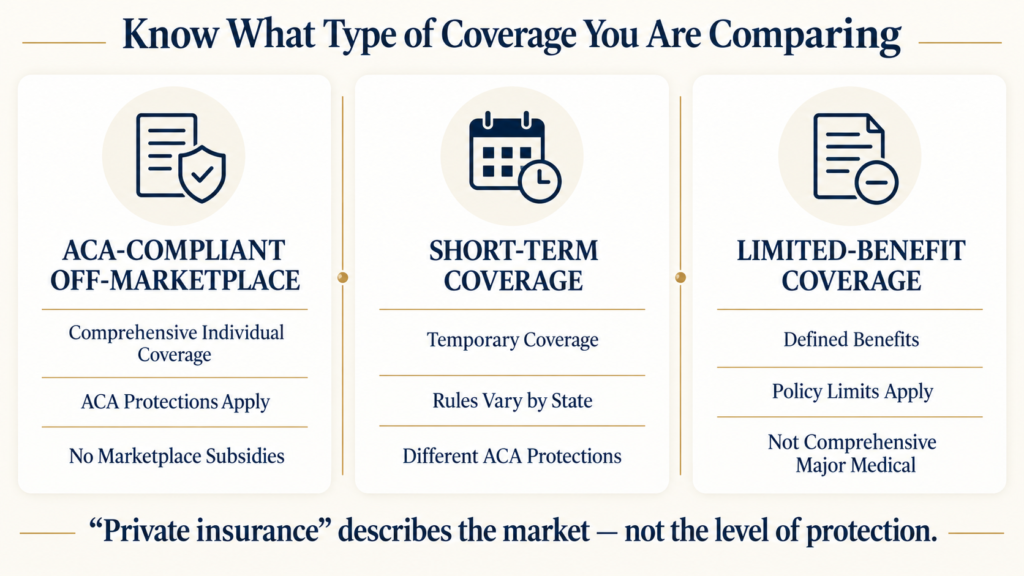
This is where the terminology becomes particularly important.
ACA-Compliant Off-Marketplace Health Insurance
Some insurers offer individual major-medical plans directly outside the Marketplace that comply with ACA individual-market standards.
These plans may provide protections concerning areas such as:
- pre-existing conditions;
- Essential Health Benefits;
- annual and lifetime limits on Essential Health Benefits;
- applicable preventive services;
- other ACA individual-market protections.
KFF confirms that ACA-compliant plans can be sold outside the Marketplace and may meet the same ACA consumer-protection standards as Marketplace plans. However, Marketplace Premium Tax Credits and cost-sharing subsidies are unavailable when the plan is purchased off-Marketplace.
An off-Marketplace ACA plan can therefore be comprehensive without being a Marketplace plan.
That distinction is frequently misunderstood.
Short-Term Limited-Duration Insurance
Short-term health insurance is intended primarily to address temporary gaps in coverage.
It generally is not subject to the same ACA individual-market requirements as comprehensive ACA-compliant coverage.
Depending on the plan and applicable law, limitations can involve:
- pre-existing conditions;
- prescription coverage;
- maternity;
- mental-health care;
- benefit limits;
- renewability;
- medical underwriting.
There is also a particularly important 2026 regulatory issue.
The 2024 federal regulations narrowed the federal definition of short-term limited-duration insurance. However, in August 2025, the Departments of Labor, HHS and Treasury announced that, pending additional rulemaking, they did not intend to prioritize enforcement concerning failures to meet that 2024 federal definition and encouraged states to consider a similar approach. State law therefore remains particularly important.
For that reason SAG should not publish a universal statement such as “all short-term plans last exactly three months”.
Duration and availability must be checked using current federal and state rules at the time of application.
Fixed Indemnity and Limited-Benefit Coverage
Fixed indemnity insurance generally pays defined dollar benefits when specified covered events occur.
For example, a policy may provide a predetermined benefit related to hospitalization or another covered event according to its contract.
That is different from a comprehensive major-medical plan designed to pay covered medical expenses according to a provider network, deductible, coinsurance and out-of-pocket maximum structure.
Federal guidance classifies qualifying hospital indemnity and other fixed indemnity coverage as an excepted benefit, meaning that it is not subject to all of the federal consumer protections applying to comprehensive health coverage.
These products can have legitimate uses.
They should not be presented as if they automatically replace comprehensive medical insurance.
Other Arrangements That Are Not Health Insurance
Consumers may also encounter products or arrangements advertised alongside health insurance.
Examples can include:
- healthcare sharing ministries;
- discount programs;
- direct-primary-care memberships;
- medical discount cards.
Some can potentially help with healthcare costs.
But they should not automatically be described as insurance.
NAIC specifically cautions consumers that healthcare sharing ministries, discount plans and certain risk-sharing arrangements do not provide the same insurance protections.
Private Health Insurance vs. ACA Marketplace: What Is the Difference?
This is one of the most important comparisons on the page.
| Feature | ACA Marketplace | ACA-Compliant Off-Marketplace | Non-ACA / Limited Private Coverage |
|---|---|---|---|
| Issued by private insurer | Yes | Yes | Usually |
| Marketplace enrollment | Yes | No | No |
| Premium Tax Credit | Potentially | No | No |
| ACA consumer protections | Yes | Yes, if ACA-compliant | Not necessarily |
| Pre-existing condition protection | Yes | Yes, if ACA-compliant | May not apply |
| Essential Health Benefits | Required for applicable plans | Required for ACA-compliant individual plans | May not be required |
| Medical underwriting | No health-status underwriting | No health-status underwriting if ACA-compliant | May apply |
| Enrollment restrictions | OE / SEP rules | Generally ACA enrollment rules | Depends on product and state |
| Year-round availability | Not generally without SEP | Not generally for standard ACA-compliant coverage | Some products may allow it |
| Network | Plan-specific | Plan-specific | Plan-specific |
| Comprehensive major medical | Yes | Yes, if qualifying ACA plan | Not always |
The key point is:
“Marketplace vs. private” is not the most accurate comparison.
A better comparison is:
Marketplace ACA coverage vs. off-Marketplace ACA-compliant coverage vs. non-ACA private coverage.
Does Private Health Insurance Cover Pre-Existing Conditions?
It depends on the type of plan.
ACA-Compliant Coverage
ACA-compliant individual major-medical plans must follow federal protections concerning pre-existing conditions.
Marketplace plans cannot reject an applicant, charge more or refuse Essential Health Benefit coverage because of a pre-existing medical condition.
ACA-compliant individual coverage sold off-Marketplace is also subject to applicable ACA individual-market protections.
Non-ACA Coverage
Certain non-ACA products may:
- ask medical questions;
- deny applications;
- exclude pre-existing conditions;
- impose benefit limitations;
- use medical underwriting.
That does not automatically make the product illegitimate.
It means it should not be confused with ACA-compliant comprehensive coverage.
Can You Buy Private Health Insurance at Any Time?
Sometimes — but not always.
This is another area where online advertising can be misleading.
Standard ACA-compliant individual major-medical coverage generally has enrollment rules connected to annual Open Enrollment or qualifying Special Enrollment circumstances.
HealthCare.gov notes that only in limited circumstances are private plans sold outside Open Enrollment considered qualifying comprehensive coverage, and that most plans being sold outside Open Enrollment do not count as qualifying health coverage.
Certain non-ACA products may offer year-round applications.
That does not mean they provide the same coverage.
Therefore:
Year-round availability should never be used as proof that a plan is equivalent to ACA major-medical insurance.
How Much Does Private Health Insurance Cost?
There is no meaningful national quote that applies to everyone.
Costs depend on the type of coverage.
ACA-Compliant Off-Marketplace Pricing
ACA-compliant individual-market premiums generally use permitted rating factors rather than an applicant’s medical history.
Relevant factors can include:
- age;
- geographic area;
- family composition;
- tobacco use where permitted;
- plan structure.
You cannot receive a Marketplace Premium Tax Credit when purchasing outside the Marketplace.
That means someone eligible for substantial Marketplace assistance should carefully compare the net Marketplace premium, not simply the full sticker price.
Medically Underwritten or Non-ACA Pricing
Some non-ACA private products may use medical underwriting.
A healthy applicant may sometimes receive an attractive initial premium, but that price cannot be evaluated separately from:
- exclusions;
- benefits;
- provider network;
- prescription coverage;
- policy limits;
- renewability;
- underwriting;
- potential out-of-pocket exposure.
A lower monthly premium does not necessarily represent a lower overall financial risk.
How to Compare Private Health Insurance Plans
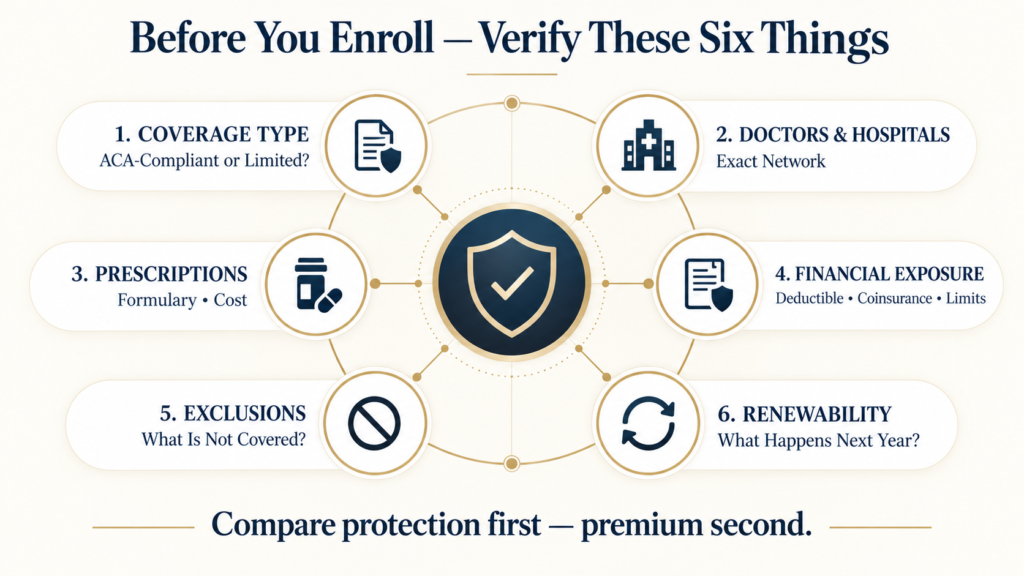
A serious comparison should evaluate at least six areas.
Provider Network
Confirm your actual:
- primary-care physician;
- specialists;
- hospitals;
- urgent-care facilities.
Do not ask only:
“Does this company have PPO plans?”
Ask:
“Is this specific provider participating in this exact plan network?”
A plan purchased privately is not automatically a PPO.
Prescription Coverage
Review:
- formulary;
- drug tiers;
- deductible;
- copay or coinsurance;
- prior authorization;
- specialty-drug rules.
If you take regular medication, do this before enrollment.
Deductible and Out-of-Pocket Exposure
Compare the cost when you actually need care.
A low premium paired with substantial uncovered expenses can create greater financial exposure than expected.
Hospital and Emergency Coverage
Ask how hospitalization and emergency services are handled.
Do not assume a benefit simply because the plan advertisement uses the word “medical.”
Exclusions and Limits
Read exclusions carefully.
Pay particular attention to:
- pre-existing conditions;
- maternity;
- mental health;
- prescriptions;
- preventive care;
- annual limits;
- benefit caps;
- waiting periods.
Renewability
Ask:
Can this coverage be renewed?
Can the contract terms change?
What happens if I develop a major condition?
The answers can be very different across private health products.
Is Private PPO Health Insurance Available?
Sometimes.
But “private insurance” and “PPO” are not synonyms.
PPO describes a network structure.
Private insurance describes how insurance is funded or purchased.
An off-Marketplace plan can use:
- PPO;
- EPO;
- HMO;
- another network structure.
PPO availability varies by insurer, state and area.
Never select a plan simply because the word PPO appears in its marketing.
Check:
- exact doctors;
- exact hospitals;
- out-of-network deductible;
- out-of-network coinsurance;
- balance-billing exposure;
- service area.
This is an excellent place to internally link to our Health Insurance guide covering HMO vs. EPO vs. PPO in greater detail.
Private Health Insurance for Self-Employed People
Self-employed individuals represent one of the strongest search-intent groups for this page.
A freelancer, independent contractor, realtor, consultant or business owner without access to employer-sponsored coverage may evaluate:
- ACA Marketplace coverage;
- ACA-compliant off-Marketplace coverage;
- other private coverage where legally available;
- spouse or partner employer coverage;
- potentially group coverage if the business later has qualifying employees.
Self-employed individuals should not assume they are automatically better off outside the Marketplace.
Marketplace financial assistance depends on actual household and tax circumstances.
Separately, federal tax rules may allow qualifying self-employed individuals to deduct certain health-insurance premiums, subject to the applicable requirements and limitations. IRS Form 7206 is used to determine the allowable self-employed health-insurance deduction.
Tax eligibility should be confirmed using current IRS guidance or a qualified tax professional.
Who May Consider Private Health Insurance Outside the Marketplace?
It may deserve comparison when someone:
- does not receive useful Marketplace financial assistance;
- wants to investigate an ACA-compliant plan sold directly by an insurer;
- wants to compare networks unavailable through Marketplace offerings;
- is self-employed;
- is transitioning between coverage arrangements;
- understands the difference between comprehensive and limited coverage;
- can evaluate underwriting and exclusions when applicable.
It should be a comparison, not a predetermined recommendation.
When Private Health Insurance May Not Be a Good Fit
An off-Marketplace option may deserve particular caution when:
- you qualify for meaningful Marketplace subsidies;
- you have significant pre-existing medical needs and the proposed plan is not ACA-compliant;
- you regularly take expensive prescriptions;
- you expect pregnancy or substantial medical treatment;
- the plan has unclear hospital benefits;
- annual or benefit limits could create significant exposure;
- the network does not include your providers;
- the salesperson cannot clearly explain whether the plan is ACA-compliant;
- the plan is being sold primarily as “cheap PPO insurance” without detailed documentation.
A lower premium is not automatically better protection.
Practical Example: ACA Marketplace vs. Private Coverage
Consider a hypothetical self-employed 42-year-old professional.
The individual does not have employer health insurance and wants a broader provider network.
Three options are identified.
Option A is an ACA Marketplace plan that may qualify for financial assistance based on the applicant’s actual tax circumstances.
Option B is an ACA-compliant individual plan sold directly outside the Marketplace.
Option C is a medically underwritten private product with a lower advertised premium.
At first glance, Option C looks most attractive.
A closer review finds that the three plans differ significantly in:
- provider network;
- prescription coverage;
- deductible;
- pre-existing-condition rules;
- hospital benefits;
- enrollment requirements;
- maximum financial exposure.
Option B may have a network advantage but does not provide Marketplace Premium Tax Credits.
Option A may offer lower net premiums if the applicant qualifies for assistance.
Option C may cost less initially but contains limitations that require a different risk calculation.
There is no automatic winner.
The correct decision depends on the individual’s healthcare needs, eligibility, providers, prescriptions and ability to absorb uncovered expenses.
This example is hypothetical and is not a quote, recommendation or guarantee of coverage or savings.
Questions to Ask Before Buying Private Health Insurance
Before enrolling, ask:
- Is this ACA-compliant comprehensive major-medical insurance?
- Is this plan considered qualifying health coverage?
- Does medical underwriting apply?
- How are pre-existing conditions handled?
- What services are excluded?
- Are there annual or lifetime benefit limits?
- What is the monthly premium?
- What is the deductible?
- What is the maximum potential out-of-pocket exposure?
- Are my doctors in this exact network?
- Is my preferred hospital in network?
- Are my prescriptions covered?
- Is this HMO, EPO or PPO coverage?
- How does out-of-network coverage work?
- Can I renew the plan?
- Can the terms change at renewal?
- When does coverage begin?
- Is coverage available in my state?
- What happens if I become seriously ill?
- What alternative Marketplace coverage should I compare before deciding?
If those questions cannot be answered clearly, do not make the decision based only on price.
Frequently Asked Questions
Is private health insurance the same as ACA insurance?
Not necessarily.
ACA Marketplace plans are issued by private insurers, and private insurers can also sell ACA-compliant individual coverage outside the Marketplace.
Other private products may not be ACA-compliant.
Can I buy private health insurance outside HealthCare.gov?
Yes.
Certain individual plans can be purchased directly from insurance companies or through agents, brokers and private enrollment channels. However, Marketplace Premium Tax Credits are unavailable for coverage purchased outside the Marketplace
Is private health insurance always cheaper than Marketplace insurance?
No.
Cost depends on plan type, eligibility, benefits, underwriting, network and whether you qualify for Marketplace financial assistance.
Does private health insurance cover pre-existing conditions?
ACA-compliant individual coverage does.
Certain non-ACA products may apply exclusions or medical underwriting.
Always verify the actual contract.
Can private health insurance deny me because of my health?
ACA-compliant individual major-medical coverage cannot use health-status underwriting in that manner.
Certain non-ACA coverage may have different eligibility rules.
Can I buy private insurance any time of year?
Some products allow year-round applications.
Standard ACA-compliant individual major-medical coverage generally remains subject to applicable enrollment rules.
Does private health insurance mean PPO?
No.
Private health insurance can use different network structures.
Always verify the exact plan.
Is an off-exchange plan ACA-compliant?
It can be.
Some ACA-compliant individual plans are sold outside the Marketplace.
Other off-Marketplace products are not ACA-compliant.
Can I receive a subsidy on private insurance?
Premium Tax Credits are available only through qualifying Marketplace enrollment, not when purchasing coverage outside the Marketplace.
Is short-term health insurance the same as private major-medical insurance?
No.
Short-term insurance is a separate category and generally does not have to comply with all ACA individual-market requirements.
Are fixed indemnity plans comprehensive health insurance?
Generally no.
They provide defined benefits according to the contract and should not automatically be treated as replacements for comprehensive medical coverage.
What should I compare first?
Start with:
coverage type, network, prescriptions, financial exposure and exclusions – then compare premium.
Compare Your Coverage Options With Clear Guidance
Private health insurance can provide useful alternatives in the right circumstances, but the phrase “private plan” alone tells you very little about the protection you are buying.
Before enrolling, determine:
- whether coverage is ACA-compliant;
- whether underwriting applies;
- whether pre-existing conditions are covered;
- whether your providers participate;
- what prescriptions are covered;
- what financial exposure remains;
- whether Marketplace assistance changes the comparison.
The objective is not simply to find a lower monthly premium.
It is to understand what protection you are actually receiving for that premium.
Understand Your Workplace Retirement Options
If you are reviewing an existing workplace plan, leaving an employer, or comparing private health coverage options, schedule a no-obligation educational consultation.
conversation. We can help you organize the questions to ask and identify when a plan administrator, tax professional, ERISA attorney, or appropriately registered investment professional should be involved.