

Dental Insurance Plans for Individuals and Families
Dental insurance plans for individuals and families can help make preventive care more affordable and reduce part of the cost of fillings, crowns, root canals, dentures and other covered services. However, dental insurance is not designed like major medical insurance. The deductible, provider network, waiting periods, coverage percentages and annual benefit maximum can be just as important as the monthly premium.
Whether you are buying coverage independently, replacing an employer plan, comparing family benefits or looking for dental coverage during retirement, the right plan depends on the care you expect to use and the contract’s limitations.

Compare available dental coverage based on your state, preferred dentist, expected services and budget. Plan benefits, rates and availability vary.
Table of Contents
What Is Dental Insurance?
Dental insurance is coverage designed to pay or reimburse part of the cost of eligible dental care. Most plans emphasize preventive services and then share the cost of basic and major treatment according to a schedule of benefits.
A dental policy may be offered:
- Through an employer or association.
- As an individual or family policy purchased directly from an insurer.
- As dental coverage included in a medical plan.
- As a stand-alone dental plan offered with Marketplace health coverage.
- As an additional benefit through certain Medicare Advantage plans.
Coverage does not mean that every procedure is paid in full. Dental policies commonly use premiums, deductibles, copayments, coinsurance, provider networks, frequency limits, waiting periods and annual maximums. The policy and schedule of benefits determine what the plan actually pays.
How Does Dental Insurance Work?
You pay a premium to keep the policy active. When you receive a covered service, the plan calculates its payment using the applicable benefit category, the plan’s allowed amount, your deductible and any remaining annual benefit.
Monthly Premium
The premium is the amount charged to maintain coverage. It is separate from what you may owe when you receive treatment. A lower premium may come with a smaller network, lower benefits, longer waiting periods or a lower annual maximum.
Deductible
The deductible is the amount you must pay for certain covered services before the plan begins sharing eligible costs. Preventive services are sometimes exempt from the deductible, but this is not universal.
Copayment and Coinsurance
A copayment is a fixed amount listed for a covered service. Coinsurance is a percentage of the plan’s allowed amount. For example, if a plan pays 50% of an eligible major service, the member generally pays the remaining eligible portion after any deductible, subject to the annual maximum and other policy rules.
Annual Maximum
The annual maximum is generally the most the dental plan will pay for covered services during a benefit year. This works differently from a medical insurance out-of-pocket maximum. When the dental plan reaches its annual maximum, the member may be responsible for additional care for the rest of that benefit year.
Some plans apply a separate lifetime maximum to orthodontic services. Pediatric dental benefits governed by Affordable Care Act rules may use different cost-sharing structures.
Provider Network and Allowed Amount
In-network dentists agree to the plan’s contracted fee schedule. Using an out-of-network dentist may reduce the plan’s payment and may expose you to the difference between the dentist’s charge and the amount recognized by the policy.
Waiting Period
A waiting period is the time after coverage begins during which the policy does not yet pay for specified services. Preventive care may be available immediately while basic or major services require additional months of coverage. You still pay the premium during the waiting period.
Frequency and Replacement Limits
Plans may limit how often they cover cleanings, examinations, X-rays, crowns, dentures or replacement appliances. A procedure can be generally covered but still be ineligible because it was performed too recently under the policy’s frequency rules.
What Does Dental Insurance Typically Cover?
Dental plans often group care into preventive, basic and major services. The categories and percentages below are general examples—not guarantees.
| Coverage category | Services that may be included | Important limitations to review |
|---|---|---|
| Preventive and diagnostic | Exams, cleanings, routine X-rays, fluoride and sealants | Frequency, age and network limits may apply |
| Basic services | Fillings, simple extractions and certain periodontal services | Deductible, coinsurance and waiting period may apply |
| Major services | Crowns, bridges, dentures, oral surgery and sometimes implants | Lower benefit percentage, waiting period and annual maximum are common |
| Endodontic services | Root canal treatment | May be classified as basic or major depending on the plan |
| Orthodontics | Braces, aligners or retainers when covered | Often optional, age-limited and subject to a separate lifetime maximum |
| Cosmetic services | Whitening, veneers and appearance-only treatment | Commonly excluded |
The widely recognized “100/80/50” structure—higher benefits for preventive care, lower benefits for basic care and still lower benefits for major care—is only an illustration. The American Dental Association’s introduction to dental benefits explains common plan designs and emphasizes that actual reimbursement is based on the carrier’s allowed fees and the specific contract.
Dental PPO vs. DHMO: What Is the Difference?
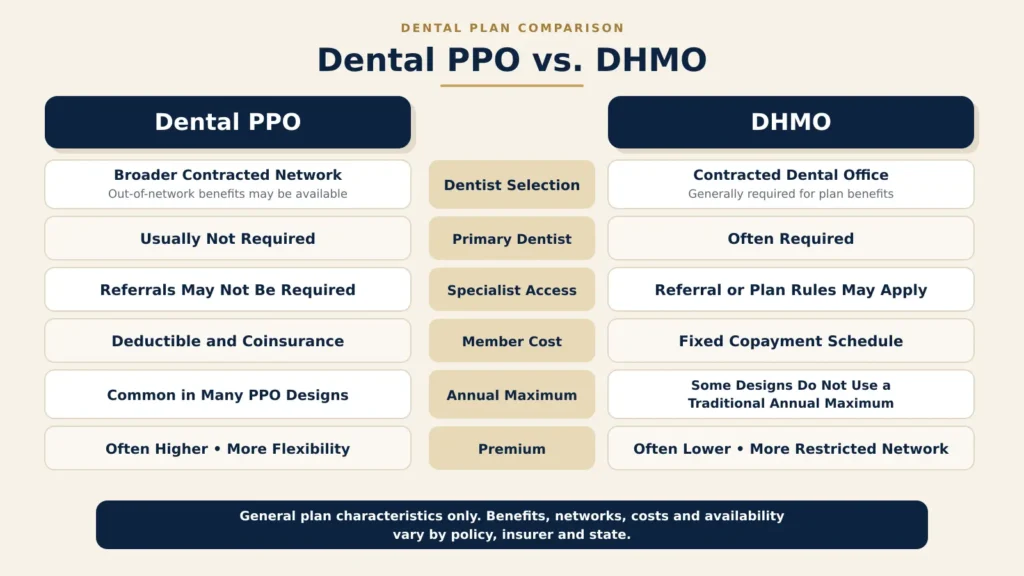
The network structure can determine which dentists you may use and how costs are calculated.
| Feature | Dental PPO | Dental HMO or DHMO |
|---|---|---|
| Dentist selection | Broad contracted network; out-of-network benefits may be available | Care generally must be received from a contracted dental office |
| Primary dentist | Usually not required | Often required |
| Specialist access | Referrals may not be required | Referral or plan procedures may apply |
| Member cost | Commonly deductible and coinsurance | Commonly a fixed copayment schedule |
| Annual maximum | Common in many PPO designs | Some DHMO designs do not use the same annual-maximum structure |
| Premium | Often higher in exchange for flexibility | Often lower, with a more restricted network |
Dental PPO
A dental preferred provider organization generally offers more provider flexibility. You usually receive the strongest benefits when you use an in-network dentist, although some policies offer reduced out-of-network benefits. Always verify both the dentist and the specific office location because network participation can change.
Dental HMO or DHMO
A dental health maintenance organization generally requires members to select or use a contracted dental office. Covered services may follow a fixed copayment schedule. Care outside the network is commonly not covered except as stated in the contract.
Dental Indemnity Plan
An indemnity plan may allow broad provider choice and reimburse a percentage or scheduled amount for covered care. The reimbursement may be based on a plan allowance rather than the dentist’s full charge, leaving the member responsible for the difference.
Dental Discount or Savings Plan
A dental discount plan is not insurance. Members pay a fee to obtain reduced prices from participating dentists, then pay the dentist directly. It may have no insurance waiting period or claims process, but it also does not pay benefits or protect the member with an insurance policy’s contractual benefit structure.
The National Association of Insurance Commissioners provides a consumer overview of PPO, DHMO, indemnity and dental savings arrangements.
How to Compare Dental Insurance Plans Step by Step
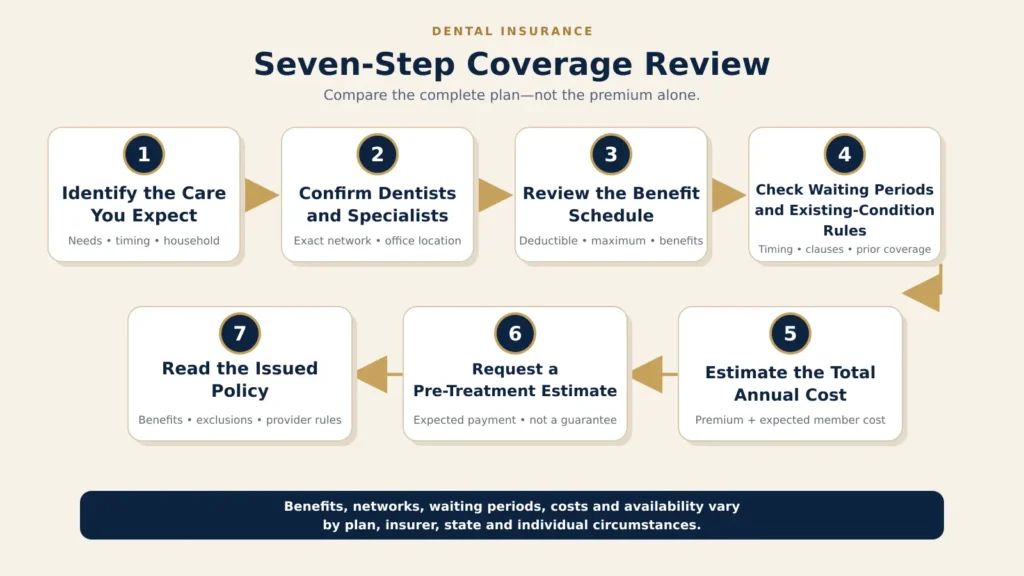
1. Identify the Care You Expect
Start with the people who need coverage and the services that may reasonably be needed during the next 12 to 24 months. Consider preventive visits, fillings, periodontal treatment, crowns, dentures, implants and orthodontics. A dental professional—not an insurance agent—should determine the treatment you need.
2. Confirm Your Dentists and Specialists
Search the plan directory, then call both the dental office and the insurer. Ask whether the dentist is in-network for the exact plan, not merely whether the office “accepts” the insurance company. Confirm access to pediatric dentists, endodontists, periodontists, oral surgeons or orthodontists when relevant.
3. Review the Benefit Schedule
Compare the plan’s treatment categories, benefit percentages or copayments, deductible, annual maximum and frequency limits. Do not assume that two plans classify root canals, periodontal care, implants or oral surgery the same way.
4. Check Waiting Periods and Existing-Condition Rules
Determine when preventive, basic and major benefits begin. Review any missing-tooth provision, replacement clause, prior-coverage credit or limitation involving work started before the policy’s effective date.
5. Estimate the Total Annual Cost
Compare the yearly premium plus the estimated member cost for likely services. Use the plan’s allowed amount—not only the dentist’s retail price—and account for the annual maximum. The plan with the lowest monthly premium may not produce the lowest total cost.
6. Request a Pre-Treatment Estimate
For expensive or multi-stage care, ask the dentist to submit a pre-treatment estimate or predetermination when available. It can clarify the plan’s expected payment, but it is not always a guarantee of final benefits. Eligibility, remaining maximums, clinical documentation and coverage status can still affect the claim.
7. Read the Issued Policy
Review the full policy, certificate, schedule of benefits, exclusions and provider rules. Save the documents and compare them with the proposal used during enrollment.
Dental Insurance With No Waiting Period
“Dental insurance with no waiting period” usually means that one or more categories of covered care can become eligible when the policy takes effect. It does not necessarily mean every procedure is covered immediately or in full.
A no-waiting-period plan may still have:
- A deductible.
- Copayments or coinsurance.
- A limited provider network.
- An annual maximum.
- Frequency or replacement limits.
- Lower first-year benefits.
- Exclusions for implants, orthodontics, cosmetic care or missing teeth.
- A requirement that treatment begin after the effective date.
When major dental work is already recommended, compare the estimated benefit with the full first-year premium and out-of-pocket cost. Buying a policy shortly before treatment does not guarantee that the treatment will be covered.
For Marketplace stand-alone dental coverage, HealthCare.gov specifically advises consumers to check adult waiting periods before enrollment because premiums may be due before certain services become eligible. See the official Marketplace dental coverage guidance.
Does Dental Insurance Cover Implants, Crowns, Root Canals and Dentures?
Some dental insurance plans cover part of these services, while others limit or exclude them. The procedure name alone is not enough to determine coverage.
Dental Implants
If implants are covered, the plan may treat the implant body, abutment, crown, extraction, bone graft and imaging as separate services. Each component may have a different benefit, limitation or clinical requirement. Check the annual maximum, waiting period and missing-tooth provision before relying on the benefit.
Crowns
Crowns are commonly treated as major services. Coverage may depend on whether the crown is considered necessary under the plan, whether the tooth meets replacement-frequency rules and whether a less costly alternative is used in the plan’s payment calculation.
Root Canals
One plan may classify root canal treatment as a basic service while another classifies it as major. The crown or restoration placed afterward is a separate service and may use a different benefit category.
Dentures and Bridges
Plans may cover part of dentures or bridges but limit how frequently they can be replaced. A missing-tooth clause may affect teeth that were already missing before coverage began.
Orthodontics
Orthodontic coverage is not automatically included. When available, it may have age restrictions, a waiting period, a separate lifetime maximum and installment-based payments that stop if coverage terminates.
Before beginning costly treatment, request the applicable procedure codes and a written estimate from the dentist, then verify the policy terms with the insurer.
A Simple Dental Insurance Cost Example
Assume a crown has an in-network allowed amount of $1,200. The member has a $50 deductible, and the plan pays 50% of the remaining eligible amount for major services.
- Allowed amount: $1,200
- Deductible paid by the member: $50
- Remaining eligible amount: $1,150
- Illustrative plan payment at 50%: $575
- Illustrative member responsibility: $625
This example assumes the waiting period has been satisfied, the crown is covered, the annual maximum has sufficient room and no other exclusion applies. If an out-of-network dentist charges more than the plan’s recognized amount, the member may also owe the additional balance.
Family Dental Insurance and Children’s Coverage
Family dental insurance may place adults and children on one policy, but each family member can have different needs. Compare:
- The family premium and any family deductible.
- Whether benefit maximums apply per person.
- Pediatric dentist access.
- Fluoride, sealant and X-ray frequency limits.
- Orthodontic benefits, age limits and lifetime maximums.
- Dependent eligibility and termination age.
Marketplace rules treat adult and pediatric dental coverage differently. Pediatric dental coverage must be made available for children age 18 or younger, but families are not necessarily required to purchase it. Adult dental coverage is not an essential health benefit, so medical plans do not have to include it. A Marketplace stand-alone dental plan generally can be purchased only while buying a Marketplace health plan. These rules are explained by HealthCare.gov.
Medicaid and CHIP dental benefits for children are subject to federal and state program rules. Adult Medicaid dental benefits vary by state. Families can review official information through Medicaid.gov and use the InsureKidsNow dentist locator when applicable.
Dental Insurance for Seniors and People With Medicare
Dental needs do not end at age 65, but Original Medicare generally does not cover routine cleanings, fillings, extractions, dentures or implants. Medicare may cover limited dental services when they are directly connected to certain covered medical treatments or qualifying hospital care.
Some Medicare Advantage plans include dental benefits, but the network, annual allowance, covered services and prior-authorization rules vary. A separate individual dental policy may also be available. Medicare Supplement insurance generally does not create routine dental benefits that Original Medicare excludes.
Review current details on the official Medicare dental services page. Anyone comparing senior dental options should avoid assuming that the word “dental” means comprehensive coverage.
Can Non-US Citizens, Green Card Holders or Visa Holders Get Dental Insurance?
Citizenship alone does not determine access to every private dental plan. Individual off-Marketplace dental policies or dental savings arrangements may be available to US residents depending on the insurer’s state, residency, identification and payment requirements.
Lawfully present immigrants—including many green card holders and people with valid nonimmigrant visas—may qualify for Marketplace health coverage if they meet the applicable requirements. Because Marketplace stand-alone dental coverage is tied to purchasing Marketplace health coverage, immigration and enrollment rules can affect that route. Review the current HealthCare.gov guidance for lawfully present immigrants.
People who are not eligible for Marketplace coverage may still be able to explore private off-Marketplace dental options, dental discount plans, community health centers, dental schools or local assistance programs. Availability is not guaranteed, and application requirements vary by provider, insurer and state.
How Much Does Dental Insurance Cost?
Dental insurance pricing varies by state, ZIP code, age or rating method, number of covered family members, plan design, network and benefit level. Instead of selecting a plan by premium alone, compare five numbers:
- Total annual premium.
- Deductible.
- Copayments or coinsurance for likely services.
- Annual maximum paid by the plan.
- Potential out-of-network balance.
Also check whether benefits increase after the first year, whether orthodontics has a separate charge, and whether paying annually changes the total premium. Rates and benefits can change, so use the current official plan documents for your location.
Is Dental Insurance Worth It?
Dental insurance may be useful when the premium is affordable, the network includes dentists you would use, preventive benefits are valuable and the policy provides meaningful help with likely treatment.
It may be less attractive when:
- The only available network does not include accessible dentists.
- A waiting period prevents near-term treatment from being covered.
- The annual maximum is low relative to the premium and expected care.
- The services you need are excluded.
- You expect only limited preventive care and a competitive cash-pay or membership option costs less.
The correct comparison is not “insurance versus free care.” It is the total expected cost, provider access, contract protection and financial predictability under each available option.
Dental Insurance vs. a Dental Discount Plan
| Question | Dental insurance | Dental discount plan |
|---|---|---|
| Is it insurance? | Yes | No |
| Who pays a covered benefit? | The insurer pays or reimburses according to the policy | No insurance benefit is paid |
| How does the member save? | Contracted rates plus covered plan benefits | Discounted fees from participating dentists |
| Waiting periods | May apply | Insurance waiting periods generally do not apply |
| Annual maximum | Common in many plans | No insurer-paid annual maximum because there is no insured benefit |
| Provider requirement | Network rules depend on plan type | Discounts apply only with participating providers |
A discount plan can be a practical alternative for some people, but it should never be presented as dental insurance. Compare the actual fee schedule and confirm that appropriate dentists participate before enrolling.
How to Use Dental Benefits More Effectively
- Confirm eligibility and network status before each significant service.
- Schedule covered preventive care within the plan’s frequency limits.
- Ask for a written treatment plan and procedure codes.
- Request a pre-treatment estimate for major work.
- Track the remaining annual maximum.
- Review whether treatment can be safely phased across benefit years; the dentist must determine the appropriate clinical timing.
- Save explanations of benefits and compare them with the dentist’s bill.
- Appeal a denied claim when the documentation or policy terms support reconsideration.
- Ask a qualified tax professional whether eligible dental expenses or premiums may receive tax-favored treatment. The IRS Publication 502 explains qualifying medical and dental expenses and applicable limitations.
Why Review Dental Insurance Every Year?
An annual dental coverage review is useful because premiums, provider networks, benefit schedules and policy limitations can change. Your family’s expected treatment may also be different from the year before.
During the review, confirm:
- Whether your dentist and specialists remain in-network.
- The new premium and effective date.
- The annual maximum and deductible.
- Preventive, basic and major-service benefits.
- Waiting periods already satisfied or newly applicable.
- Changes involving implants, orthodontics or missing teeth.
- Whether the benefit year follows the calendar year.
- Whether a different plan would restart waiting periods or replacement limits.
Do not cancel existing coverage until you understand the effective date and restrictions of any replacement policy. A new plan can have different exclusions even when its headline benefits look similar.
Frequently Asked Questions About Dental Insurance
Can I buy dental insurance without health insurance?
Individual dental coverage may be available directly from an insurer without a medical plan. However, a stand-alone dental plan offered through the federal Marketplace generally cannot be purchased unless you are also buying Marketplace health coverage.
Can I enroll in dental insurance at any time?
Many off-Marketplace individual dental plans accept applications during the year, but effective dates and availability vary. Employer and Marketplace dental coverage may follow specific enrollment periods or qualifying-event rules.
Does dental insurance cover preventive care immediately?
Many plans provide preventive benefits without a waiting period, but frequency limits, network rules and deductibles may still apply. Verify the schedule of benefits.
What does “no waiting period” really mean?
It means the plan does not delay the specified eligible benefit after the effective date. It does not eliminate deductibles, copayments, coinsurance, annual maximums or exclusions.
Does dental insurance cover implants?
Some policies cover part of implant treatment, while others exclude it. Confirm coverage for each component, the waiting period, annual maximum and missing-tooth provision.
Does dental insurance cover root canals and crowns?
They may be covered, but the benefit category can differ. A root canal may be basic or major, while a crown is commonly treated as major. The policy controls.
Is there a dental plan with no annual maximum?
Some plan designs, including certain DHMO arrangements, may not use a traditional insurer-paid annual maximum. This does not mean all services are free; a copayment schedule, network restriction and exclusions may apply.
Can I keep my dentist with a new dental plan?
Only if the dentist participates in that specific network or the policy provides usable out-of-network benefits. Confirm the exact plan and office location before enrolling.
Does Medicare Supplement cover dental care?
Medicare Supplement policies generally help with certain cost-sharing for services covered by Original Medicare. They do not ordinarily add routine dental coverage for services that Original Medicare excludes.
Is cosmetic dentistry covered?
Procedures performed only to improve appearance, such as whitening or many veneers, are commonly excluded. Reconstructive treatment may be handled differently depending on the policy and clinical circumstances.
Can an undocumented person get dental coverage?
Marketplace eligibility is restricted by federal immigration rules, but private off-Marketplace dental options, discount plans and community resources may be available depending on local and provider requirements. Verify eligibility before applying.
Should I replace my current dental insurance just because another plan costs less?
Not without comparing networks, waiting periods, annual maximums, replacement clauses and service classifications. A lower premium can create higher costs when treatment is needed.
Find Dental Coverage That Fits the Care You Expect
Choosing dental insurance requires more than comparing monthly premiums. A coverage review can help you evaluate the dentist network, waiting periods, annual maximum, treatment categories and likely out-of-pocket costs before you apply.
Complete the request form to receive an educational review of dental coverage options that may be available in your state. We can explain how the plans differ and help you identify questions to ask before enrollment. We do not diagnose dental conditions or determine which treatment is medically necessary.
Important Disclosure
This page is for general educational purposes and is not dental, medical, tax or legal advice. It does not describe every policy or guarantee eligibility, approval, rates, provider participation, reimbursement or coverage for a specific service. Dental professionals determine appropriate treatment. Insurance benefits are determined by the issued policy and the insurer’s claim rules. Products, networks, exclusions, waiting periods, costs and availability vary by insurer, state and individual circumstances.