How does long-term care insurance work? It helps pay for eligible services when a chronic condition, physical limitation or severe cognitive impairment causes someone to need ongoing assistance with everyday activities.
Long-term care is not limited to nursing homes. Depending on the policy, benefits may help pay for care at home, adult day care, assisted living, memory care, respite care or a nursing facility. The purpose is to help preserve choices, independence and family resources when extended support is needed.
Coverage is not automatic simply because someone becomes older or receives a diagnosis. A policy defines the benefit triggers, covered services, elimination period, maximum benefit and claim requirements. Medical underwriting usually takes place before coverage is issued, which is why planning generally works better before a care need has already developed.
Quick answer: Long-term care insurance may be appropriate when someone wants help managing future care expenses without relying entirely on personal savings or unpaid family caregivers. It should be selected only after reviewing affordability, health, available assets, family support, state rules and the policy’s exact limitations.
Long-term care refers to medical and nonmedical services that support people who cannot safely manage certain everyday activities on their own because of a chronic illness, disability, cognitive impairment or age-related limitation.
It is different from treatment intended to cure an illness. Long-term care frequently focuses on helping someone live safely and maintain the greatest practical level of independence.
Services may be provided:
In the person’s home.
Through an adult day care program.
In an assisted living residence.
In a memory care community.
In a nursing facility.
Through respite or hospice-related support when covered by the policy.
The Administration for Community Living explains that long-term care includes services and support that help people live as independently and safely as possible when they can no longer perform everyday activities on their own.
What Is Long-Term Care Insurance?
Long-term care insurance is designed to pay or reimburse eligible expenses after the insured meets the policy’s benefit triggers and completes any required elimination period.
The policy may establish:
A maximum daily or monthly benefit.
A total pool of money or benefit period.
Covered care settings and services.
Benefit triggers based on physical or cognitive impairment.
A waiting or elimination period.
Rules for reimbursement or cash-indemnity payments.
Inflation-protection options.
Premium-waiver provisions during an eligible claim.
Optional benefits such as shared care, restoration or nonforfeiture.
The contract—not a sales illustration or general website—determines what will be paid.
The NAIC Shopper’s Guide to Long-Term Care Insurance provides a detailed consumer overview of coverage types, benefit triggers, elimination periods, inflation protection, underwriting and policy comparisons.
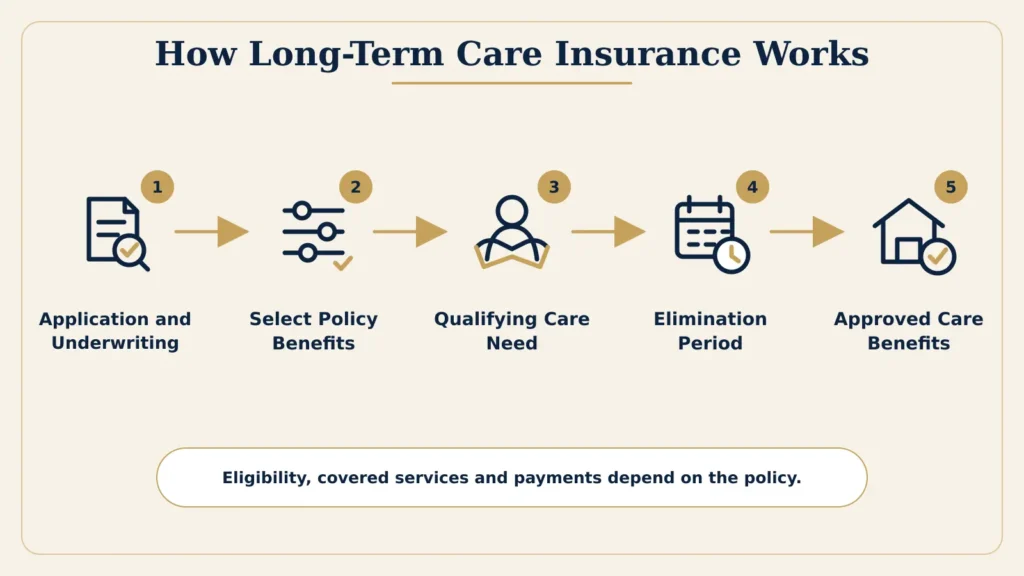
How Does Long-Term Care Insurance Work Step by Step?
1. Application and Medical Underwriting
The applicant provides health and lifestyle information. The insurer may review medical records, prescription history, cognitive screening, telephone interviews and other underwriting evidence.
Approval, policy class and premium depend on the insurer’s guidelines. A person who already needs care or has certain diagnosed conditions may not qualify. Never cancel existing coverage until new coverage has been issued, reviewed and accepted.
2. Select the Policy Benefits
Before issue, the applicant selects available features such as the monthly benefit, benefit period, elimination period, inflation option and care settings.
More extensive benefits generally cost more. The goal is not to purchase every optional feature; it is to design coverage that fits likely care costs, available savings and an affordable long-term premium.
3. A Qualifying Care Need Occurs
Coverage begins only when the insured meets the policy’s benefit-trigger requirements. Many policies use an inability to perform a specified number of activities of daily living or a qualifying severe cognitive impairment.
A licensed health care practitioner may need to certify the condition and approve a plan of care. Definitions and documentation requirements vary by contract.
4. Complete the Elimination Period
The elimination period is the waiting period before benefits become payable. It is sometimes described as a deductible measured in days.
One policy may count calendar days after eligibility is established. Another may count only days on which covered services are received. That difference can materially affect when payments begin.
5. Receive Approved Care Benefits
After eligibility and the elimination period are satisfied, the insurer pays benefits according to the policy. Payments may reimburse documented covered expenses or provide a defined cash-indemnity amount.
Benefits continue only while claim requirements are satisfied and coverage remains available under the contract.
What Are the Six Activities of Daily Living?
Activities of daily living, commonly called ADLs, are basic self-care functions used by many long-term care policies to measure whether someone qualifies for benefits.
The six commonly used ADLs are:
Bathing: washing oneself safely.
Dressing: putting on and removing clothing and necessary supports.
Toileting: getting to and from the toilet and completing related personal hygiene.
Transferring: moving into or out of a bed, chair or wheelchair.
Continence: controlling bowel and bladder functions or managing related care.
Eating: feeding oneself after food has been prepared and made available.
Many tax-qualified policies generally require certification that the insured is unable to perform at least two ADLs without substantial assistance for an expected period defined by federal requirements. The policy’s precise definitions control.
Severe Cognitive Impairment
A person may qualify even when physically able to perform ADLs if severe cognitive impairment requires substantial supervision for safety. Conditions may include forms of dementia, but a diagnosis alone does not automatically establish eligibility. The policy’s definition, certification and plan-of-care requirements must be met.
What Does Long-Term Care Insurance Cover?
Covered services vary, but modern comprehensive policies may include several settings.
Home Care
Home care may include assistance with personal care, homemaker services, nursing services, therapy or other policy-defined support. Review whether care must be provided by a licensed agency and whether family caregivers can be paid.
Adult Day Care
Adult day programs may provide supervision, activities and selected health or personal-care services while allowing the insured to continue living at home.
Assisted Living
Assisted living provides housing and support with everyday activities without the full level of medical care offered by a nursing facility. Confirm how the policy defines an eligible facility.
Memory Care
Memory care provides structured support and supervision for individuals with cognitive impairment. Coverage depends on the policy’s benefit trigger and facility requirements.
Nursing Facility Care
A policy may pay eligible expenses in a qualified nursing facility up to the applicable daily or monthly maximum and total benefit.
Respite and Hospice-Related Care
Some policies include respite care to give an unpaid caregiver temporary relief. Hospice-related services may also be covered when contract requirements are satisfied.
Do not assume every policy covers every provider, facility or location. Ask whether the policy requires licensed providers, preauthorization, a written care plan or specific documentation.
What Long-Term Care Insurance Usually Does Not Cover
Exclusions vary by contract and state. Examples may include:
Care that does not satisfy the policy’s benefit triggers.
Services received during an elimination period.
Expenses above the daily or monthly maximum.
Care from an ineligible provider or facility.
Services outside the covered geographic area.
Certain care provided by family members.
Conditions or services excluded under the contract.
Care resulting from specifically excluded circumstances.
Long-term care insurance is not a replacement for regular health insurance. It is not primarily designed to pay for routine doctor visits, hospital treatment, surgery or prescription drugs.
How Long-Term Care Benefits Are Paid
Reimbursement Policies
A reimbursement policy generally pays eligible documented expenses up to the policy’s limit. The insured or provider may submit invoices, receipts and proof of covered services.
If the monthly benefit is $6,000 but eligible expenses are $4,500, the policy may reimburse $4,500 rather than the full maximum. Whether unused benefits remain in the pool depends on the contract.
Indemnity or Cash-Benefit Policies
An indemnity policy may pay a defined amount after claim eligibility is established, regardless of the exact covered expense incurred. A cash-indemnity design may offer broader flexibility, including possible use for informal care, but definitions, documentation and benefit limits still apply.
Indemnity coverage is not automatically superior. It may cost more, and tax treatment can depend on the benefit structure and applicable limits.
Understanding the Elimination Period
The elimination period is one of the most important and misunderstood policy features.
Common designs may use 30, 60, 90 or more days. A longer elimination period usually lowers the premium because the insured retains more early claim cost.
Before purchasing, ask:
Does the period use calendar days or service days?
Must the days be consecutive?
Does it need to be satisfied once or for each claim?
Does home care count the same way as facility care?
Are any services covered immediately?
Who pays expenses during the waiting period?
Keep enough liquid savings to cover the period and any expenses above policy limits.
The Benefit Amount, Period and Pool of Money
A long-term care policy may be expressed as a daily benefit, monthly benefit, benefit period or total pool.
For example, a policy might provide a maximum monthly amount for three years. That does not necessarily mean coverage ends exactly three calendar years after a claim begins. If actual eligible expenses are below the maximum and unused amounts remain in the pool, benefits may last longer, depending on the policy.
Review:
Initial monthly or daily maximum.
Total benefit pool.
Minimum and maximum benefit periods.
Rules for unused benefits.
Whether home-care benefits use the same limit as facility care.
How inflation protection changes the benefit.
Inflation Protection Explained
Long-term care may be purchased many years before a claim. Inflation protection is designed to increase available benefits over time.
Options may include compound increases, simple increases, future-purchase options or other formulas. A higher growth option generally increases the initial premium.
Compare how each option affects the monthly benefit and total pool at ages 70, 80 and 90. Do not assume a label such as “3% inflation” always produces the same result across policies.
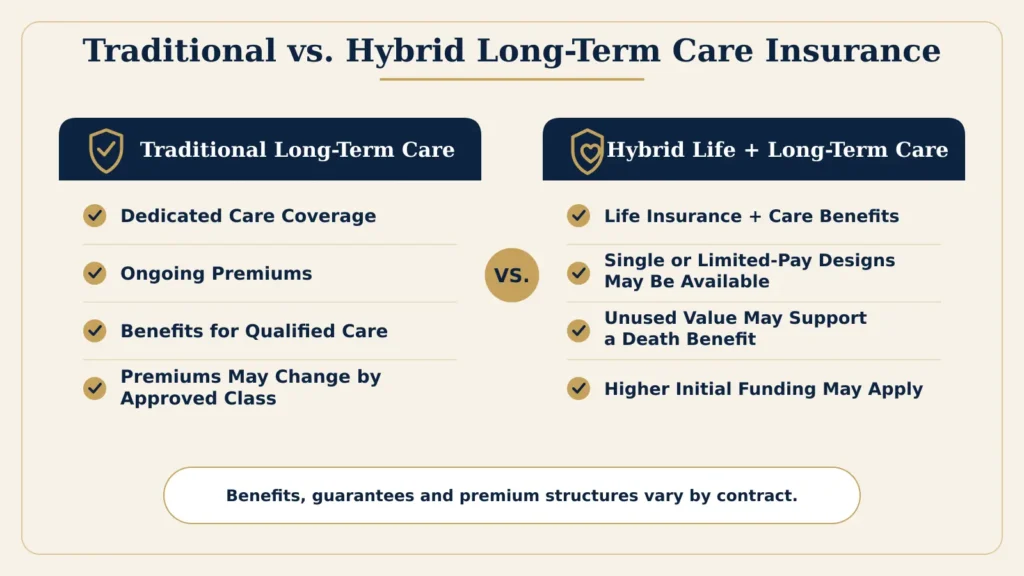
Traditional coverage is designed primarily to pay qualified long-term care benefits.
Potential advantages include:
A benefit structure dedicated to care expenses.
Multiple benefit periods and inflation options.
Shared-care features may be available for couples.
Lower initial funding than some hybrid designs, depending on coverage.
Potential trade-offs include:
Premiums are generally ongoing.
Premium increases may be requested for an approved class of policies, subject to state regulation.
Coverage normally has little or no death benefit if care is never needed unless a return-of-premium or nonforfeiture feature applies.
Medical underwriting is required.
An insurer generally cannot raise only one insured’s premium because that person’s health changes after issue, but class-wide increases may be permitted under applicable law and policy terms.
Hybrid or Linked-Benefit Life Insurance
A hybrid policy combines permanent life insurance with benefits that may be used for qualified long-term care. It may be called a linked-benefit or combination policy.
Potential advantages include:
Long-term care benefits when eligibility requirements are met.
A death benefit may remain when care benefits are not fully used.
Single-premium or limited-pay designs may be available.
Some contracts offer an extension-of-benefits rider beyond the accelerated death benefit.
Potential trade-offs include:
Higher initial funding may be required.
Using care benefits may reduce the remaining death benefit and other policy values.
Benefits, riders and premium guarantees vary.
The policy may provide less dedicated care coverage than another design for the same funding amount.
Life Insurance With a Chronic-Illness Rider Is Not Always Long-Term Care Insurance
A chronic-illness accelerated death-benefit rider may permit access to part of a life insurance death benefit after a qualifying chronic condition. That does not automatically make it long-term care insurance.
Qualification rules, benefit calculations, charges, reimbursement requirements and permitted uses may differ. Ask whether the rider is intended to meet long-term care insurance requirements or is an accelerated death benefit under a different regulatory framework.
Annuity Contracts With Long-Term Care Features
Some annuity contracts offer enhanced benefits or riders for qualifying care needs. These designs may increase available benefits under defined conditions while retaining annuity features if care is not needed.
They can involve significant funding, surrender provisions, tax considerations and underwriting. Compare the actual contract with a traditional policy and hybrid life insurance rather than treating the enhanced benefit as free coverage.
The NAIC guide explains that long-term care benefits may be available through individual policies, life insurance, hybrid policies and certain annuity contracts. Availability varies by carrier and state.
Shared Care for Couples
A shared-care rider may allow two insured people to access a combined pool of benefits. If one person uses more than an individual allocation, the rider may permit access to part of the other person’s available pool.
Review what happens after the first death, divorce, policy lapse or exhaustion of one pool. Shared care can add flexibility, but it may also leave fewer benefits for the second person if the first claim is extensive.
Long-Term Care Insurance Costs
There is no universal premium. Pricing commonly depends on:
Age at application.
Health and underwriting class.
Sex, where permitted.
State and carrier.
Individual or couple coverage.
Monthly benefit and total pool.
Benefit period.
Elimination period.
Inflation protection.
Reimbursement or indemnity design.
Optional riders.
Premium-payment schedule.
An inexpensive policy is not useful if its benefit is too small, its provider requirements do not fit the care plan or the premium later becomes unaffordable. Request carrier-approved proposals with matching assumptions before comparing prices.
What Is the Best Age to Buy Long-Term Care Insurance?
There is no perfect age. Applying earlier may provide lower premiums and a better chance of meeting health requirements, but it also means paying premiums for more years.
Many consumers evaluate coverage in their 50s or early 60s, when retirement planning becomes more specific and before significant health conditions develop. The best timing depends on health, family history, assets, income, retirement date and the ability to maintain premiums.
Waiting until care is needed is generally too late because long-term care insurance requires medical underwriting.
Does Medicare Cover Long-Term Care?
Medicare does not generally pay for long-term custodial care. It may cover certain medically necessary skilled nursing facility or home health services when Medicare requirements are met, but that is different from ongoing help with bathing, dressing, eating or supervision.
Medicare.gov states that Medicare and most health insurance, including Medigap, do not pay for most nonmedical long-term care services in a nursing home or community setting.
This distinction is important when comparing long-term care planning with Medicare, which generally does not cover ongoing custodial care.
Medicaid and Long-Term Care
Medicaid may help pay for certain long-term services for people who satisfy state-specific financial, medical and functional requirements. Rules vary by state and program.
Do not assume that transferring or giving away assets will create immediate eligibility. Look-back periods, transfer penalties, estate-recovery rules and spousal protections can apply. Medicaid planning requires qualified legal guidance.
Long-Term Care Partnership Policies
A qualifying Partnership policy may provide Medicaid asset-disregard protection linked to benefits paid by the policy, subject to state rules. It does not eliminate Medicaid eligibility requirements or guarantee that every service or facility will be available.
Partnership requirements, reciprocity and inflation provisions vary. Confirm that the exact policy is Partnership-qualified in the applicable state and consult an elder-law professional about Medicaid implications.
Benefits from a federally tax-qualified long-term care insurance contract are generally treated favorably under federal tax rules when statutory requirements are met. Reimbursement benefits and per-diem benefits can be subject to different rules and limits.
Eligible premiums may qualify as medical expenses up to age-based federal limits, subject to tax rules, itemization and the taxpayer’s circumstances. Self-employed individuals and HSA owners may have additional considerations.
The limits can change each year. Review IRS Publication 502 and consult a qualified tax professional before claiming a deduction, paying premiums from an HSA, completing a 1035 exchange or evaluating taxable benefits.
Practical Long-Term Care Insurance Examples
These examples are educational and do not represent actual policies, quotes or recommendations.
Example 1: Planning for Home Care
Linda, age 56, wants to remain at home if she later needs assistance. She compares policies based on home-care coverage, provider requirements, monthly benefit, elimination period and inflation protection.
She does not simply choose the largest nursing-facility benefit. She verifies whether a licensed home-care agency is required and whether the elimination period counts calendar or service days.
Example 2: A Couple Considering Shared Care
Michael and David apply for individual traditional policies with a shared-care rider. Each has an individual benefit pool, but the rider may permit one spouse to access additional benefits from the combined structure.
They review what would remain for the second spouse after a long first claim and confirm the survivor provisions.
Example 3: Comparing Traditional and Hybrid Coverage
Angela wants care protection but dislikes the possibility that a traditional policy may provide no benefit if she never needs care. She compares traditional coverage with a hybrid life-and-long-term-care policy.
The hybrid design may leave a death benefit, but it requires more initial funding. Angela compares guaranteed values, care benefits, death benefits, inflation options and surrender provisions—not only the “use it or leave it” marketing phrase.
Example 4: Completing an Elimination Period
Robert qualifies for benefits after being unable to perform two policy-defined ADLs. His policy has a 90-day service-day elimination period.
Because only covered service days count, the waiting period may take longer than 90 calendar days. Robert’s family keeps invoices and works with the carrier’s claim department before assuming a payment date.
Example 5: Cognitive Impairment
Maria can still dress and eat without physical assistance, but severe cognitive impairment requires substantial supervision for safety. Her licensed health care practitioner provides the certification and plan of care required by the policy.
Her eligibility is evaluated under the cognitive-impairment benefit trigger rather than only the physical ADLs.
Who May Consider Long-Term Care Insurance?
Coverage may deserve consideration when someone:
Wants more choice over where care may be received.
Has income and assets that could be disrupted by extended care costs.
Wants to reduce potential reliance on unpaid family caregivers.
Can comfortably maintain the required premium.
Has sufficient liquid savings for the elimination period and uncovered expenses.
Is healthy enough to qualify through underwriting.
Understands that insurance may cover only part of the total cost.
When Coverage May Be a Poor Fit
Long-term care insurance may not be appropriate when someone:
Cannot afford the premium without sacrificing essential expenses.
Has very limited assets and is likely to depend on Medicaid.
Needs immediate care or cannot satisfy underwriting.
Expects the policy to cover every possible care expense.
Does not have funds to cover the elimination period and expenses above policy limits.
Is considering a replacement without a clear improvement after accounting for new underwriting, age, premiums and lost benefits.
Questions to Ask Before Buying
Which benefit triggers must be met?
How does the policy define each ADL and severe cognitive impairment?
Which home, community and facility services are covered?
Does the elimination period count calendar days or service days?
What is the monthly benefit and total benefit pool?
How does inflation protection work?
Is the benefit reimbursement, indemnity or cash indemnity?
Are family caregivers eligible providers?
Can premiums change, and under what circumstances?
What happens if the premium becomes unaffordable?
Is the policy federally tax-qualified?
Is it Partnership-qualified in the state where it is issued?
What happens if care is never needed?
What happens after moving to another state or country?
How are claims filed, certified and reviewed?
Five Frequently Asked Long-Term Care Insurance Questions
1. What Does Long-Term Care Insurance Cover?
Depending on the policy, coverage may include home care, adult day care, assisted living, memory care, respite services, hospice-related care and nursing facilities. The insured must first meet the policy’s benefit triggers, complete the elimination period and use eligible providers or services.
2. How Much Does Long-Term Care Insurance Cost?
Cost depends on age, health, sex where permitted, state, insurer, monthly benefit, benefit period, inflation option, elimination period and riders. Compare carrier-approved proposals using the same benefits. A lower premium may reflect less coverage, a longer waiting period or fewer features.
3. Does Medicare Pay for Long-Term Care?
Medicare generally does not pay for ongoing custodial care. It may cover limited skilled services when its requirements are met, but it should not be treated as comprehensive long-term care coverage.
4. What Is the Best Age to Buy Long-Term Care Insurance?
There is no single best age. Many people evaluate coverage in their 50s or early 60s, before health conditions make approval more difficult. The right time depends on health, affordability, retirement plans, family history and available assets.
5. What Happens If I Never Use Long-Term Care Insurance?
With traditional coverage, the policy may pay no claim benefit if qualifying care is never needed, unless it includes a nonforfeiture or return-of-premium feature. A hybrid life-and-long-term-care policy may provide a death benefit or other contract value, but usually requires more funding and has different trade-offs.
Final Takeaway: Plan Before Care Is Needed
Long-term care insurance is not only nursing-home insurance. It can help support care at home, in the community or in a facility when policy requirements are met.
The best policy is not automatically the one with the largest benefit, lowest premium or most impressive illustration. It is the coverage that remains affordable, matches the preferred care setting and clearly explains its benefit triggers, elimination period, inflation protection, claims process and limitations.
Review Your Long-Term Care Options With Confidence
Sterling Arc Group can help you understand available traditional and hybrid long-term care insurance options, compare their benefits and limitations, and organize the questions that should be answered before applying.
This page is for general educational purposes and is not individualized insurance, investment, tax, medical or legal advice. Product availability, underwriting, premiums, benefits, riders, exclusions, tax treatment and Partnership status vary by insurer, state, contract and individual circumstances. Coverage is subject to the issued policy. Sterling Arc Group and its representatives offer only products for which they are properly licensed, appointed, trained and authorized. Consult qualified tax, legal, medical and financial professionals regarding your circumstances.
Manage Consent
To provide the best experiences, we use technologies like cookies to store and/or access device information. Consenting to these technologies will allow us to process data such as browsing behavior or unique IDs on this site. Not consenting or withdrawing consent, may adversely affect certain features and functions.
Functional
Always active
The technical storage or access is strictly necessary for the legitimate purpose of enabling the use of a specific service explicitly requested by the subscriber or user, or for the sole purpose of carrying out the transmission of a communication over an electronic communications network.
Preferences
The technical storage or access is necessary for the legitimate purpose of storing preferences that are not requested by the subscriber or user.
Statistics
The technical storage or access that is used exclusively for statistical purposes.The technical storage or access that is used exclusively for anonymous statistical purposes. Without a subpoena, voluntary compliance on the part of your Internet Service Provider, or additional records from a third party, information stored or retrieved for this purpose alone cannot usually be used to identify you.
Marketing
The technical storage or access is required to create user profiles to send advertising, or to track the user on a website or across several websites for similar marketing purposes.