


How Do Annuities Work for Retirement Income?
How do annuities work for retirement income? In simple terms, an annuity is a contract with an insurance company that can help you accumulate money, create future income or convert part of your savings into payments that may continue for life.
An annuity is not one single product. Some contracts provide a declared fixed rate. Some calculate interest using a market index without directly investing your premium in that index. Others are designed primarily to begin income now or at a future date. The right structure depends on your goal, time horizon, need for liquidity, tax status and preference for guarantees.

Annuities can solve a real retirement problem: savings can fluctuate or eventually run out, while essential expenses continue. They can also create trade-offs. Surrender periods may limit access, optional riders may add cost, inflation may reduce future purchasing power and every insurance guarantee depends on the issuing company’s financial strength and claims-paying ability.
Quick answer: An annuity may be useful when you want part of your retirement strategy to provide predictable interest, tax-deferred accumulation or contractual income. It should be evaluated as one part of a complete financial picture-not as a replacement for emergency savings, every investment account or professional tax advice.
Table of Contents
- What an annuity is
- How annuities work step by step
- Accumulation and income phases
- Fixed, MYGA, fixed indexed and income annuities
- How a life income annuity works
- Annuitization versus an income rider
- Qualified and nonqualified annuities
- Taxes, 401(k) rollovers and beneficiaries
- Fees, surrender charges and limitations
- Practical examples
- Five frequently asked annuity questions
What Is an Annuity?
An annuity is an insurance contract between the contract owner and an insurance company. The owner pays a premium—either one payment or a series of payments—and the insurer provides the benefits stated in the contract.
Depending on the annuity, those benefits may include:
- A guaranteed interest rate for a stated period.
- Interest-crediting potential linked to the performance of a market index.
- Tax-deferred growth while money remains in the contract.
- A future stream of income.
- Payments guaranteed for the life of one or two people.
- A death benefit or remaining value for beneficiaries, subject to the contract.
- Optional living-benefit riders that establish rules for future withdrawals.
The words used in an annuity contract matter:
- Owner: controls the contract and makes decisions permitted by its terms.
- Annuitant: the person whose age or life expectancy may be used to calculate benefits.
- Beneficiary: the person or entity designated to receive applicable benefits after a death.
- Insurer: the insurance company issuing the contract and backing its guarantees.
The owner and annuitant may be the same person, but they do not have to be. Ownership, beneficiary designations and tax treatment should be reviewed carefully before the contract is issued.
The SEC’s Investor.gov annuity overview explains that an annuity is an insurance contract funded with a lump sum or series of payments that can later provide periodic income.
How Do Annuities Work Step by Step?
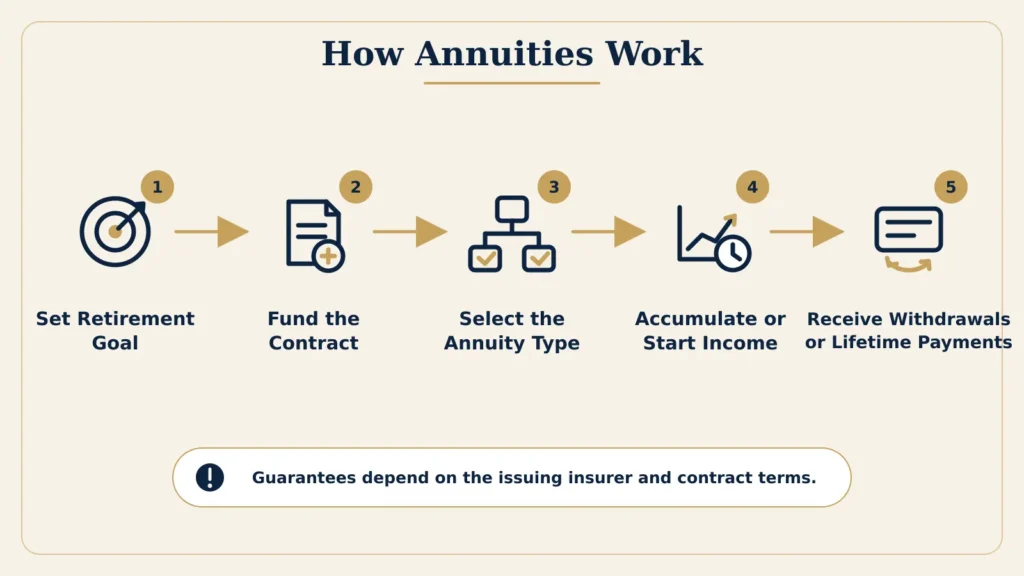
1. Define the Retirement Goal
Start with the problem the annuity is expected to solve. Is the priority principal stability, a known rate for a specific period, tax deferral, income beginning soon or income that cannot be outlived?
This step also includes reviewing liquid savings, expected expenses, Social Security, pensions, investment accounts, insurance needs and money reserved for emergencies. An annuity should not absorb funds that may be needed during its surrender period.
2. Fund the Contract
An annuity may be purchased with nonqualified money, such as personal after-tax savings, or qualified retirement money from an IRA or an eligible retirement-plan rollover. The source of funds affects the tax treatment of future distributions.
Funding an annuity inside an IRA does not create a second layer of tax deferral. The IRA already has tax advantages. In that situation, the annuity should be selected for its insurance features—such as guarantees or income options—not merely because it is tax deferred.
3. Select the Annuity Type
The contract might be a traditional fixed annuity, a multi-year guaranteed annuity, a fixed indexed annuity, an immediate annuity or a deferred income annuity. Each solves a different problem and uses different rules for interest, access and income.
4. Accumulate Value or Begin Income
A deferred annuity normally has time to accumulate before distributions begin. An immediate annuity is generally designed to begin scheduled payments within approximately one year of purchase. Contract definitions and start dates vary.
5. Take Withdrawals or Elect an Income Option
Later, the owner may take permitted withdrawals, activate an optional withdrawal benefit or permanently annuitize the contract. These choices are not identical. They can affect access to the account value, payments to beneficiaries and the ability to change course later.
The Two Basic Phases: Accumulation and Income
The Accumulation Phase
During accumulation, the contract value may earn declared interest or index-linked interest credits according to the annuity’s formula. Growth is generally tax deferred until money is distributed.
The owner may still have access to a contractually permitted amount, but withdrawals can be subject to surrender charges, a market value adjustment, rider reductions and tax consequences. “Tax deferred” does not mean “tax free.”
The Income Phase
The income phase begins when scheduled payments start. That may occur through formal annuitization, an immediate or deferred income-annuity payout, or withdrawals under an optional guaranteed lifetime withdrawal benefit.
Before selecting income, distinguish among three values that may appear on a contract statement:
- Account or contract value: the actual value available under the contract, subject to its terms.
- Cash surrender value: the amount available after applicable surrender charges, adjustments and withdrawals.
- Income benefit base: a value used to calculate an optional rider benefit. It is generally not a lump sum that can be withdrawn or surrendered.
Types of Annuities Available Through a Licensed Insurance Professional
The Florida 2-15 license includes authority for annuity contracts, but a license alone does not make every product available. The agent must also maintain the appropriate insurer appointment, complete required annuity and product-specific training and follow the carrier’s authorization rules. Securities products require separate securities authority.
| Structure | Primary purpose | Typical timing |
|---|---|---|
| Fixed deferred annuity | Predictable tax-deferred accumulation | Income or withdrawals later |
| MYGA | Guaranteed rate for a selected multi-year term | Accumulation first |
| Fixed indexed annuity | Limited index-linked interest-crediting potential with no direct index ownership | Accumulation and optional future income |
| Single premium immediate annuity | Convert one premium into scheduled income | Generally begins within one year |
| Deferred income annuity | Establish contractual income for a later date | Begins after a longer deferral period |
| QLAC | Specialized longevity income using eligible qualified funds | Generally begins later in retirement |
Annuities may also be classified by how premiums are paid. A single-premium deferred annuity is funded with one payment and accumulates before income or withdrawals begin. A flexible-premium deferred annuity permits additional premiums under its contract rules. Not every carrier or product accepts additional payments, and each added premium may affect rates, surrender schedules or other values.
Traditional Fixed Deferred Annuity
A fixed deferred annuity credits interest according to rates and guarantees stated by the insurer. A contract may guarantee a minimum rate while allowing the insurer to declare a higher current rate for a defined period.
It may fit someone who values predictable accumulation and principal protection from direct market losses. It is not a bank account or certificate of deposit. It is issued by an insurer, is not FDIC insured and may impose surrender charges or other contract restrictions.
Multi-Year Guaranteed Annuity (MYGA)
A multi-year guaranteed annuity, commonly called a MYGA, is a type of fixed annuity that guarantees a stated interest rate for a selected number of years, subject to the insurer’s claims-paying ability.
At the end of the guaranteed term, the owner normally has a contract-defined window to choose among available actions. Depending on the contract, those choices may include renewal, withdrawal, transfer, exchange or an income option. Missing the window may cause the contract to renew under the terms then in effect.
A MYGA can be straightforward, but the details still matter:
- Length of the rate-guarantee period.
- Length of the surrender-charge schedule.
- Free-withdrawal provision.
- Renewal process and post-guarantee rate.
- Market value adjustment, if any.
- Death-benefit rules.
- Financial strength of the issuing insurer.
Fixed Indexed Annuity (FIA)
A fixed indexed annuity is an insurance contract that credits interest using a formula connected to one or more external market indexes. The owner does not directly own the index or the securities inside it.
Index-linked interest may be limited by a cap, participation rate, spread, margin or other formula. An index may rise more than the amount credited to the contract, and many formulas do not include index dividends. The insurer may be allowed to change certain nonguaranteed elements after the initial term, subject to contractual minimums and maximums.
Many fixed indexed annuities protect the contract from a negative index-credit result by applying a stated floor, often 0%, for the crediting period. That does not mean the contract can never decline. Withdrawals, rider charges, surrender charges, a market value adjustment and other provisions can reduce available value.
The Investor.gov indexed-annuity bulletin provides a useful explanation of caps, participation rates, spreads, surrender charges and other variables that can affect results.
Bonus Annuities
An upfront or premium bonus is a contract feature, not a separate guarantee that the annuity is better. A bonus may be subject to vesting, recapture rules or restrictions and may be paired with a longer surrender period, lower interest-crediting terms or other trade-offs.
Compare the contract with and without the bonus. Review what happens after a withdrawal, surrender, exchange, death or income-rider activation. The relevant question is the contract’s complete value over the intended holding period—not the size of the first-year bonus.
Single Premium Immediate Annuity (SPIA)
A single premium immediate annuity is funded with one payment and is designed to begin income soon—typically within one year, based on the contract.
The owner selects a payout option before payments begin. A life-only option may provide more initial income than an option that also guarantees payments to a beneficiary, but life-only payments generally stop when the annuitant dies. Because the income election may be irrevocable, liquidity needs and beneficiary goals should be evaluated first.
Deferred Income Annuity (DIA)
A deferred income annuity is purchased now for income that begins at a later date. The delay can be several years or longer. In exchange for committing the premium and deferring the start date, the contract defines how future income will be calculated or guaranteed.
A DIA may be considered when someone wants to establish income for a later stage of retirement. It is generally not designed for near-term liquidity.
Qualified Longevity Annuity Contract (QLAC)
A qualified longevity annuity contract is a specialized deferred income annuity purchased with eligible qualified retirement funds and structured to meet federal tax requirements. Its purpose is generally to begin income later in life while receiving specific treatment under required-minimum-distribution rules.
Eligibility, premium limits, start-age rules, contract language and tax consequences are technical and can change. A QLAC should be reviewed with the carrier, retirement-plan custodian and a qualified tax professional before purchase.
Income Annuities and Optional Income Riders
Immediate and deferred income annuities create payments under a selected payout option. A fixed or fixed indexed deferred annuity may instead offer an optional guaranteed lifetime withdrawal benefit, often called a GLWB. Both may produce lifetime income, but they operate differently. The distinction is explained below.
Fixed Annuity vs. Fixed Indexed Annuity
| Feature | Traditional fixed annuity or MYGA | Fixed indexed annuity |
|---|---|---|
| Interest method | Declared fixed rate or stated multi-year rate | Formula linked to an external index |
| Direct market ownership | No | No |
| Direct market loss from index decline | No, subject to contract terms | Usually no negative index credit below the stated floor, but charges and withdrawals may reduce value |
| Growth potential | Predictable but limited to the credited rate | May be higher or lower depending on the index-crediting formula |
| Common limits | Renewal rates, surrender schedule and possible MVA | Caps, participation rates, spreads, crediting terms, surrender schedule and possible MVA |
| Complexity | Generally lower | Generally higher |
| Best evaluated for | Rate certainty and conservative accumulation | Principal protection from direct index loss with limited index-linked crediting potential |
Neither type is automatically better. The practical question is which contract, if any, fits the consumer’s objectives, liquidity needs, time horizon and tolerance for nonguaranteed elements.
How Does a Life Income Annuity Work?
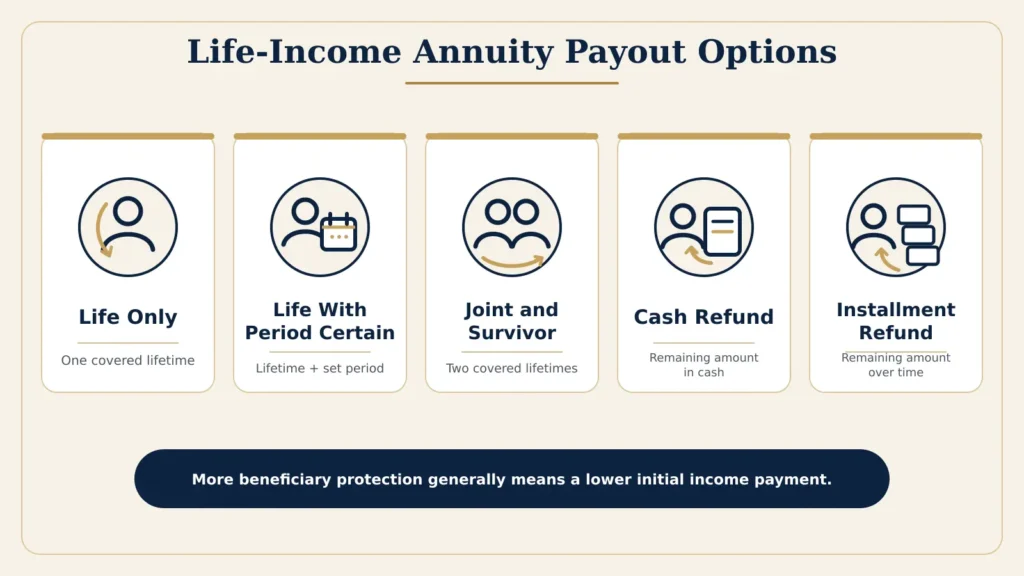
A life income annuity converts a premium or eligible contract value into payments designed to continue for as long as the covered person lives. This addresses longevity risk—the risk of outliving the money allocated to retirement income.
The insurer calculates the payment using factors that may include:
- Premium or value applied to the income option.
- Age when payments begin.
- Whether one life or two lives are covered.
- Payout option selected.
- Current pricing and interest assumptions.
- Payment frequency.
- Contract provisions and state requirements.
Once traditional annuitization begins, the election is commonly permanent. The owner may give up access to the annuitized principal in exchange for the contractual payment stream. That is why payout options must be understood before the election is made.
Life Only
Life-only income generally continues for the annuitant’s lifetime and stops at death. Because it provides no guaranteed continuation to a beneficiary, it may produce a higher initial payment than options that include beneficiary protection.
The trade-off is significant: if the annuitant dies soon after payments begin, total payments may be less than the original premium and no remaining value may be payable, depending on the contract.
Life With Period Certain
This option provides lifetime income and guarantees payments for at least a stated period, such as 10 or 20 years. If the annuitant dies before the period ends, the beneficiary generally receives the remaining scheduled payments for that period. If the annuitant outlives it, payments continue for life.
Joint and Survivor
Joint-and-survivor income is based on two lives and continues while either covered person remains alive. The amount paid after the first death may remain at 100% or change to another elected percentage, depending on the contract.
Because the insurer may be required to pay for two lifetimes, the starting income is generally lower than comparable life-only income on one life.
Cash Refund
With a cash-refund option, if the annuitant dies before receiving payments equal to the amount defined by the contract, the beneficiary generally receives the remaining difference as a lump sum. The exact calculation and tax treatment depend on the contract.
Installment Refund
An installment-refund option works similarly, but any remaining amount is generally paid to the beneficiary through installments instead of one lump sum.
Period Certain
A period-certain payout provides payments for a selected number of years rather than for life. If the payee dies during the period, the remaining scheduled payments generally continue to the beneficiary. Payments stop when the period ends, even if the original owner is still living.
Practical rule: Adding beneficiary protection normally lowers the initial payment because the insurer may be obligated to pay for a longer period. The goal is not to select the option with the largest headline payment; it is to choose the option that matches the household’s income and survivor needs.
Annuitization vs. a Guaranteed Lifetime Withdrawal Benefit
These two income methods are often confused.
Traditional Annuitization
Annuitization changes the contract into a stream of payments under a selected payout option. The election is often irrevocable, and the owner may no longer have a separately accessible account value for the portion annuitized.
Guaranteed Lifetime Withdrawal Benefit (GLWB)
A GLWB is an optional rider on some deferred fixed or fixed indexed annuities. It may permit withdrawals for life when its rules are followed, even if the contract’s account value later reaches zero for reasons covered by the rider.
Important distinctions include:
- The income benefit base is generally an accounting value used to calculate eligible withdrawals; it is not cash available for surrender.
- The rider may charge an annual fee.
- The withdrawal percentage may depend on age and the date income begins.
- Excess withdrawals can reduce or terminate guarantees.
- Rider roll-ups, bonuses or step-ups are not the same as investment returns earned in the account value.
- If account value remains at death, it may be available to beneficiaries under the contract; the income benefit base itself is generally not a death benefit unless the contract expressly provides otherwise.
Request a carrier illustration showing account value, cash surrender value, benefit base, rider cost and the effect of early or excess withdrawals.
Qualified vs. Nonqualified Annuities
“Qualified” and “nonqualified” describe how the annuity is funded, not the interest-crediting method.
Qualified Annuity
A qualified annuity is funded with money from a tax-qualified retirement arrangement, such as an IRA or eligible retirement-plan rollover. Because the contribution may not have been taxed, distributions are generally taxable as ordinary income, subject to the owner’s basis and applicable rules.
Required minimum distributions, beneficiary rules and rollover requirements still apply. An annuity contract does not erase the rules attached to qualified retirement money.
Nonqualified Annuity
A nonqualified annuity is generally funded with after-tax money. The contract’s earnings grow tax deferred. The taxable portion of a withdrawal or income payment depends on whether the contract is in accumulation, has been annuitized and other tax rules.
The premium is not automatically taxed again, but determining the return-of-basis and taxable portions can be technical. The owner should retain records and consult a tax professional.
How Are Annuities Taxed?
Federal tax treatment depends on the funding source, distribution method, ownership and contract history.
General principles include:
- Growth inside an annuity is generally tax deferred, not tax free.
- Taxable distributions are generally treated as ordinary income rather than capital gains.
- A qualified annuity funded entirely with pretax money will generally produce taxable distributions.
- A nonqualified annuity funded with after-tax money may include both taxable earnings and a return of cost basis, but the ordering and exclusion rules differ for withdrawals and annuitized payments.
- A taxable distribution before age 59½ may also be subject to a 10% additional federal tax unless an exception applies.
- A surrender, exchange, rollover, ownership change or beneficiary distribution may have tax consequences.
For official federal guidance, review IRS Publication 575, Pension and Annuity Income. Tax law is fact specific; Sterling Arc Group does not provide tax or legal advice.
Can I Roll Over My 401(k) Into an Annuity?
Eligible retirement money may sometimes be moved from a former employer’s 401(k) or another qualified plan into an IRA annuity through a direct rollover. Whether it should be moved is a separate question.
Before making a rollover decision, compare:
- The existing plan’s investment choices and expenses.
- Access to institutional pricing or other plan benefits.
- Creditor protection.
- Loan provisions, if relevant.
- Required minimum distribution rules.
- Liquidity and anticipated withdrawals.
- The annuity’s guarantees, surrender period, costs and income features.
- Whether employer stock or another special tax situation is involved.
A direct rollover generally sends the money directly from the plan to the receiving custodian or carrier. Taking possession of the funds can create withholding, timing and tax issues. Coordinate the transaction with the plan administrator, receiving carrier and a qualified tax professional.
What Happens to an Annuity When the Owner or Annuitant Dies?
The answer depends on the contract stage, ownership structure, beneficiary designation and payout option.
Before Income Begins
A deferred annuity may provide a death benefit equal to the contract value or another amount defined by the policy. Surrender adjustments, prior withdrawals and rider provisions can affect the benefit.
After Traditional Annuitization
The selected payout option controls. Life-only payments generally stop at death. Life with period certain, joint-and-survivor, cash-refund and installment-refund options may continue benefits according to their terms.
While Taking Rider Withdrawals
If income is being taken through a GLWB and account value remains, the beneficiary may receive the applicable death benefit. If the account value has been depleted and the rider is only continuing lifetime income, there may be no remaining death benefit unless the contract states otherwise.
Beneficiaries may have distribution choices and deadlines. Spousal and nonspousal beneficiaries may be treated differently. Review beneficiary designations after marriage, divorce, a death, a birth or a major estate-planning change.
Annuity Fees, Surrender Charges and Limitations Explained
An annuity should be understood by its complete contract, not by a single rate or income number.
Surrender Charges
A surrender charge may apply when more than the contract’s permitted amount is withdrawn during the surrender period. Charges commonly decline over time, but the schedule varies by product.
Some contracts permit a free annual withdrawal, but “free” generally means free of the insurer’s surrender charge—not necessarily free of income tax, an additional federal tax, rider reductions or a market value adjustment.
Market Value Adjustment (MVA)
An MVA may increase or decrease the amount available when certain withdrawals occur, often based on changes in interest rates. The formula, exceptions and applicable period are defined in the contract.
Rider Charges
Optional income, enhanced death-benefit or other riders may carry annual charges. Compare the rider’s contractual benefit with its cost and restrictions rather than assuming every rider adds value.
Index-Crediting Limits
Fixed indexed annuities may use caps, participation rates, spreads, averaging methods, crediting periods and other formulas. These can limit interest credits even when an index rises.
Limited Liquidity
An annuity is generally designed for long-term goals. It should not replace an emergency fund or money expected to be used for near-term expenses.
Inflation Risk
A level payment may buy less in the future as prices rise. Some contracts offer increasing income or other adjustments, often with a lower initial payment or additional conditions.
Insurer Risk
Fixed-annuity guarantees are backed by the issuing insurer’s financial strength and claims-paying ability. Annuities are not FDIC deposits and are not guaranteed by SIPC or a federal agency. State guaranty associations may provide limited protection under applicable law, but they should not be presented as a reason to purchase a product.
The FINRA annuity overview summarizes common annuity structures, expenses, surrender charges and the distinction between insurance products and securities products.
Can You Lose Money in a Fixed Annuity?
A traditional fixed annuity is designed to protect principal from direct stock-market losses when contract requirements are followed. However, “principal protection” is not the same as unrestricted access or zero risk.
Available value may be reduced by:
- Withdrawals above the contract’s permitted amount.
- Surrender charges.
- A negative market value adjustment.
- Rider charges.
- Tax liabilities and possible early-distribution penalties.
- Failure of the issuing insurer to meet its obligations.
A fixed indexed annuity also does not directly invest the premium in the stock market. A negative index period may result in no index credit rather than a market loss, subject to the stated floor and contract. Charges and withdrawals can still reduce value.
Practical Annuity Examples
These examples are educational and do not represent actual quotes, recommendations or guaranteed outcomes.
Example 1: A Known Rate for a Defined Period
Maria is five years from retirement and has liquid emergency savings outside her retirement accounts. She wants a portion of her nonqualified savings to earn a known rate for several years without direct stock-market exposure.
She compares a MYGA with other available options. Instead of looking only at the advertised rate, she reviews the surrender schedule, free-withdrawal provision, renewal process, MVA, carrier strength and what happens at the end of the guarantee period.
Example 2: Limited Index-Linked Interest Potential
David wants principal protection from direct index losses but is comfortable with interest that may vary. He reviews a fixed indexed annuity.
The illustration shows several index-crediting strategies. David learns that a 10% increase in an index does not mean his contract will receive 10%. A cap, participation rate, spread and the exclusion of dividends may reduce the credit. He also checks which formula elements are guaranteed and which the insurer may change later.
Example 3: Life Income With Protection for a Spouse
Angela and Robert want part of their savings to cover essential household expenses for as long as either spouse is alive. They compare a joint-and-survivor life income option with life-only income.
The joint option starts with a lower payment because it may continue across two lifetimes. They choose based on the surviving spouse’s needs, not simply the largest first-year payment.
Example 4: Income Now With a Beneficiary Period
James purchases an immediate annuity and selects life income with a 10-year period certain. If he lives beyond 10 years, payments continue for life. If he dies after three years, the named beneficiary generally receives the remaining scheduled payments through the end of the guaranteed period, subject to the contract.
Example 5: Moving Former Employer-Plan Money
Sophia is considering a direct rollover from a former employer’s 401(k) into an IRA annuity with an optional income rider. She first compares her existing plan’s fees, investment choices and protections with the annuity’s surrender period, rider cost, income rules and liquidity.
She confirms that the benefit base shown in the illustration is not a cash value and coordinates the rollover with the plan administrator and tax professional.
Who May Consider an Annuity?
An annuity may deserve consideration when someone:
- Wants to dedicate part of retirement assets to contractual income.
- Is concerned about outliving savings.
- Values a declared rate or protection from direct market loss on that portion of assets.
- Has adequate liquid reserves outside the annuity.
- Can hold the contract through its surrender period.
- Understands the difference between guaranteed and nonguaranteed values.
- Wants tax-deferred accumulation after considering other available tax-advantaged accounts.
When an Annuity May Be a Poor Fit
An annuity may be inappropriate when someone:
- Needs near-term access to most of the money.
- Has not established sufficient emergency savings.
- Does not understand or accept the surrender period.
- Is being asked to replace an existing contract without a clear, documented benefit.
- Primarily wants unrestricted stock-market participation.
- Cannot comfortably absorb the effect of inflation on level income.
- Is considering the contract only because of a bonus, promotional rate or sales presentation.
Questions to Ask Before Buying an Annuity
Request written answers and a complete carrier-approved illustration when applicable:
- What retirement problem is this contract intended to solve?
- Is it fixed, multi-year guaranteed, fixed indexed, immediate or deferred income?
- Which values and rates are guaranteed, for how long and by whom?
- Which caps, participation rates, spreads, renewal rates or other elements may change?
- What is the surrender period, and how is each surrender charge calculated?
- Does a market value adjustment apply?
- How much can be withdrawn annually without an insurer surrender charge?
- What rider charges or other fees apply?
- Is the income benefit base different from the contract value and cash surrender value?
- What happens after an excess withdrawal?
- What happens when the owner, annuitant or spouse dies?
- How is the agent compensated, and which insurers and products can the agent offer?
- What tax issues should be reviewed before funding, exchanging or taking distributions?
- How does this recommendation address liquidity, risk tolerance, time horizon and financial objectives?
Florida law requires an agent making an annuity recommendation to act in the consumer’s best interest under the circumstances known at the time, including care, disclosure, conflict-management and documentation obligations. It also requires consideration of consumer profile information such as age, income, liquidity needs, time horizon, tax status and risk tolerance. See Florida Statutes §627.4554.
Five of the Most Frequently Asked Annuity Questions
1. How Much Does a $100,000 Annuity Pay per Month?
There is no universal monthly payment for a $100,000 annuity. The amount depends on the annuity type, age when income begins, one-life or joint-life coverage, payout option, income-start date, prevailing carrier pricing, state, optional riders and whether beneficiary protection is included.
An immediate life-only quote for one person can differ substantially from joint-and-survivor income or life income with a 20-year period certain. A GLWB also uses a different calculation from traditional annuitization.
Use carrier-approved quotes prepared for the correct state, age and payout option. Do not rely on a generic online estimate as a promise of actual income.
2. Can You Lose Money in an Annuity?
It depends on the annuity. Fixed and fixed indexed annuities are designed to avoid direct stock-market loss under their contract rules, but surrender charges, an MVA, rider fees, withdrawals, taxes and insurer risk can reduce available value.
Variable annuities and registered index-linked annuities are securities and can lose value based on market performance. They require securities licensing and are outside the fixed-insurance annuity services described on this page.
3. What Happens to an Annuity When You Die?
Before income begins, the beneficiary may receive the applicable contract death benefit. After income begins, the result depends on the payout option. Life-only income normally stops at death; period-certain, refund and joint-and-survivor options may continue payments or provide a remaining benefit.
Ownership and beneficiary designations also affect the outcome. Review the actual contract and applicable tax rules rather than assuming unused value always passes to heirs.
4. Are Annuity Withdrawals Taxable?
Often, at least part of a distribution is taxable as ordinary income. A qualified annuity funded with pretax money will generally produce taxable distributions. A nonqualified annuity funded with after-tax money may return part of the owner’s basis, but the tax calculation depends on the withdrawal or payout method.
Distributions before age 59½ may also be subject to an additional 10% federal tax unless an exception applies. Consult a qualified tax professional before taking or restructuring a distribution.
5. What Is the Best Age to Buy an Annuity?
There is no single best age. The better question is whether the contract solves a defined need at the right time.
A person still accumulating savings may evaluate a deferred fixed, MYGA or fixed indexed annuity. Someone near retirement may focus on future withdrawals or a deferred income start. Someone already retired may evaluate immediate income. Age affects pricing and payout levels, but liquidity, health, household income, survivor needs, tax status and time horizon matter just as much.
Fixed Insurance Annuities and Securities Products
Sterling Arc Group’s annuity education and insurance review may include fixed annuities, MYGAs, fixed indexed annuities, immediate annuities, deferred income annuities and available fixed-insurance income riders, subject to state licensing, carrier appointment, product training and availability.
Variable annuities and registered index-linked annuities, sometimes called RILAs or buffer annuities, are securities products. They require appropriate securities registration and broker-dealer authorization in addition to applicable insurance licensing. They are not presented here as fixed-insurance offerings.
The Florida Department of Financial Services’ 2-15 license guide identifies annuities within the license authority and notes that an appointment is required for the license to be valid.
Final Takeaway: Match the Contract to the Job
An annuity is most useful when its job is clearly defined. A MYGA may provide a known rate for a period. A fixed indexed annuity may provide limited index-linked interest potential without direct index ownership. An immediate or deferred income annuity may create a contractual payment stream. A lifetime withdrawal rider may preserve controlled access to an account value while establishing rules for future income.
None of those features makes every annuity suitable for every person. The decision should account for liquidity, other retirement income, inflation, beneficiary goals, taxes, surrender charges, insurer strength and the difference between guaranteed and illustrated values.
Review Your Annuity Options With Confidence
Sterling Arc Group can help you understand how available fixed-insurance annuity options work, compare their guarantees and limitations, and identify the questions that should be answered before you make a decision.