

Trust and Will Planning: Wills, Trusts & Legacy Planning
Trust and will planning is part of a broader estate planning process that is not only about deciding who receives your property after you die.
A well-coordinated plan can also address who may manage financial matters if you become incapacitated, who may make healthcare decisions, how assets are transferred, how minor or vulnerable beneficiaries are protected, and whether beneficiary designations on life insurance and retirement accounts still match your intentions.
Two of the best-known estate-planning tools are a Last Will and Testament and a Revocable Living Trust.

They are not interchangeable.
And one is not automatically better than the other.
The appropriate structure depends on your family, assets, state laws, property ownership, beneficiaries, business interests and planning objectives.
Sterling Arc Group is part of a collaborative network of qualified professionals who work together across complementary areas of expertise to help clients coordinate insurance, financial protection, beneficiary, trust, will, and broader legacy-planning needs. This professional network may include licensed insurance professionals, estate-planning attorneys, law firms, tax professionals, and other appropriately qualified specialists. Sterling Arc Group itself is not a law firm and does not independently provide legal advice or practice law.
Table of Contents
Trust and Will Planning: Do You Need a Will, a Trust, or Both?
There is no universal answer.
A will generally directs how probate assets should be handled after death and can nominate guardians for minor children.
A revocable living trust is established during life and can hold and manage properly transferred assets. When structured and funded correctly, it may help those trust assets avoid probate and can provide continuity of asset management if the person creating the trust becomes incapacitated.
Many estate plans use both.
The American Bar Association specifically cautions that estate planning is not one-size-fits-all and that having a revocable trust does not necessarily eliminate the need for a will.
The correct question is therefore not:
“Which document is better?”
It is:
“What do I need each document to accomplish?”
What Is Estate Planning?
Estate planning is the process of organizing how your financial, legal and personal affairs should be managed during incapacity and after death.
Depending on individual circumstances, a complete estate plan may involve several separate components:
- Last Will and Testament
- Revocable Living Trust
- Power of Attorney
- Healthcare directive
- Beneficiary designations
- Property titles
- Retirement-account beneficiaries
- Life-insurance beneficiaries
- Business ownership or succession arrangements
- Guardianship nominations
- Digital-asset instructions
Not every individual needs every tool.
The ABA’s current estate-planning resources emphasize wills, trusts, healthcare decisions and powers of attorney as distinct elements that may need to work together.
What Is a Last Will and Testament?
A will is a legal document that provides instructions concerning the disposition of certain property after death.
State law determines the formal requirements necessary for a valid will.
What a Will May Do
Depending on state law and the person’s circumstances, a will can generally be used to:
- identify beneficiaries;
- name a personal representative or executor;
- direct distribution of probate property;
- nominate guardians for minor children;
- establish certain testamentary trusts;
- address other post-death instructions permitted by law.
What a Will Does Not Automatically Do
A will does not automatically avoid probate.
The ABA describes a will as instructions governing how probate assets should be handled through the probate process.
A will also generally does not override assets that transfer through other legal mechanisms, such as valid beneficiary designations.
That distinction becomes especially important for insurance and retirement accounts.
What Is a Revocable Living Trust?
A revocable living trust is generally created during the person’s lifetime. The American Bar Association’s guide to revocable trusts explains their potential roles in asset management and probate planning.
Assets can then be transferred or titled into the trust according to applicable law and the trust agreement.
The person creating the trust may commonly retain significant control over the assets while living and may modify or revoke the trust subject to its terms.
Why People Consider a Revocable Trust
Depending on the circumstances, potential objectives can include:
- avoiding probate for properly funded trust assets;
- maintaining greater privacy;
- managing property during incapacity;
- coordinating property located in multiple states;
- controlling how and when beneficiaries receive assets;
- simplifying future asset management.
The ABA and ACTEC both emphasize that the probate-avoidance benefit depends on actually transferring appropriate assets into the trust.
A Trust Must Be Properly Funded
Creating a trust document alone does not automatically place your house, brokerage account or other property into the trust.
The ownership or beneficiary structure of the relevant asset must be coordinated with the estate plan.
This process is often called trust funding.
An unfunded or partially funded trust may fail to accomplish the intended probate-avoidance objective for assets left outside it.
Living Trust vs. Will: What Is the Difference?
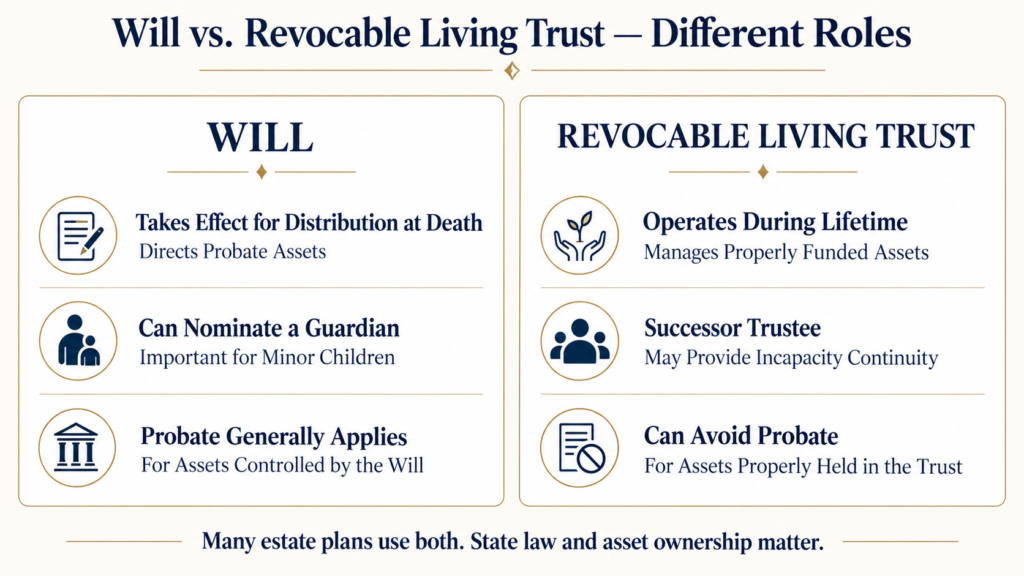
| Feature | Last Will & Testament | Revocable Living Trust |
|---|---|---|
| Created during life | Yes | Yes |
| Primarily operative for asset distribution after death | Yes | Can operate during life and after death |
| Can nominate guardian for minor children | Generally yes | Generally not a substitute for the will’s nomination |
| Probate | Assets controlled by the will generally pass through probate | Properly funded trust assets may avoid probate |
| Incapacity management | Limited by itself | Successor trustee may manage trust assets under the document |
| Privacy | Probate documents may become public | Trust terms generally remain more private |
| Must be funded with assets | No | Yes, for assets intended to be governed by the trust |
| Automatically avoids estate tax | No | No |
| Replaces beneficiary designations | No | Not automatically |
| One-size-fits-all solution | No | No |
These are general principles, not state-specific legal advice.
State law and the actual documents control.
Do You Still Need a Will if You Have a Living Trust?
Often, yes.
A revocable trust does not necessarily eliminate every reason for having a will.
For example, a will may address assets that were never properly transferred into the trust and may be used to nominate a guardian for minor children.
Estate-planning attorneys frequently use a pour-over will alongside a revocable trust so that certain remaining probate assets are directed toward the trust after death.
However, assets passing through a pour-over will may still require probate before reaching the trust.
The ABA therefore explicitly notes that a trust does not make a will unnecessary.
Does a Living Trust Avoid Probate?
It can help avoid probate for assets properly owned by or payable to the trust.
That statement needs two important qualifications.
First:
The trust must actually control the asset.
Second:
Not every asset should necessarily be transferred into a trust.
How real estate, retirement accounts, insurance policies, business interests and other property should be coordinated depends on the circumstances.
A trust should therefore be evaluated as part of a complete estate plan rather than as a document purchased in isolation.
Does a Will Avoid Probate?
Generally, no.
A will tells the probate court how applicable probate property should be administered.
Having a valid will can create greater clarity about the person’s intentions, but the existence of a will does not itself remove the probate process.
This is one of the most common misconceptions surrounding estate planning.
Beneficiary Designations Can Be More Important Than People Realize
Reviewing beneficiary designations helps keep your life insurance and retirement benefits aligned with your estate-planning goals.
Some assets transfer according to a beneficiary designation rather than through the will.
Examples can include:
- life insurance;
- annuities;
- IRAs;
- 401(k) plans;
- pension benefits;
- certain payable-on-death accounts;
- certain transfer-on-death accounts.
ACTEC explains that beneficiary-designated assets generally pass to the named beneficiary regardless of what the will says.
That means someone can have a perfectly drafted will and still produce a result they did not intend if an old beneficiary designation remains in place.
Example
Suppose your will says that your assets should be divided equally among your three children.
But a life-insurance policy still names only one child as beneficiary.
The will does not normally rewrite the policy’s beneficiary designation.
That is why estate documents and insurance beneficiaries should be reviewed together.
Life Insurance and Estate Planning
Life insurance can play an important role in a broader legacy strategy.
Potential objectives can include:
- family financial protection;
- replacing lost income;
- providing liquidity;
- equalizing inheritances;
- business-continuity objectives;
- funding certain legacy goals.
But life insurance is not a substitute for a will or trust.
Likewise, creating a trust does not automatically mean the trust should be the beneficiary or owner of a life-insurance policy.
Ownership and beneficiary decisions can have legal, tax and financial consequences.
They should be coordinated among the applicable insurance professional, estate-planning attorney and tax advisor.
What About Powers of Attorney and Healthcare Directives?
Estate planning is not only about death.
It should also consider incapacity.
Financial Power of Attorney
A financial power of attorney can authorize another person to make specified financial decisions when permitted by the document and state law.
The authority granted can be broad, so the person selected should be chosen carefully.
Advance Healthcare Directive
Healthcare directives can document healthcare wishes and designate an individual to make certain healthcare decisions if the person becomes unable to do so.
Requirements vary by state.
These documents address different responsibilities from wills and trusts.
A complete estate plan may therefore require more than one document.
Who May Need More Than a Simple Will?
A will alone may be adequate for some people.
Others may need to discuss additional planning with an estate-planning attorney.
Situations worth reviewing can include:
Minor Children
Parents may want to address guardianship nominations and how inherited property should be managed for children.
Blended Families
Second marriages, children from previous relationships and competing beneficiary objectives can increase complexity.
Real Estate in Multiple States
Owning property in more than one state can create additional probate and legal considerations.
The ABA specifically identifies multi-state real estate as one circumstance in which revocable-trust planning may deserve consideration.
A Beneficiary With Special Needs
Special-needs planning can interact with eligibility for government programs and requires specialized legal advice.
Business Ownership
Business owners may need to coordinate:
- ownership interests;
- operating or shareholder agreements;
- succession arrangements;
- insurance;
- beneficiaries;
- retirement accounts;
- estate documents.
Privacy Concerns
Probate proceedings can create public records.
Properly structured trust planning can offer greater privacy for certain assets and distributions.
Concerns About Incapacity
A funded revocable trust may provide a mechanism for a successor trustee to manage trust assets if the person creating the trust becomes incapacitated.
Do You Need a Trust if You Are Not Wealthy?
Not necessarily — but wealth alone is not the only deciding factor.
One persistent misconception is that trusts exist exclusively for ultra-high-net-worth families.
That is too simplistic.
Factors such as:
- minor children;
- real estate;
- multi-state property;
- incapacity;
- privacy;
- beneficiary needs;
- family structure;
may matter independently of federal estate-tax exposure.
The ABA specifically describes revocable trusts as a tool whose usefulness depends on the person’s circumstances rather than a fixed net-worth threshold.
Does a Revocable Living Trust Reduce Estate Taxes?
Not automatically.
A standard revocable living trust is generally not, by itself, an automatic federal estate-tax avoidance strategy.
For 2026, the federal basic estate-tax exclusion amount is $15 million per individual, according to the IRS. Do not assume this amount applies to every international estate: different rules apply to nonresident noncitizens. Citizenship, domicile and any applicable treaty require individualized tax review.
But that number should not be used to decide whether someone needs estate planning.
Why?
Because:
- probate and estate tax are different issues;
- state estate or inheritance taxes may have different rules;
- trusts may be used for reasons unrelated to estate tax;
- complex irrevocable-trust strategies operate differently from revocable trusts.
Tax planning should be performed using current law and individualized professional advice.
Revocable Trust vs. Irrevocable Trust
These should not be treated as the same product.
Revocable Trust
The creator generally retains substantial control and may amend or revoke the trust according to its terms.
It is commonly used for management, probate and incapacity-planning objectives.
Irrevocable Trust
An irrevocable trust generally involves giving up significantly greater control under its terms.
Different irrevocable trusts can be used for very different purposes involving:
- estate planning;
- asset transfers;
- life insurance;
- special needs;
- charitable objectives;
- tax planning;
- asset protection.
This is an area where individualized attorney and tax advice is particularly important.
An irrevocable trust does not automatically produce tax savings. Its effects depend on the trust terms, applicable law and your circumstances; review any proposed structure with your attorney and tax advisor.
Estate Planning for Business Owners
For entrepreneurs, personal estate planning and business planning often overlap.
Questions can include:
- Who owns the company after death?
- What happens if the owner becomes incapacitated?
- Are there buy-sell arrangements?
- Are ownership documents consistent with the estate plan?
- Is life insurance being used for a business objective?
- Who are the beneficiaries of retirement accounts?
- Are business and personal beneficiaries coordinated?
The right answer may involve legal documents, insurance and business agreements working together.
No single policy or document solves every part of the problem.
Estate Planning for Italians Living in the United States
Estate planning can become substantially more complicated when someone has connections to more than one country.
An Italian living in the United States may have:
- U.S. property;
- Italian property;
- accounts in multiple countries;
- dual citizenship;
- heirs living abroad;
- different residency or domicile considerations.
U.S. and Italian succession, tax and property rules should not be assumed to work identically.
Cross-border cases may require coordinated advice from professionals familiar with both relevant jurisdictions.
If your family, assets or beneficiaries span Italy and the United States, ask your legal and tax advisors to review how the documents and beneficiary arrangements work together in both countries.
When Should You Review Your Estate Plan?
Estate planning should not be treated as “create once and forget forever.”
Consider reviewing documents and beneficiary designations after major events such as:
- marriage;
- divorce;
- birth or adoption;
- death of a beneficiary;
- purchase or sale of significant property;
- starting or selling a business;
- moving to another state;
- major changes in wealth;
- retirement;
- significant changes in tax law.
Recent ABA guidance likewise recommends revisiting an estate plan after important personal and financial changes.
Estate Planning Coordination Checklist

A coordinated review should examine more than the will.
Legal Documents
Confirm whether applicable wills, trusts, powers of attorney and healthcare directives remain current.
Beneficiary Designations
Review:
- life insurance;
- annuities;
- retirement plans;
- IRAs;
- TOD/POD accounts.
Asset Ownership
Ask how important assets are titled.
Trust Funding
If a revocable trust exists, determine whether the assets intended to be governed by it were actually transferred appropriately.
Insurance
Review whether:
- coverage amounts still make sense;
- beneficiaries remain correct;
- ownership remains appropriate;
- the policy still serves the intended purpose.
Family Changes
Confirm that executors, trustees, agents, guardians and beneficiaries remain appropriate.
The ACTEC Foundation similarly emphasizes coordinating inventories, beneficiary forms and trust funding rather than reviewing these pieces separately.
Practical Example
Consider a hypothetical married couple in their early 50s.
They own:
- a primary residence;
- retirement accounts;
- brokerage investments;
- life insurance;
- a small business.
They also have two children.
Years ago, they created wills naming both children equally.
At first glance, their estate plan appears complete.
During a broader review, however, they discover:
- an old life-insurance beneficiary designation;
- one retirement account with outdated beneficiaries;
- no current healthcare directives;
- no plan for managing the business if one spouse becomes incapacitated;
- property ownership that has never been reviewed alongside the wills.
Their problem is not necessarily that they “need a trust.”
Their problem is that the different parts of the plan have never been coordinated.
They meet with a qualified estate-planning attorney to determine which legal documents should be updated and separately review the life-insurance and beneficiary structure.
This example is hypothetical and does not constitute individualized legal, tax or insurance advice.
Questions to Ask Before Creating or Updating an Estate Plan
- Which assets would actually pass through my will?
- Which assets have separate beneficiary designations?
- Who currently receives my life-insurance benefits?
- Are my retirement-account beneficiaries current?
- Do I have minor children?
- Who would I want to nominate as guardian?
- Do I own property in more than one state?
- Would probate create a significant concern?
- Do I need incapacity planning?
- Who should manage my financial affairs if I cannot?
- Are my healthcare directives current?
- Would a revocable trust accomplish an objective my will cannot?
- If I create a trust, which assets should actually be transferred into it?
- Do I have a blended family?
- Does anyone inheriting assets have special needs?
- Do I own a business?
- Are my business agreements coordinated with my estate plan?
- Do I have assets or beneficiaries outside the United States?
- Have recent life events changed my intentions?
- Which questions require an attorney, tax professional or other specialist?
Frequently Asked Questions
Is a trust better than a will?
Not automatically.
They perform different functions, and many estate plans use both.
Does a will avoid probate?
Generally, no. A will normally directs the disposition of applicable probate assets through the probate process.
Does a revocable living trust avoid probate?
Properly funded trust assets can generally avoid probate, but assets left outside the trust may still require probate.
Do I still need a will if I have a trust?
Often, yes. A will can address assets outside the trust and may nominate guardians for minor children.
Does a trust automatically save estate taxes?
No.
A standard revocable living trust should not automatically be treated as an estate-tax reduction strategy.
Is estate planning only for wealthy people?
No.
Family structure, children, incapacity, beneficiaries, property ownership and business interests can matter regardless of federal estate-tax exposure.
Does my will control my life-insurance beneficiary?
Normally, life-insurance proceeds follow the valid beneficiary designation rather than instructions in a will.
Does my will control my 401(k) or IRA beneficiary?
Beneficiary-designated retirement assets generally follow the applicable beneficiary designation and plan/account rules rather than the will.
Can SAG create my will or trust?
Sterling Arc Group provides insurance education and helps you organize insurance and beneficiary questions for your estate-planning review.
Legal documents should be prepared or reviewed by a qualified estate-planning attorney.
How often should an estate plan be reviewed?
Review is particularly important after major family, property, business, residency or financial changes.
Organize Your Legacy Planning Questions With Clear Guidance
Estate planning involves more than choosing between a will and a trust.
Your legal documents, beneficiary designations, life insurance, retirement accounts and asset ownership should work toward the same objective.
We can help you organize the insurance and beneficiary questions to review and identify when an estate-planning attorney, tax professional or other qualified specialist should be involved.