

What Happens When You Sell Your Life Insurance Policy?
Life Settlements Explained in Simple Terms
What happens when you sell your life insurance policy? Through a transaction commonly called a life settlement, ownership of an existing policy transfers to a third-party buyer. You receive an agreed cash payment, the buyer generally assumes responsibility for future premiums, and the buyer becomes entitled to the policy’s death benefit when the insured dies.
A life settlement can provide another option when coverage is no longer needed or premiums have become difficult to maintain. It is also a permanent financial decision. The original beneficiaries will generally no longer receive the sold policy’s death benefit, and the seller may face tax, privacy, public-benefit, creditor, and estate-planning consequences.
The right question is not simply, “Can I sell my life insurance policy for cash?” It is: How does the net offer compare with every reasonable alternative, and what protection will my family lose if I accept it?

Quick answer: You may be able to sell an eligible life insurance policy, but not every policy or policyowner qualifies. No offer is guaranteed, and you are not required to accept an offer merely because your policy was evaluated.
Table of Contents
What Is a Life Settlement?
A life settlement is the sale of an existing life insurance policy to another person or company. After the transaction is completed, the purchaser becomes the policyowner or beneficiary, continues the required premium payments, and may collect the death benefit when the insured dies.
The cash payment is less than the full death benefit. In many completed transactions, it may be more than the policy’s net cash surrender value, but that result should never be promised. The amount depends on the policy, premiums, insured’s age and health, life expectancy estimates, market conditions, fees, state rules, and the buyer’s underwriting.
The National Association of Insurance Commissioners’ consumer guide recommends reviewing alternatives, tax consequences, privacy, public benefits, escrow arrangements, costs, licensing, and the effect on beneficiaries before selling.
Life Settlement, Viatical Settlement and State Terminology
The words used for these transactions can vary by state. In general consumer education, “life settlement” often describes the sale of a policy by an older adult who does not necessarily have a terminal illness. “Viatical settlement” often refers to a sale involving a person with a terminal or serious illness.
Some states use viatical settlement as a broader legal term that also covers transactions commonly marketed as life settlements. The contract and law in the policyowner’s state—not a website label—determine which rules, disclosures, licenses, and consumer protections apply.
How Does a Life Settlement Work Step by Step?
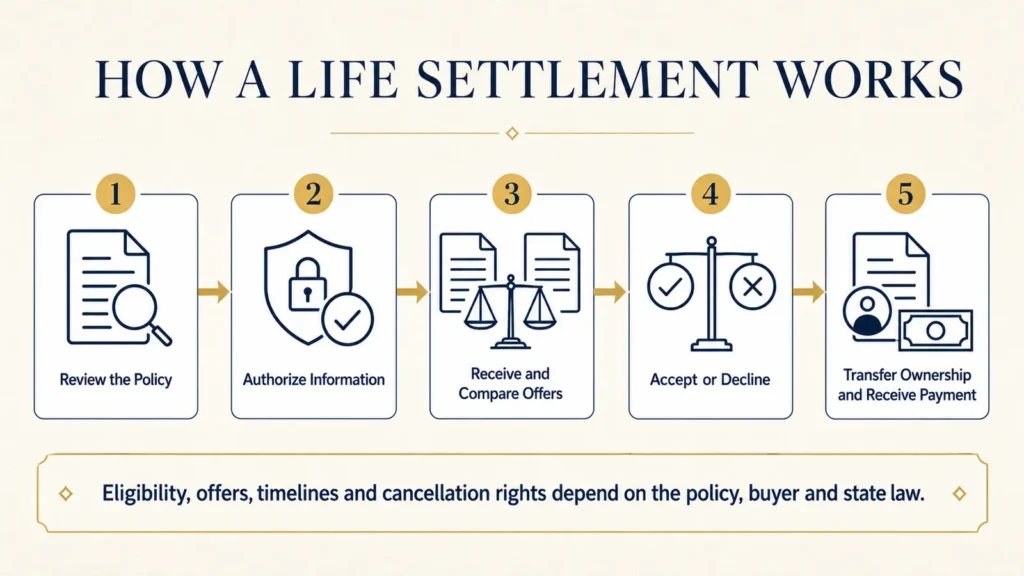
1. Review the Policy and the Reason for Selling
Begin with the current policy, not an online estimate. Request an up-to-date in-force illustration or policy statement showing the death benefit, premium requirements, cash value, surrender value, loans, riders, guarantees, and projected duration.
Clarify why the policy is being reconsidered. Common situations include:
- The original beneficiaries are now financially independent.
- A mortgage, business obligation, or estate-planning need has changed.
- Premiums are becoming difficult to afford.
- The policy is at risk of lapsing.
- The owner needs liquidity for another financial priority.
- The owner is considering surrendering the policy and wants to compare alternatives first.
2. Authorize Policy and Medical Information
If an initial review suggests that the policy may be marketable, the policyowner may be asked to authorize access to insurance records and medical information. Buyers use this information to estimate future premium costs and the insured’s life expectancy.
Ask who may receive the information, how it will be stored, whether it may be shared with additional buyers, and whether health-status updates will be requested after the sale. Do not sign blank forms, and verify that every application answer is complete and accurate.
3. Receive and Compare Offers
A life settlement provider may evaluate the policy directly. A life settlement broker may seek offers from multiple providers on behalf of the policyowner, depending on state law and licensing.
Do not compare offers by gross payment alone. Request a written explanation of:
- The gross offer.
- Every commission, fee, and expense.
- The estimated net amount to the seller.
- The current net cash surrender value.
- The death benefit the beneficiaries would give up.
- Any outstanding policy loan or assignment.
- The party that will hold funds during the ownership transfer.
- The state-specific cancellation or rescission rights, if applicable.
4. Accept, Decline or Continue Comparing
The policyowner is not obligated to accept an offer. An offer may be declined if it does not provide enough value, if the beneficiaries still need coverage, or if another policy option better serves the owner’s goals.
Before accepting, the owner should understand the potential effect on taxes, Medicaid or other needs-based benefits, creditors, estate documents, trusts, business agreements, and the ability to obtain replacement coverage later.
5. Transfer Ownership and Receive Payment
If an offer is accepted, the parties complete the transfer documents. The buyer’s funds may be placed with an independent escrow party while the insurer confirms the change of ownership and beneficiary.
After the transfer conditions are satisfied, the seller receives the agreed net proceeds. The purchaser then generally manages the policy and pays future premiums. State law and the contract determine the exact process and any right to cancel after closing.
What Happens After You Sell Your Life Insurance Policy?
Selling changes more than who pays the premium.
You Give Up Control of the Policy
The new owner generally receives the contractual ownership rights. The former owner can no longer change beneficiaries, take policy loans, withdraw cash value, surrender the contract, or direct how the policy is managed unless the settlement agreement expressly preserves a limited right.
The Buyer Pays Future Premiums
The purchaser generally becomes responsible for keeping the policy in force. The purchaser assumes the risk that premiums may be higher or continue longer than expected.
The Buyer Receives the Death Benefit
When the insured dies and the claim is approved, the insurer pays the death benefit to the beneficiary then listed on the policy—usually the purchaser or a related entity after a completed settlement.
Your Original Beneficiaries Generally Lose That Benefit
The children, spouse, trust, business, charity, or other beneficiaries previously named will generally receive nothing from the portion of the policy that was sold. This is usually the most important trade-off to discuss before accepting an offer.
Personal and Medical Information May Continue to Be Relevant
The purchaser has a financial interest in maintaining the policy and knowing when a claim becomes payable. The settlement documents may permit periodic contact or health-status verification. The policy may also be transferred again. Review privacy provisions carefully and ask who can access or receive your information.
Which Life Insurance Policies Can Be Sold?
Permanent policies are commonly evaluated because they can remain in force for life when contractual requirements are satisfied. Potentially eligible policy types may include:
- Whole life insurance.
- Universal life insurance.
- Indexed universal life insurance.
- Guaranteed universal life insurance.
- Survivorship or second-to-die life insurance.
- Variable life or variable universal life insurance, subject to additional securities and regulatory considerations.
- Some convertible term life insurance policies.
Eligibility is not automatic. A buyer evaluates the policy’s death benefit, premium schedule, cash value, guarantees, policy age, contestability status, loans, assignments, conversion rights, and issuing insurer.
Can You Sell a Term Life Insurance Policy?
Possibly—but most term policies do not have cash value and eventually expire. A term policy may receive consideration when it has enough time remaining or includes a valuable conversion privilege that allows it to become permanent coverage.
Before assuming a convertible term policy has settlement value, verify:
- The conversion deadline.
- The permanent products available for conversion.
- The premium required after conversion.
- Whether conversion is permitted without new medical underwriting.
- Whether the buyer requires conversion before closing.
- Who would fund the conversion and initial premium.
A term policy that is near expiration, no longer convertible, or too expensive to maintain may attract no offer.
Who May Qualify for a Life Settlement?
There is no universal age, policy size, or health requirement that guarantees eligibility. Different buyers and states use different criteria. Market interest is commonly influenced by:
- The insured’s age.
- Current health and estimated life expectancy.
- The policy’s death benefit.
- The amount and timing of future premiums.
- The current cash surrender value.
- The policy type and guarantees.
- Existing loans or collateral assignments.
- How long the policy has been in force.
- The insurer and the policy’s administrative history.
Older age or a significant change in health can increase buyer interest because it may reduce the number of future premiums the purchaser expects to pay. That does not mean someone should exaggerate or omit medical information. Accurate records are essential.
How Much Is My Life Insurance Policy Worth?
A policy does not have one single value. It can have several different values at the same time:
- Death benefit: The amount potentially payable to the beneficiary after an approved death claim, adjusted for loans, withdrawals, accelerated benefits, and contract terms.
- Cash value: The policy’s internal accumulated value, if applicable.
- Net cash surrender value: The amount the owner may receive from the insurer after surrender charges, loans, and other adjustments.
- Life settlement market value: The amount a third-party buyer is willing to pay after evaluating the policy and insured.
Life settlement buyers generally estimate the present value of the future death benefit and subtract expected premiums, expenses, risk, and the return they require. This means two policies with the same death benefit may receive very different offers.
Do not rely on a generic calculator as a final valuation. A meaningful comparison requires current policy data, medical underwriting, written offers, and a clear calculation of net proceeds.
Life Settlement vs. Cash Surrender Value, Policy Loan and Other Options
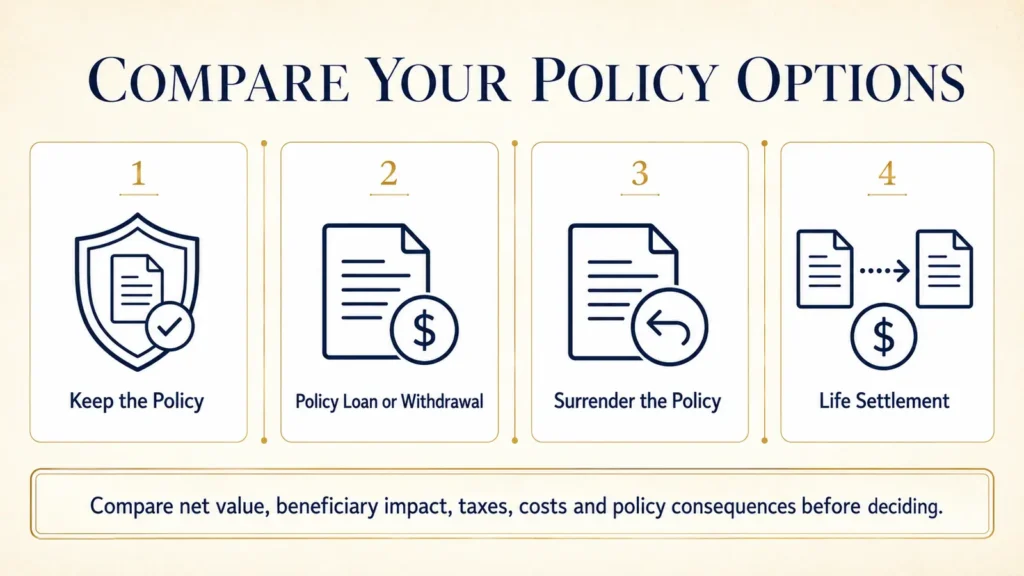
Before selling, compare the transaction with every realistic alternative.
| Option | What happens now | Effect on beneficiaries | Important trade-off |
|---|---|---|---|
| Keep the policy | Owner continues meeting premium and policy requirements | Death benefit may remain available | Ongoing cost and lapse risk must be manageable |
| Reduce coverage or use a nonforfeiture option | Coverage or future premium obligations may be reduced, if the contract permits | Some benefit may remain | Available only under the policy’s provisions |
| Policy loan or withdrawal | Owner accesses available policy value | Benefit and value may be reduced | Interest, lapse risk, and tax consequences may apply |
| Accelerated death benefit | Part of the death benefit may be paid after a qualifying event under a rider | Remaining benefit is generally reduced | Eligibility, discounts, charges, and tax treatment vary |
| Surrender the policy | Coverage ends and insurer pays the available net surrender value | No future death benefit | Surrender charges and taxes may apply |
| 1035 exchange | Value may transfer directly to another qualifying contract | Depends on the replacement contract | New costs, surrender periods, underwriting, and suitability must be reviewed |
| Life settlement | Policy is sold to a third party for an agreed payment | Original beneficiaries generally lose the sold benefit | Ownership, privacy, taxes, fees, and public-benefit effects require review |
The NAIC advises policyowners to contact their insurer and understand available policy options before completing a settlement. A settlement should be compared with the net surrender value—not only the headline cash value—and with the financial value of keeping coverage for beneficiaries.
Can You Sell a Life Insurance Policy With a Loan?
An outstanding policy loan does not always prevent a settlement, but it can reduce the policy’s net death benefit and market value. The buyer will examine the balance, accrued interest, collateral assignment, and effect on policy performance.
Request written confirmation of how the loan will be handled at closing. Do not assume that the full death benefit or the quoted gross offer will be available after the loan and transaction expenses are addressed.
Potential Benefits of a Life Settlement
A life settlement may deserve consideration when:
- The policy is no longer needed for its original purpose.
- The owner is otherwise preparing to surrender or lapse the coverage.
- Premiums have become difficult to maintain.
- The net settlement proceeds materially exceed the net surrender value.
- The owner values current liquidity more than the future death benefit.
- The sale has been reviewed alongside tax, estate, public-benefit, and family considerations.
The transaction does not have to be completed merely because these circumstances exist. It is one option to compare.
Risks and Trade Offs to Understand
Loss of the Death Benefit
The buyer generally replaces the original beneficiaries. If the family, trust, business, or charity still needs the death benefit, selling may conflict with the policy’s purpose.
Potential Tax Consequences
Life settlement proceeds are not automatically tax-free. Federal tax reporting rules may apply, and the result can depend on the policyowner’s basis, surrender value, sale price, policy history, and individual circumstances. The IRS maintains current Form 1099-LS instructions for reportable life-insurance sales. A qualified tax professional should calculate the possible liability before the owner accepts an offer.
Effect on Medicaid or Other Public Benefits
A cash payment may change countable income or assets for a needs-based program. Ask the appropriate benefits specialist or elder-law attorney before closing—not after the proceeds arrive.
Creditor Exposure
Life insurance protections and settlement cash may receive different treatment under federal and state law. Creditors may be able to reach settlement proceeds in circumstances where they could not reach policy benefits.
Privacy and Medical Information
The underwriting process can require detailed medical and personal records. The purchaser or later owner may also receive information needed to administer the policy and monitor claim status.
Fees and Compensation
Brokers, providers, and other intermediaries may be compensated differently. Ask for the gross offer, compensation, expenses, and net seller proceeds in writing. A higher gross bid is not necessarily the best result if costs are higher.
Future Insurability
After selling, replacing the coverage may be expensive or impossible because of age or health. Never assume a new policy will be available later.
Variable-Policy Considerations
Settlements involving variable insurance can raise additional securities issues. FINRA’s guidance emphasizes balanced disclosure of taxes, transaction costs, access to future insurance, private medical information, and other material risks.
Life Settlement Broker vs. Life Settlement Provider
A provider generally enters into or funds the purchase of the policy. Its economic goal is to acquire the policy on acceptable terms.
A broker generally represents the policyowner and seeks one or more offers, subject to state law. Compensation and duties vary. In some jurisdictions, the broker may owe specific duties to the seller.
Before sharing records or signing documents, verify:
- Which party the professional represents.
- Whether the person and company are licensed where required.
- How each party is paid.
- How many providers may review the case.
- Whether every offer and counteroffer will be disclosed.
- Who will protect the funds during closing.
- What privacy policy applies.
Life settlement regulation is state-specific. Consumers can locate their regulator through the NAIC directory of state insurance departments.
A Practical Life Settlement Example
Imagine a retired policyowner has a $500,000 permanent life insurance policy. The original purpose was to protect children and a mortgage, but the children are now independent and the mortgage has been paid. The owner is considering surrendering the policy because annual premiums have become difficult to maintain.
The first step is not to cancel the policy. The owner requests an in-force illustration showing the current death benefit, premium requirements, cash value, net surrender value, policy loan balance, and future projections.
Next, the owner compares several possibilities:
- Keep the full policy and continue paying premiums.
- Reduce the death benefit or use another contractual option.
- Access cash value through a loan or withdrawal.
- Complete a 1035 exchange if another qualifying contract better fits the goal.
- Surrender the policy for its available net value.
- Request a life settlement evaluation.
Suppose a settlement offer is received. The owner should compare the net offer after all costs with the net surrender value and the value of the death benefit being given up. The owner should also review taxes, family needs, estate documents, public benefits, privacy, and whether replacement coverage would ever be needed.
There is no automatic correct answer. The best decision depends on which benefit—current liquidity or future protection—has greater real value to that policyowner.
Five Questions People Ask Most About Selling Life Insurance
1. Can I sell my life insurance policy for cash?
You may be able to sell an eligible policy through a life settlement. Eligibility and the offer depend on the insured, policy, premiums, state rules, and buyer underwriting. An evaluation does not guarantee an offer.
2. How much money do you get when you sell a life insurance policy?
There is no reliable universal percentage. The buyer evaluates the death benefit, future premiums, life expectancy, policy guarantees, loans, expenses, and required investment return. Compare only written net offers with the policy’s current net surrender value.
3. Can you sell a term life insurance policy?
Sometimes. A term policy may be considered if it has sufficient time remaining or can be converted to permanent insurance. Conversion deadlines, premium costs, and buyer requirements are critical.
4. Do my beneficiaries still receive the death benefit after I sell?
Generally, no. After a completed sale, the purchaser normally becomes the owner and beneficiary of the sold coverage. Original beneficiaries generally lose their right to that death benefit.
5. Do you pay taxes on a life settlement?
Potentially. The tax result depends on the policy and transaction. Life settlement proceeds should not be described as automatically tax-free. Review the proposed transaction with a qualified tax professional before accepting an offer.
Questions to Ask Before Accepting an Offer
- Do I still need the policy to protect anyone?
- What are the current cash value and net surrender value?
- What contractual alternatives did the insurer provide?
- Is the offer gross or net of every fee and commission?
- How was the policy valued?
- Who represents me, and who represents the buyer?
- Are all required parties properly licensed in my state?
- Who will receive my medical and personal information?
- Will I be contacted for future health-status updates?
- How could the proceeds affect taxes, Medicaid, creditors, or estate planning?
- Who will hold the funds while ownership transfers?
- What cancellation or rescission right does my state provide?
- Can the purchaser resell the policy?
- Could I qualify for replacement coverage if I need it later?
Final Takeaway: Review the Policy Before You Cancel It
Selling a life insurance policy can convert future protection into money available today, but it also transfers ownership and the future death benefit to someone else. That trade is permanent after applicable cancellation rights expire.
Before surrendering, lapsing, or selling a policy, obtain current policy values, compare all contractual alternatives, evaluate the effect on beneficiaries, and request written disclosure of the settlement’s net proceeds, costs, privacy terms, and state protections.
Review Your Policy Before Making a Permanent Decision
If you are considering surrendering, reducing, or selling an existing life insurance policy, a structured policy review can help you identify the questions to ask and the options that may deserve comparison.
No-obligation educational review. A policy review does not guarantee settlement eligibility or an offer. Life settlement transactions, where available, must be handled by appropriately licensed providers or brokers under applicable state law.
Important Disclosure
This page is for general educational purposes and is not individualized insurance, investment, securities, tax, legal, Medicaid, estate-planning, or accounting advice. Sterling Arc Group is not an insurance company and does not issue policies, determine life settlement eligibility, make settlement offers, or guarantee transaction results. Please also review our Website Disclaimer.
Life settlement terminology, licensing, eligibility, disclosures, waiting periods, rescission rights, privacy requirements, and availability vary by state. Services requiring a separate license are offered only through appropriately licensed professionals or partner organizations where permitted. Selling a policy generally transfers ownership and beneficiary rights and may affect taxes, creditors, public benefits, estate plans, and future insurability. Consult the issuing insurer and qualified independent advisors before making a decision.