

LEARN BEFORE YOU CHOOSE
Insurance Learning Center: Clear Guides to U.S. Insurance
The Insurance Learning Center helps make U.S. insurance easier to understand when every product seems to come with its own terminology, rules, costs and exceptions.
The SAG Insurance Learning Center was created to make those decisions easier to understand.
Here you can learn how life insurance, health coverage, Medicare, annuities, employee benefits and other protection strategies work before comparing specific options.
No unnecessary jargon. No assumption that you already understand the American insurance system. And no need to begin by knowing which product to ask for.
Start with the question you have.

Table of Contents
Quick Answer: What Is the SAG Insurance Learning Center?
The Learning Center is an educational library designed to help individuals, families and business owners understand insurance before making decisions.
You will find:
- Plain-English insurance guides
- Side-by-side comparisons
- Explanations of common insurance terminology
- Enrollment and eligibility guides
- Questions to ask before applying
- Checklists
- Practical examples
- Explanations of costs and trade-offs
- Updates when important rules change
- Resources specifically useful to people learning the U.S. insurance system
The purpose is not to tell every reader to buy more insurance.
It is to help you understand what a product does, what it does not do, what questions matter and what alternatives should be compared.
Explore Insurance by Topic
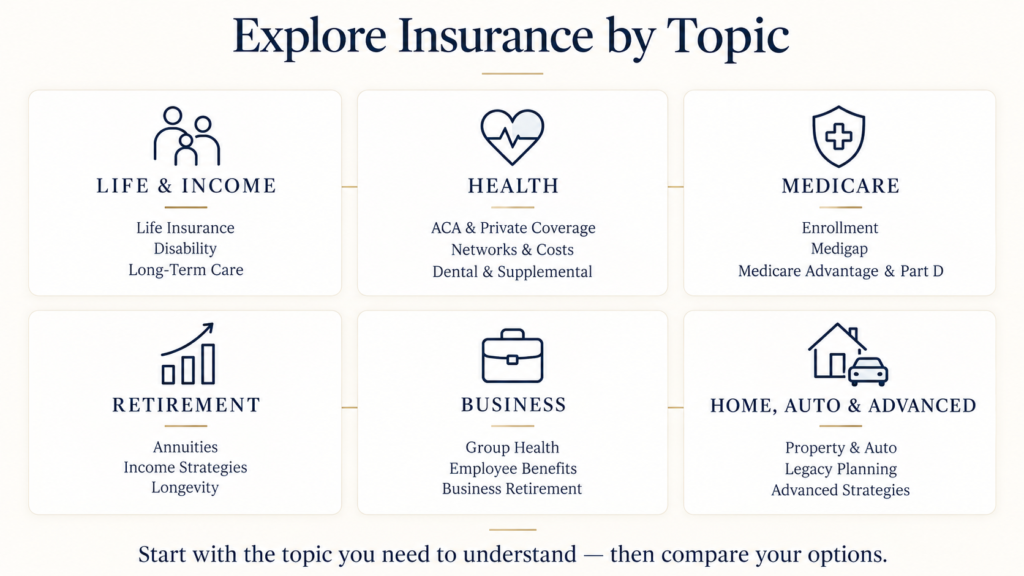
Life & Income Protection
Life insurance and disability insurance address different financial risks.
Life insurance generally focuses on financial protection following the death of an insured person.
Disability insurance focuses on the possibility that someone remains alive but loses the ability to earn normal income because of a qualifying illness or injury.
The Life & Income Protection Learning Center will help explain topics such as:
- Term Life Insurance
- Return of Premium Term Life
- Whole Life Insurance
- Final Expense Insurance
- Indexed Universal Life Insurance
- Guaranteed Universal Life
- Living Benefits
- Policy Loans
- Cash Value
- Beneficiaries
- Life Insurance Underwriting
- Disability Insurance
- Long-Term Care Insurance
Questions We Help Answer
Term or permanent life insurance — what is the difference?
How much life insurance might a family need?
What happens to cash value if I cancel a policy?
How do policy loans work?
Are living benefits the same as long-term-care insurance?
What does disability insurance actually replace?
Understanding the purpose of each product is more important than beginning with a particular policy.
Health Insurance
American health insurance comes with an entire language of its own.
Premium.
Deductible.
Copay.
Coinsurance.
Out-of-pocket maximum.
Network.
Formulary.
HMO.
EPO.
PPO.
Understanding those terms can substantially change how you compare plans.
The Health Insurance Learning Center will cover:
- ACA Marketplace Health Insurance
- Private Health Insurance
- Open Enrollment
- Special Enrollment Periods
- HMO vs. EPO vs. PPO
- Deductible vs. Out-of-Pocket Maximum
- Provider Networks
- Prescription Drug Coverage
- Health Insurance for Self-Employed People
- Health Insurance for New U.S. Residents
- Dental Insurance
- Supplemental Health Insurance
Questions We Help Answer
What does a deductible actually mean?
Is a low-premium health plan really less expensive?
What is the difference between an HMO, EPO and PPO?
How do I know whether my doctor is in network?
Can I get health insurance outside Open Enrollment?
What is the difference between ACA Marketplace and private health insurance?
A health plan should be compared on total financial exposure and access to care — not monthly premium alone.
Medicare
Medicare introduces a new vocabulary and a new set of decisions.
People approaching age 65 may suddenly encounter:
- Part A
- Part B
- Part C
- Part D
- Original Medicare
- Medicare Advantage
- Medigap
- Plan G
- Plan N
- Enrollment periods
- Late-enrollment penalties
- Prescription formularies
Those terms should be understood before choosing coverage.
The Medicare Learning Center will explain:
- How Medicare works
- When to enroll
- Original Medicare
- Medicare Advantage
- Medicare Supplement Insurance
- Medicare Part D
- Plan G vs. Plan N
- Medicare Advantage vs. Medigap
- Working after age 65
- Medicare and employer coverage
- Medicare enrollment periods
- Common Medicare mistakes
Questions We Help Answer
What happens when I turn 65?
Do I automatically receive Medicare?
What is the difference between Medicare Advantage and Medigap?
What does Medicare Part D cover?
Can I keep employer coverage after 65?
When can Medicare penalties apply?
Medicare costs, enrollment rules and plan availability can change. Current information should always be verified before making an enrollment decision.
Retirement & Annuities
Retirement planning involves two very different questions:
How do I accumulate assets?
and
How will I create income from those assets later?
Insurance-based retirement strategies may be used for specific objectives, but they should not be treated as identical products.
The Retirement Learning Center will explain:
- How Annuities Work
- Fixed Indexed Annuities
- Multi-Year Guaranteed Annuities
- Immediate Annuities
- Guaranteed Lifetime Withdrawal Benefits
- Accumulation Value
- Income Value
- Surrender Value
- Surrender Charges
- Market Value Adjustments
- Income Riders
- Retirement Income Risk
- Longevity Risk
Questions We Help Answer
What is an annuity?
Is an annuity an investment account?
What is the difference between a MYGA and a fixed indexed annuity?
What does a lifetime-income rider actually guarantee?
What is a surrender charge?
Are annuities FDIC insured?
Annuity guarantees depend on the claims-paying ability of the issuing insurance company, and contract terms should always be reviewed carefully.
Business & Employee Benefits
Business owners often need to coordinate their personal financial protection with benefits provided through the company.
The Business & Employee Benefits Learning Center will cover:
- Group Health Insurance
- Employee Supplemental Benefits
- Business 401(k) Plans
- Fully Insured Health Plans
- Level-Funded Health Plans
- Self-Funded Arrangements
- HMO, EPO and PPO Networks
- ICHRA
- QSEHRA
- Remote Employees
- Employer Contributions
- Participation Requirements
- Small Business Health Care Tax Credit
Questions We Help Answer
How many employees do you need for group health insurance?
How much does group health insurance cost per employee?
What is the difference between fully insured and level-funded coverage?
What is ICHRA?
What is QSEHRA?
How can a company cover employees working in different states?
Are supplemental benefits a replacement for health insurance?
The correct benefits structure depends on workforce size, employee location, budget, eligibility and applicable federal and state rules.
Home & Auto Insurance
Home and auto insurance can appear straightforward until the details of deductibles, liability limits and exclusions become important.
The Personal Insurance Learning Center will explain topics such as:
- Homeowners Insurance
- Property Coverage
- Liability
- Deductibles
- Replacement Cost
- Actual Cash Value
- Flood Coverage
- Auto Liability
- Collision Coverage
- Comprehensive Coverage
- Uninsured and Underinsured Motorist Coverage
Questions We Help Answer
What does homeowners insurance actually cover?
Does homeowners insurance cover flooding?
What is replacement cost versus actual cash value?
How much liability coverage should I review?
What is uninsured motorist coverage?
State requirements and available coverage vary considerably, particularly for auto insurance.
Advanced Insurance & Legacy Strategies
Some insurance and legacy strategies involve substantially greater complexity.
These topics deserve education before implementation.
The Advanced Strategies Learning Center will explain:
- Premium Financing
- Life Settlements
- International or Offshore Insurance
- Trust and Insurance Coordination
- Estate and Legacy Planning
- Policy Ownership
- Beneficiary Planning
- Advanced Life Insurance Strategies
Questions We Help Answer
How does premium financing work?
What risks come with borrowing to pay life-insurance premiums?
What is a life settlement?
When can a trust own a life-insurance policy?
What is the difference between insurance planning and estate planning?
These strategies may involve legal, tax, financial and regulatory considerations and generally require coordination among qualified professionals.
Start With the Question You Are Asking
You do not have to know the name of the insurance product before using this Learning Center.
Start with your real question.
“What insurance does my family need?”
Begin with life, health, disability, home and income-protection resources.
“I am self-employed. What changes?”
Start with individual health coverage, disability protection, retirement planning and business-owner resources.
“I am approaching 65.”
Begin with Medicare enrollment, Original Medicare, Medicare Advantage, Medigap and Part D.
“I own a business and want employee benefits.”
Begin with Group Health Insurance, Employee Supplemental Benefits and Business 401(k) resources.
“I am worried about retirement income.”
Start with the Retirement & Annuity Learning Center.
“I just moved to America and do not understand the insurance system.”
Start with our U.S. insurance basics and plain-English terminology guides.
The question you are trying to answer is usually a better starting point than the product someone is trying to sell you.
Insurance Terms Explained in Plain English
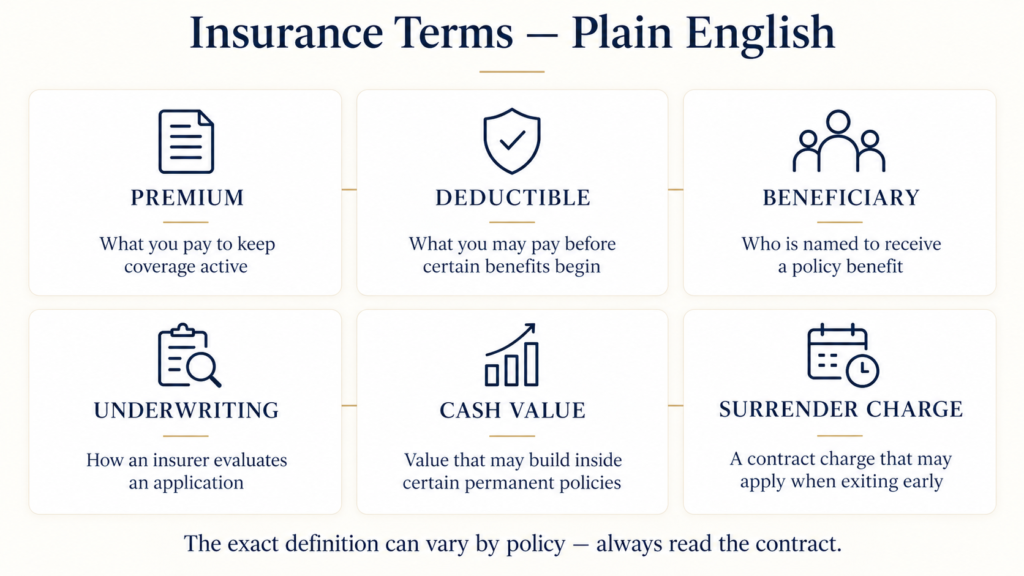
Insurance becomes much easier once the vocabulary makes sense.
Here are several terms you will see frequently throughout this Learning Center.
Premium
The amount paid to keep an insurance policy or health plan in force according to its terms.
Deductible
In health, property and other forms of insurance, a deductible generally represents an amount the insured is responsible for before certain policy benefits apply.
The exact way a deductible works depends on the type of insurance and policy.
Copay
A fixed amount that may apply to a covered healthcare service or prescription under a health plan.
Coinsurance
A percentage of covered healthcare costs that a member may be responsible for according to the plan’s terms.
Out-of-Pocket Maximum
For health insurance, this generally refers to the annual limit on qualifying cost sharing for covered services under the applicable plan rules.
It is not the same as a deductible.
Provider Network
The physicians, hospitals and other providers that participate in a specific health plan network.
Always verify the exact plan — not only the insurance-company name.
Beneficiary
The person or entity designated to receive an insurance-policy benefit when the applicable contractual conditions are satisfied.
Underwriting
The process an insurer may use to evaluate an application and determine eligibility, classification, premium or other policy terms.
Underwriting varies substantially by insurance type.
Cash Value
A value that can accumulate within certain permanent life-insurance contracts.
Cash value is not the same as a bank savings account, and policy costs, loans, withdrawals and surrender provisions can affect it.
Surrender Charge
A contractual charge that may apply when certain life-insurance or annuity contracts are surrendered or withdrawals are made during specified periods.
Always review the contract.
How to Compare Insurance Before You Choose
A useful insurance comparison should answer more than:
“What is the premium?”
Use this six-step approach.
1. Identify the Risk
What financial problem are you trying to solve?
2. Understand the Coverage
What exactly does the policy provide?
3. Review the Limitations
What is excluded, limited or conditional?
4. Understand the Cost
Look beyond the initial premium.
Depending on the product, review deductibles, cost sharing, policy charges, rider costs, surrender charges and other expenses.
5. Compare Alternatives
Ask what other structures can solve the same problem.
6. Verify Before Applying
Confirm current eligibility, state availability, policy terms and important deadlines.
A comparison becomes meaningful only when equivalent benefits and risks are being compared.
Learn the Difference Before You Decide
Some of the most useful insurance searches are comparisons.
Examples include:
- Term Life vs. Whole Life
- Whole Life vs. Indexed Universal Life
- HMO vs. EPO vs. PPO
- Deductible vs. Out-of-Pocket Maximum
- ACA Marketplace vs. Private Health Insurance
- Medicare Advantage vs. Medicare Supplement
- Plan G vs. Plan N
- FIA vs. MYGA
- Group Health Insurance vs. ICHRA
- Fully Insured vs. Level-Funded Health Plans
Our comparison guides are designed to show advantages and trade-offs on both sides.
One option should not be presented as universally superior simply because it is the product being discussed.
Insurance Guidance for Italians Living in the United States
For someone who grew up in Italy, the American insurance system can feel unnecessarily complicated.
Many concepts work differently.
Healthcare is structured differently.
Retirement programs work differently.
Insurance terminology is different.
Employer benefits play a much larger role in certain areas.
And words such as:
- Deductible
- Coinsurance
- Out-of-pocket maximum
- HMO
- PPO
- Underwriting
- Cash value
- Surrender charge
- Medigap
may not have an obvious equivalent in a system you previously used.
That is one reason SAG is building this Learning Center.
The insurance laws do not change because someone speaks Italian.
The explanation can.
Our goal is to make the American system understandable without oversimplifying the rules that matter.
As the multilingual site develops, key resources will also be localized for Italian, Spanish and potentially Brazilian Portuguese audiences rather than simply translated word for word.
How SAG Researches Insurance Content
Insurance, health, Medicare, retirement and taxation can affect important financial decisions.
For that reason, SAG educational content should be treated as YMYL — Your Money or Your Life — content and held to a higher accuracy standard.
When applicable, our research process prioritizes:
Primary Government Sources
For topics involving federal rules, enrollment and public programs, we prioritize sources such as:
- Medicare.gov
- Centers for Medicare & Medicaid Services
- HealthCare.gov
- Internal Revenue Service
- Social Security Administration
- U.S. Department of Labor
Insurance Regulators
For insurance rules and consumer education, we prioritize:
- National Association of Insurance Commissioners
- State Departments of Insurance
Contractual Sources
For product-specific characteristics, the insurance contract and applicable policy illustration take priority over generic marketing descriptions.
Current Review Dates
Information that changes annually — including Medicare amounts, Marketplace rules, tax thresholds and enrollment dates — should be reviewed regularly.
Clear Distinction Between Education and Advice
General educational information is not the same as individualized insurance, legal, investment or tax advice.
Information Changes — Good Insurance Education Should Too
Some insurance fundamentals remain relatively stable.
Others do not.
Examples of information that can change include:
- Medicare premiums and deductibles
- Part D rules
- ACA enrollment periods
- Marketplace subsidy rules
- Tax limits
- HSA limits
- QSEHRA limits
- Employer affordability thresholds
- State insurance requirements
- Carrier availability
- Provider networks
- Prescription formularies
For topics like these, look for:
Published date
and
Last reviewed or updated date
rather than assuming that an older guide is still current.
How to Use the Insurance Learning Center
If You Are Just Beginning
Start with an overview guide.
Understand the basic terminology before comparing products.
If You Already Know the Product
Read the product guide and then the relevant comparison article.
If You Are Comparing Plans
Use the appropriate checklist and verify current costs, providers, medications, benefits and limitations.
If a Rule Has a Date Attached to It
Confirm that the information applies to the current year.
If You Still Have Questions
Write down the questions that remain.
A productive insurance conversation begins with informed questions rather than pressure to make an immediate decision.
Frequently Asked Questions
Is the SAG Learning Center free?
Yes. The educational information published in the Learning Center is designed to be accessible without requiring someone to purchase insurance.
Is the Learning Center personalized insurance advice?
No.
The guides provide general educational information. Individual circumstances, state rules, underwriting, plan availability and contractual terms can change the appropriate options.
Can I use these guides before speaking with an insurance professional?
Yes.
That is one of their main purposes: helping you understand the terminology, trade-offs and questions worth asking before a conversation.
Are insurance rules the same in every state?
No.
Insurance regulation, available products and certain requirements can differ by state.
Federal programs and laws may also interact with state rules.
How often are the guides updated?
Evergreen concepts may require fewer updates, while Medicare, ACA, tax-related and regulatory information should be reviewed whenever relevant rules change and at least before important annual enrollment periods.
Does SAG recommend one insurance product for everyone?
No.
Different products address different risks and involve different advantages, costs and limitations.
The purpose of the Learning Center is comparison and education rather than presenting one solution as universally appropriate.
Still Have Questions After Reading?
Learning about insurance should make the next decision clearer — not create more pressure.
If you understand the basics but still need help comparing the options available for your circumstances, you can discuss your questions with an insurance professional before deciding what to do next.
Important Disclosure
The SAG Insurance Learning Center is provided for general educational purposes only.
Content does not constitute individualized insurance, investment, legal, accounting, medical or tax advice.
Insurance products, benefits, premiums, underwriting, exclusions, eligibility requirements, provider networks, enrollment periods and availability can vary by state, insurer, plan and individual circumstances.
Government-program rules, tax provisions and annual limits can change.
Readers should verify current information through appropriate official sources and consult qualified professionals when individualized legal, tax, financial or insurance guidance is required.
Any examples are hypothetical unless clearly identified otherwise.
Insurance products and services should be offered only in jurisdictions where the applicable insurance professional or agency is appropriately licensed and authorized.