

Advanced Insurance Strategies for Business Owners and Families

Advanced insurance strategies for business owners and families can help address financial needs that may go beyond traditional life insurance, health insurance or business insurance. These strategies may be considered when protecting business interests, coordinating legacy objectives, evaluating existing life insurance assets, planning for larger coverage needs or addressing more complex personal and business circumstances.
Because advanced planning can involve insurance, legal, tax, estate and financial considerations, there is rarely a single solution that fits every situation. The goal is to understand what you are trying to accomplish first, then determine which insurance strategies may be appropriate and which other professionals may need to be involved.
On this page, we introduce the five advanced insurance strategy areas available through Sterling Arc Group and explain how each one works, when it may be considered, the potential advantages and limitations, and the questions worth asking before making a decision.
The right starting point is not a product. It is a clear understanding of the objective, the parties involved, the available alternatives and the risks that remain if circumstances change.
Sterling Arc Group helps clients organize the insurance side of advanced planning and coordinate with the attorneys, tax professionals, retirement-plan specialists, lenders and appropriately registered financial professionals whose work may be required. This page explains the five Advanced Strategies areas available through our website and the questions to consider before moving forward.
Table of Contents
What Are Advanced Insurance Strategies?
Advanced insurance strategies are planning approaches used when coverage intersects with business ownership, borrowing, cross-border circumstances, retirement-plan design, an existing policy transaction or estate documents.
They are not automatically better than conventional insurance. In many cases, a straightforward personally funded policy or standard workplace retirement plan is more practical. An advanced strategy should be considered only when it addresses a defined need, remains understandable to the client and can withstand realistic changes in interest rates, policy performance, cash flow, tax rules and personal circumstances.
A sound review should answer five basic questions:
- What problem is the strategy intended to solve?
- Which product, contract or legal structure would be used?
- Who owns, controls, funds and benefits from each component?
- Which assumptions are guaranteed and which can change?
- Which licensed or credentialed professionals must approve or implement the work?
Explore Sterling Arc Group’s Advanced Strategies
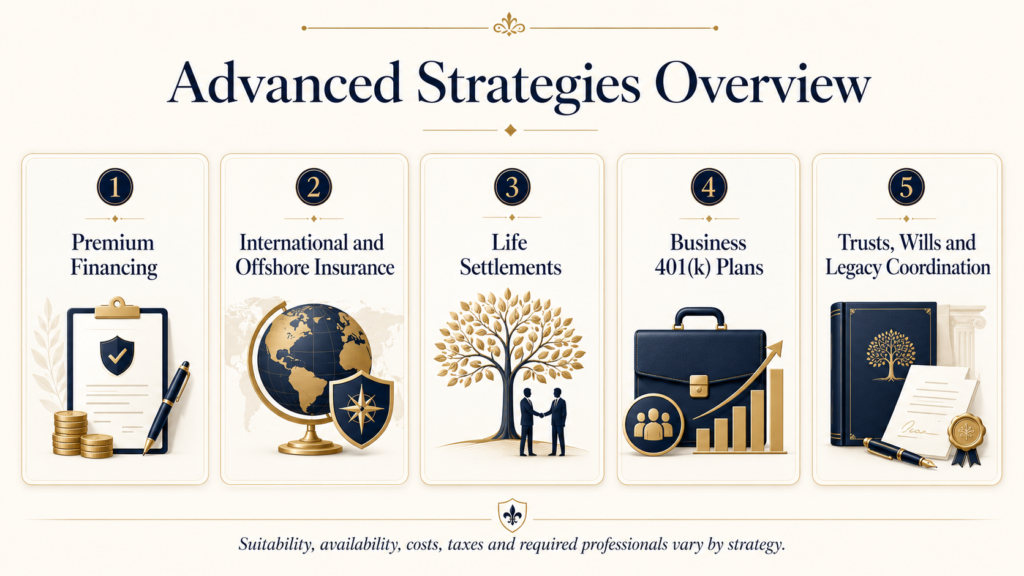
Premium Financing
Premium financing generally involves borrowing money to pay some or all of the premiums for a life insurance policy. It may be considered by affluent individuals or business owners who need substantial coverage and prefer not to liquidate other assets to fund premiums directly.
The arrangement includes two separate contracts: the insurance policy and the loan. The policy’s results do not eliminate the borrower’s obligation to the lender. Interest rates, collateral requirements, loan renewals, policy performance and exit timing can all change. Additional collateral or out-of-pocket funding may be required, and a poorly performing plan can create substantial financial pressure.
Premium financing is not “free life insurance.” It should be reviewed with conservative assumptions, an independent repayment plan and a clear exit strategy. The NAIC has highlighted the risks of presentations that make indexed universal life and premium financing appear self-funding or risk-free in its public materials on IUL and premium-financing concerns.
International and Offshore Insurance
International and offshore insurance may arise when a person lives, works, owns assets or has family connections in more than one country. The relevant questions can include where the applicant resides, where the policy is issued, which insurer assumes the risk, how premiums move across borders and which country’s tax, reporting and insurance rules apply.
The word “offshore” does not create a tax exemption. A U.S. person may have federal reporting obligations for certain foreign financial accounts or assets. Depending on the facts, reporting may involve the Foreign Bank and Financial Accounts Report, Form 8938 or other filings. FinCEN explains the general FBAR filing framework, while the IRS provides current information about Form 8938.
Cross-border insurance requires coordinated legal, tax and insurance review before an application, transfer, premium payment or ownership change is completed. Sterling Arc Group does not present an international structure as a way to conceal assets, avoid lawful reporting or bypass licensing requirements.
Life Settlements
A life settlement is the sale of an existing life insurance policy to a third party. The seller receives an agreed payment, and the buyer generally becomes the policyowner and beneficiary, assumes future premium obligations and receives the death benefit when the insured dies.
A settlement may produce more than the policy’s cash surrender value but less than its death benefit. Eligibility and offers depend on factors such as the insured’s age and health, the policy type, death benefit, premiums, carrier and applicable state law. Selling also means that the original beneficiaries will generally no longer receive the policy’s death benefit.
Before deciding, a policyowner should compare keeping the policy, changing coverage, using a loan or withdrawal, surrendering it and pursuing a settlement. Taxes, transaction costs, privacy, creditor issues and public-benefit eligibility may be affected. The NAIC consumer guide to life settlements explains the transaction and questions consumers should ask.
Business 401(k) Plans
A 401(k) plan can help a business offer employees a structured way to save for retirement while supporting recruiting and retention goals. The employer must select an appropriate plan design, arrange administration and recordkeeping, communicate with participants and satisfy ongoing operational requirements.
Traditional, safe harbor, automatic-enrollment and one-participant designs serve different situations. Fees, eligibility, employer contributions, vesting, testing, investment selection and payroll integration should be evaluated together rather than one feature at a time.
The IRS identifies four foundational actions for establishing a plan: adopt a written plan, arrange a trust for plan assets when required, create a recordkeeping system and provide plan information to eligible employees. Review the agency’s current 401(k) establishment guidance. Employers should also understand that hiring service providers does not necessarily remove all fiduciary responsibility; the Department of Labor provides an official retirement-responsibilities resource for employers.
Sterling Arc Group can support the insurance and coordination conversation but does not act as an ERISA fiduciary, plan administrator, recordkeeper or investment adviser unless a separate, properly licensed or authorized party is expressly engaged for that role.
Trusts, Wills and Legacy Coordination
Trusts, wills, powers of attorney, beneficiary designations and insurance ownership should work together. A change to one document or account does not automatically update the others. For example, changing a will does not necessarily change the beneficiary named in a life insurance contract, and naming a trust as owner or beneficiary can create legal, tax and administrative consequences.
Legacy coordination begins by identifying what documents and contracts exist, who currently controls them and where instructions conflict or leave gaps. An estate-planning attorney should draft or interpret legal documents. A qualified tax professional should evaluate tax consequences. The insurance professional’s role is to explain policy provisions, obtain carrier forms and illustrations when appropriate, and help the client’s professional team understand how the coverage fits the intended plan.
Sterling Arc Group does not draft wills or trusts, provide legal advice or replace an attorney. The objective is accurate coordination so that the insurance contract and the legal plan are reviewed together.
How Does Advanced Insurance Planning Work Step by Step?
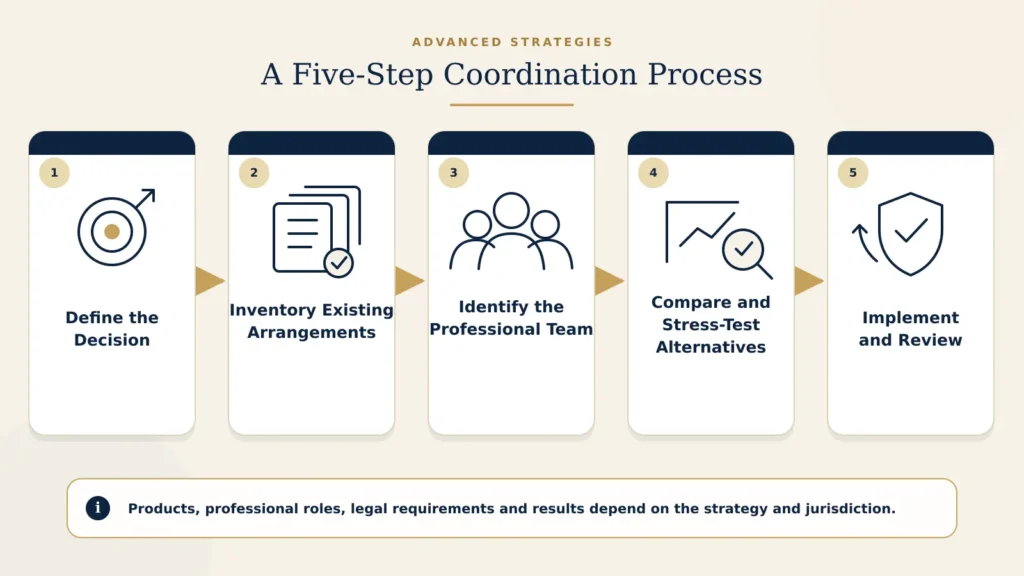
1. Define the Decision
Begin with the event or risk that needs attention. Examples include protecting business continuity, funding significant premiums, managing a cross-border insurance need, reviewing an unwanted policy, offering a retirement plan or coordinating insurance with legacy documents.
An advanced structure should not be selected before the objective is specific enough to measure.
2. Inventory Existing Contracts, Assets and Responsibilities
Gather current policies, in-force illustrations, ownership and beneficiary records, loan information, business agreements, retirement-plan documents and relevant estate documents. Identify who pays, who owns, who can make changes and who receives value.
This step often reveals that an update or correction to an existing arrangement may be more appropriate than purchasing something new.
3. Identify the Required Professional Team
Complex planning may require more than one professional. Determine which questions belong to the insurance agent, attorney, CPA or enrolled agent, lender, plan administrator, third-party administrator, registered investment professional, valuation specialist or life-settlement professional.
The client should know who represents whom, how each party is paid and where one professional’s responsibility ends.
4. Compare Alternatives Under Realistic Assumptions
Compare the proposed strategy with simpler alternatives and with taking no action. Review guaranteed and non-guaranteed policy values, interest-rate changes, fees, taxes, collateral calls, lapse risk, surrender consequences, participant obligations and the effect on beneficiaries.
Illustrations and projections are decision tools, not promises. Stress testing should show what happens if the assumptions are less favorable than expected.
5. Implement, Document and Review
Implementation may require underwriting, legal documents, lender approval, participant notices, tax reporting, signed disclosures or ownership changes. Keep copies of final contracts and confirm that they match the intended design.
Review the arrangement regularly and after changes in health, residency, family, business value, cash flow, interest rates, tax law or professional relationships.
Who May Benefit From an Advanced Strategy Review?
An introductory review may be useful for:
- Business owners coordinating personal protection, company obligations and employee benefits.
- Families with significant or illiquid assets and a permanent insurance need.
- Executives or professionals whose financial life involves multiple entities or jurisdictions.
- U.S. citizens, residents or families with legitimate cross-border insurance questions.
- Policyowners considering whether to retain, modify, surrender or sell existing coverage.
- Employers evaluating whether a 401(k) plan fits their workforce and operating capacity.
- Families updating beneficiary designations alongside wills or trusts.
Complexity alone is not a reason to proceed. The strategy must be affordable, support a real need and remain manageable over time.
How the Five Advanced Strategies Compare
| Strategy | Primary Decision | Important Variables | Other Professionals Commonly Needed |
|---|---|---|---|
| Premium Financing | Whether borrowing to fund premiums is appropriate | Interest rate, collateral, policy performance, loan renewal and exit plan | Lender, attorney, CPA or tax adviser; registered financial professional when investments or securities are involved |
| International and Offshore Insurance | Whether coverage can be lawfully and efficiently coordinated across borders | Residency, solicitation and issue location, currency, ownership, tax and reporting rules | Cross-border tax professional and attorney; appropriately licensed insurance professionals in relevant jurisdictions |
| Life Settlements | Whether selling an existing policy is preferable to available alternatives | Eligibility, offer, future premiums, beneficiary impact, privacy, costs and taxes | Licensed settlement provider or broker as state law requires, tax professional and legal counsel |
| Business 401(k) Plans | Which plan design and service model fit the employer | Eligibility, contributions, fees, testing, investments, payroll and fiduciary duties | TPA, recordkeeper, ERISA counsel, CPA and appropriately registered investment professional |
| Trusts, Wills and Legacy Coordination | Whether contracts and beneficiary instructions support the legal plan | Ownership, beneficiary designations, trustee powers, control, liquidity and tax consequences | Estate-planning attorney and tax professional |
The Difference Between Coordination and Professional Advice
Advanced planning works best when every professional stays within a clearly defined role.
| Professional | Typical Role in the Process |
|---|---|
| Licensed insurance professional | Explains insurance products and policy provisions, helps obtain underwriting and carrier information, and services coverage within applicable licensing authority |
| Attorney | Drafts and interprets legal documents, advises on ownership structures, contracts, trusts, wills and state-law consequences |
| CPA, enrolled agent or qualified tax adviser | Evaluates federal, state and cross-border tax treatment, reporting and filing obligations |
| Registered investment professional | Provides investment or securities advice within the scope of the professional’s registration and engagement |
| Retirement-plan specialist, TPA or recordkeeper | Supports plan documents, testing, administration, reporting, payroll coordination and participant records as contracted |
| Lender or transaction specialist | Underwrites and administers financing or performs a regulated transaction role, such as a life-settlement provider or broker |
One person may hold more than one credential, but credentials and responsibilities should be verified rather than assumed.
Benefits of a Coordinated Review
A properly scoped review can help a client:
- Connect insurance decisions with business, retirement and legacy objectives.
- Identify ownership or beneficiary inconsistencies before a claim or transaction.
- Compare a proposed structure with simpler alternatives.
- Separate guaranteed policy terms from illustrated assumptions.
- Understand which costs and obligations continue after implementation.
- Assign legal, tax, investment and administrative questions to the correct professionals.
- Create a schedule for future policy and plan reviews.
These are process benefits, not guarantees that a particular product will improve financial results.
Risks and Trade-Offs to Review
Advanced strategies can introduce additional layers of cost, documentation and risk. Depending on the strategy, concerns may include:
- Higher premiums, professional fees or transaction costs.
- Variable loan rates and additional collateral requirements.
- Non-guaranteed policy values, dividends, caps or participation rates.
- Policy lapse, surrender charges or reduced death benefits.
- Taxable events and domestic or foreign reporting obligations.
- Fiduciary, administrative and participant-communication duties.
- Loss of control after transferring ownership or completing a settlement.
- Privacy implications when health and policy information is shared.
- Conflicts between contracts, beneficiary designations and estate documents.
- Reduced flexibility when a trust, loan or long-term agreement is difficult to change.
If the client cannot explain how the strategy works, who bears each risk and how the arrangement ends, the review is not complete.
Three Practical Coordination Examples
A Business Owner Considering Multiple Priorities
A business owner wants permanent personal coverage, is evaluating a company retirement plan and has an outdated buy-sell agreement. These are related issues, but they are not one transaction. The insurance review should be coordinated with business counsel, a CPA and qualified retirement-plan professionals. Coverage should not be presented as a substitute for the legal agreement or the 401(k) plan’s administrative requirements.
A Family With Cross-Border Connections
A family lives in the United States but owns assets abroad and is considering a policy connected to another jurisdiction. Before applying, the team should confirm where the insurance activity may lawfully occur, how ownership will be reported, how premiums and benefits may be taxed and whether currency or transfer restrictions apply. A favorable illustration cannot answer those questions.
An Older Policyowner Reviewing an Existing Policy
An older adult no longer needs the original amount of coverage and is concerned about future premiums. The review may compare keeping the policy, reducing coverage, changing dividend or nonforfeiture options, borrowing or withdrawing value, surrendering the policy and evaluating a life settlement. Each alternative affects value, taxes and beneficiaries differently, so net results matter more than a headline offer.
Questions to Ask Before Using an Advanced Strategy
- What specific problem does this solve?
- What simpler alternatives were considered?
- Which benefits are contractually guaranteed?
- Which values depend on rates, market indexes, dividends, lender decisions or other assumptions?
- What are the first-year and long-term costs?
- Who owns the policy, plan, account or trust?
- Who can change the arrangement, and who cannot?
- What happens if premiums, loan interest or collateral requirements increase?
- What happens if I move, sell my business, retire, become ill or change my estate plan?
- How could beneficiaries be affected?
- Could implementation or termination create a taxable event?
- Which forms, reports, notices or annual reviews are required?
- How is each professional compensated, and whom does each professional represent?
- What is the written exit strategy?
Frequently Asked Questions About Advanced Insurance Strategies
What does “advanced insurance strategies” mean?
The term generally describes insurance planning that interacts with borrowing, a business, a retirement plan, an international situation, an existing-policy transaction or legal and estate documents. It is a planning category, not a standardized insurance product.
Are advanced strategies only for high-net-worth clients?
No. Some strategies, such as a life-settlement review or a small-business 401(k), may be relevant without ultra-high net worth. However, certain arrangements—especially premium financing and complex cross-border structures—often require substantial assets, cash flow, professional support and risk tolerance.
Is premium financing a way to obtain free life insurance?
No. The borrower remains responsible for the loan according to the financing agreement. Interest rates, collateral requirements and policy results can change. A credible analysis includes conservative assumptions, the ability to provide additional funds and a written exit plan.
Can a U.S. person own an offshore life insurance policy?
The answer depends on the policy, insurer, place of solicitation and issue, the person’s residency and citizenship, and applicable U.S. and foreign law. Ownership may also create tax or reporting obligations. Obtain cross-border legal and tax advice before proceeding.
Is a life settlement the same as surrendering a policy?
No. Surrendering terminates the policy with the insurance company in exchange for its available net cash surrender value. A life settlement is a sale to a third party. The buyer generally continues the policy and receives the death benefit. Eligibility, offers and regulation vary.
Can Sterling Arc Group create a 401(k) plan or act as its fiduciary?
Sterling Arc Group can participate in an educational and coordination process within its applicable insurance authority. Plan documents, administration, recordkeeping, fiduciary investment advice and legal or tax work must be handled by properly engaged professionals. The precise service team should be documented before a plan is adopted.
Does Sterling Arc Group draft wills or trusts?
No. Wills and trusts should be drafted and interpreted by a qualified estate-planning attorney. Sterling Arc Group can help explain insurance contract information and coordinate beneficiary or ownership questions with the client and attorney.
How often should an advanced insurance strategy be reviewed?
Review timing depends on the arrangement. At minimum, consider a review after major changes in family, health, business value, ownership, employment, residency, tax law, interest rates or policy performance. Financing arrangements and non-guaranteed policies may require more frequent monitoring.
Coordinate Before You Commit
Advanced insurance strategies can be useful when a clearly defined need crosses several areas of planning. Their value depends on accurate contracts, realistic assumptions, suitable funding and coordination among professionals—not on complexity itself.
Before implementing a strategy, confirm what is guaranteed, what can change, who is responsible for each decision and how the arrangement can be maintained or exited. A good review should make the plan easier to understand, not harder.
Important Disclosure
This page is for general educational purposes and is not individualized insurance, investment, securities, legal, tax, accounting, ERISA or retirement-plan advice. It is not an offer to lend, provide a life settlement, establish a trust or act as a fiduciary. Product features, underwriting, costs, guarantees, financing terms, settlement eligibility, taxes, reporting requirements and availability vary by insurer, lender, provider, plan, jurisdiction and individual circumstances. Insurance products are subject to policy terms, exclusions, limitations and the claims-paying ability of the issuing insurer. Consult appropriately licensed or qualified professionals before implementing any strategy.