


How does individual disability insurance work?
It begins with a contract designed to replace part of your earned income when a covered illness or injury limits your ability to work and you satisfy the policy’s definition of disability.
The policy does not automatically pay because a medical condition has been diagnosed. Eligibility depends on the precise contract language, medical evidence, occupational duties, elimination period, benefit period, exclusions, limitations, and continued proof of disability.
Individual disability insurance is also different from health insurance, workers’ compensation, unemployment insurance, Family and Medical Leave Act protection, and Social Security Disability Insurance. Each serves a different purpose. Understanding those differences is essential before relying on any one source of protection.

Quick Answer
An individual disability income policy is purchased by the insured rather than provided solely through an employer. After underwriting and policy issuance, the owner pays premiums to keep coverage in force. If a covered disability occurs, the insured files a claim and completes the contractual elimination period. Once the claim is approved, the insurer may pay a monthly benefit while the insured continues to meet the policy’s requirements, up to the maximum benefit period.
The monthly benefit is generally designed to replace only part of pre-disability earned income—not 100% of it. The exact amount, tax treatment, and duration depend on who paid the premiums, how the contract is written, and the insured’s circumstances.
Table of Contents
What Is Individual Disability Insurance?
Individual disability insurance is a private insurance contract intended to protect a portion of a person’s earned income. It may provide monthly benefits when a covered sickness or injury prevents the insured from working fully or causes a qualifying loss of income.
The individual generally owns the policy. This can provide greater control than relying exclusively on workplace coverage because the contract is not automatically lost when the insured changes employers. Portability, renewability, premium guarantees, and benefit provisions still depend on the specific policy.
Income Protection, Not Medical Reimbursement
Health insurance helps pay eligible medical expenses. Disability income insurance addresses a different problem: the loss of earnings that may occur while someone is sick or injured.
Subject to the contract, disability benefits may help the insured continue paying ordinary obligations such as:
- Mortgage or rent payments.
- Utilities and transportation.
- Food and household expenses.
- Health-insurance premiums.
- Childcare and education expenses.
- Loan and credit obligations.
- Other regular living costs.
The benefit usually is not tied to a specific medical bill. However, it is limited by the policy’s maximum monthly benefit and may be affected by current earnings, other benefits, offsets, or the type of disability.
Who Owns the Policy?
With an individual policy, the insured is commonly also the policyowner and premium payer. Employer group coverage is different: the employer or another organization typically holds the master policy, determines which plan is offered, and may change or terminate the group arrangement subject to applicable law and plan terms.
An individual policy may therefore be useful as primary income protection or as supplemental coverage designed to address gaps in an employer plan.
The NAIC consumer overview of disability insurance explains that disability policies can differ in their definitions, covered disabilities, waiting periods, benefit amounts, benefit periods, renewability, and optional benefits.
How Does Individual Disability Insurance Work Step by Step?
Although policy details vary, the process generally includes five stages: application, underwriting, policy design, a qualifying claim, and ongoing benefit eligibility.
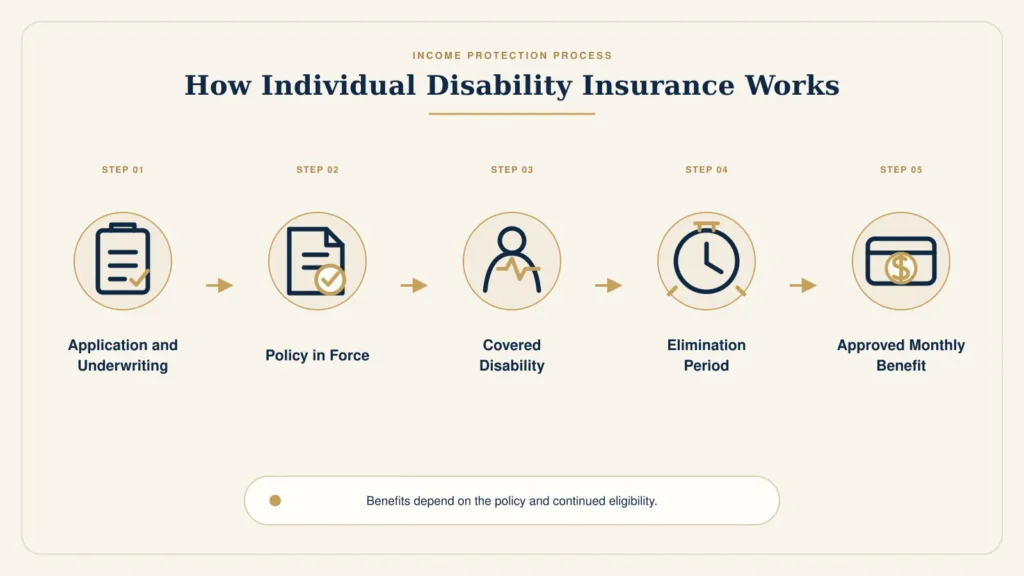
1. Apply Based on Occupation, Income, and Health
The applicant provides information that may include:
- Age and state of residence.
- Occupation and specific job duties.
- Employment status and work history.
- Earned income and existing coverage.
- Medical history, medications, and treatment.
- Tobacco or nicotine use.
- Driving history.
- Hazardous hobbies or activities.
- Requested benefit amount and policy features.
The insurer may request tax returns, W-2 forms, pay statements, business financial records, medical records, laboratory testing, or a paramedical examination. Requirements differ by company, occupation, benefit amount, age, and health history.
Underwriting may result in approval as applied for, approval with a modified premium or exclusion, a reduced benefit, postponement, or denial. No applicant should assume eligibility until the insurer completes underwriting and issues the policy.
2. Select the Contract Design
The applicant chooses among available features, including:
- Monthly benefit amount.
- Elimination period.
- Maximum benefit period.
- Definition of total disability.
- Partial or residual disability provisions.
- Renewability terms.
- Optional riders.
These choices affect both the protection and the premium. A longer elimination period or shorter benefit period may reduce cost, but it also shifts more financial risk to the policyowner.
3. Pay Premiums and Keep Coverage in Force
Once the policy is accepted, required premiums must be paid according to the contract. A late or missed payment can cause coverage to lapse after any applicable grace period.
The owner should keep the original policy, application, amendments, exclusions, and annual statements. Disability claims often depend on exact occupational duties and medical facts, making accurate records important.
4. Submit a Claim After a Covered Disability
If a sickness or injury limits the insured’s ability to work, the insured generally notifies the carrier and submits claim documentation. The insurer may request:
- A claimant statement.
- A physician statement.
- Medical records and test results.
- A description of material occupational duties.
- Employer information.
- Tax returns or other proof of earnings.
- Evidence of work hours and post-disability income.
Approval depends on whether the facts satisfy the contract—not simply on whether a doctor recommends time away from work.
5. Complete the Elimination Period and Maintain Eligibility
The elimination period is the contractual period after disability begins during which benefits are generally not payable. Once it is completed and the claim is approved, benefits may begin.
Payments may continue while the insured remains eligible, provides required documentation, and has not reached the end of the benefit period. Benefits may stop or change if the insured recovers, returns to work, earns additional income, no longer satisfies the policy definition, fails to provide proof, reaches the maximum benefit period, or encounters another contractual limitation.
A Simplified Example
Assume a professional earns $8,000 per month and purchases an individual long-term disability policy with:
- A maximum monthly benefit of $4,800.
- A 90-day elimination period.
- A benefit period potentially lasting to age 65.
- Coverage for qualifying sicknesses and injuries.
- A disability definition established by the contract.
If the insured experiences a covered disability, completes the 90-day elimination period, submits the required evidence, and receives claim approval, the policy may pay up to $4,800 per month.
The amount actually payable could be affected by current earnings, partial-disability formulas, other benefits, offsets, taxes, and continuing eligibility. A benefit period described as “to age 65” is the maximum potential duration; it does not guarantee payment through age 65.
This example is hypothetical and does not represent the premium, terms, underwriting, or benefits of a particular policy.
Short-Term vs. Long-Term Disability Insurance
Short-term and long-term disability insurance both protect income, but they are designed for different lengths of disability. The contract-not the product label alone-determines when payments begin and how long they may continue.
| Feature | Short-Term Disability Insurance | Long-Term Disability Insurance |
|---|---|---|
| Primary role | Temporary income replacement | Protection against extended income loss |
| Elimination period | Generally shorter | Generally longer |
| Benefit period | Limited period stated in the plan | May last several years or potentially to a stated age |
| Availability | Commonly offered through employers; individual availability varies | Available through employer plans and individual policies |
| Underwriting | Group enrollment may require limited or no individual medical underwriting | Individual coverage commonly requires medical, occupational, and financial underwriting |
| Premium considerations | Reflects faster potential access and shorter duration | Reflects benefit amount, waiting period, duration, occupation, health, and contract features |
| Best use | Bridging a temporary absence from work | Protecting against a disability that could affect years of future earnings |
Short-term coverage may coordinate with sick leave, paid time off, state programs, or employer benefits. Long-term coverage is intended for disabilities that continue beyond shorter resources.
Having one does not automatically eliminate the need for the other. A household with sufficient emergency savings may choose a longer elimination period for long-term coverage. Someone with limited savings may place greater value on earlier benefits, when available and affordable.
The terms “short-term” and “long-term” are not universal guarantees. Review the actual elimination period, benefit period, covered conditions, offsets, and definition of disability.
Individual vs. Employer Group Disability Insurance
Employer coverage can be valuable, especially when it is provided at little or no direct cost to the employee. It should still be reviewed carefully because the benefit may be limited by a maximum monthly amount, based only on base salary, reduced by other income, taxable, or lost when employment ends.
| Feature | Individual Disability Insurance | Employer Group Disability Insurance |
|---|---|---|
| Policy control | Generally owned by the individual | Master policy generally controlled by the employer or plan sponsor |
| Portability | Commonly remains with the owner when employment changes, subject to the contract | Often ends when employment or eligibility ends |
| Underwriting | Usually medical, occupational, and financial | Group enrollment may involve simplified or no individual medical underwriting |
| Benefit design | May offer more choices in definitions, riders, and benefit periods | Benefits and definitions are selected by the plan sponsor |
| Income covered | May consider eligible earnings under carrier guidelines | May cover only base salary and impose a monthly maximum |
| Tax treatment | Benefits are generally not taxable when the insured paid premiums with after-tax dollars | Benefits may be taxable when premiums were paid by the employer or with pre-tax dollars |
| Offsets | Depend on the individual contract | Group benefits commonly coordinate with or offset other disability income |
| Legal framework | Governed by the policy and applicable state law | Many private-employer plans are also subject to ERISA claims procedures |
Questions to Ask About Workplace Coverage
Before purchasing supplemental coverage, request the Summary Plan Description or certificate and ask:
- What percentage of income is covered?
- Is the calculation based on base salary only?
- What is the maximum monthly benefit?
- Who pays the premium?
- Are benefits expected to be taxable?
- What other benefits reduce the payment?
- How long is the elimination period?
- How long can benefits continue?
- Does the disability definition change after a stated period?
- Does coverage continue after leaving the employer?
Individual and group coverage can work together, but the combined benefits cannot automatically exceed carrier participation limits. Existing coverage must be disclosed during underwriting.
Own-Occupation vs. Any-Occupation Disability Definitions
The definition of disability is one of the most important parts of the contract. Two policies with the same monthly benefit and elimination period may respond differently to the same medical condition because their definitions are different.
Own-Occupation Definition
An own-occupation definition generally evaluates whether the insured can perform the material and substantial duties of the occupation performed before disability.
However, “own occupation” is not one standardized promise. A policy may use:
- True own-occupation: Depending on the contract, the insured may qualify when unable to perform their occupation even if working in another occupation.
- Modified own-occupation: Benefits may require the insured not to work in another occupation.
- Transitional own-occupation: Earnings from a new occupation may reduce the disability benefit according to the policy formula.
- Own-occupation for a limited period: The contract may use an own-occupation standard initially and later change to an any-occupation standard.
Marketing labels are not enough. Read the complete definition, including earnings provisions, work requirements, recovery benefits, and the period during which the definition applies.
Any-Occupation Definition
An any-occupation definition generally requires the insured to be unable to perform another occupation for which they are reasonably suited by education, training, experience, or other factors stated in the contract.
This is usually more restrictive than an own-occupation definition. It does not necessarily mean literally any job, but the contract controls how vocational ability, earnings potential, and alternative work are evaluated.
Practical Comparison
Consider a surgeon who develops a hand condition and can no longer perform surgery but can still teach medicine.
Under certain true own-occupation contracts, the inability to perform surgery may satisfy the definition even if the surgeon teaches. Under a modified or any-occupation definition, teaching ability or teaching income may affect or prevent benefits.
This example illustrates why an occupational title alone is insufficient. The insurer may evaluate the insured’s actual duties, time spent on each duty, income sources, specialty, and work immediately before disability.
The North Carolina Department of Insurance Consumer’s Guide to Disability Income Insurance explains the general distinction between own-occupation and any-occupation definitions, while emphasizing that eligibility depends on the policy language.
Total, Partial, Residual, and Presumptive Disability
A disability does not always eliminate the ability to work completely. The strongest comparison therefore looks beyond total disability and examines whether the contract addresses reduced capacity or reduced earnings.
Total Disability
Total disability is defined by the policy. It may focus on the inability to perform occupational duties, an inability to work in another suitable occupation, loss of earnings, or a combination of requirements.
The word “total” should not be interpreted without reading the definition. Some contracts do not require complete helplessness, while others impose more restrictive work limitations.
Partial Disability
Partial-disability provisions may pay a stated portion of the total benefit when the insured can perform some duties or work only part time. Qualification and payment formulas vary.
Residual Disability
Residual disability commonly focuses on income loss caused by sickness or injury. A person may be able to continue working but experience fewer hours, reduced duties, lower productivity, or reduced earnings.
The policy may require a minimum percentage of income loss, a loss of time or duties, a prior period of total disability, or other conditions. Some contracts offer recovery benefits after the insured returns to work but income has not fully recovered.
Presumptive Disability
Presumptive-disability provisions may treat specified severe losses-defined in the contract-as total disability. Examples may include certain losses of sight, hearing, speech, or limbs. Covered losses and benefit rules differ by policy.
Benefit Amount, Elimination Period, and Benefit Period
Three numbers determine much of the policy’s practical value: how much may be paid, when payments may begin, and how long they may continue.
Monthly Benefit Amount
Disability insurance is generally designed to replace a portion of earned income rather than all gross earnings. Insurers limit coverage to reduce overinsurance and encourage a financially meaningful return to work.
The maximum available benefit may depend on:
- Salary or net earned income.
- Bonuses and commissions.
- Business ownership percentage.
- Existing individual and group coverage.
- Occupational class.
- Carrier participation limits.
- Tax treatment of other benefits.
Someone earning $12,000 per month may not qualify for a policy that replaces the entire $12,000. The insurer applies its issue and participation limits, and existing coverage may reduce the amount available.
Elimination Period
The elimination period is similar to a time-based deductible. It is the period after disability begins during which benefits are not generally payable.
When comparing 30-, 60-, 90-, 180-, or other available elimination periods, consider:
- Emergency savings.
- Paid sick leave and vacation time.
- Short-term disability benefits.
- A spouse or partner’s income.
- State disability programs, where applicable.
- The time needed to receive and document a claim decision.
A longer elimination period may reduce premiums but requires the household to finance a longer interruption of income.
Benefit Period
The benefit period is the maximum period during which benefits may be payable for a qualifying disability. Available options may include a stated number of years or potentially a period ending at a specified age.
A longer benefit period generally provides stronger protection against catastrophic income loss but usually increases the premium. Benefits still end earlier if the insured no longer qualifies.
What Does Disability Insurance Cover—and What Can Be Excluded?
Many individual disability income policies may cover qualifying disabilities caused by both sickness and injury. Other products may be accident-only. Coverage should never be assumed from the product name.
A Covered Medical Condition Must Cause a Covered Disability
A medical diagnosis alone is not necessarily sufficient. The condition must affect work or income in the manner required by the policy.
The insurer may evaluate:
- Objective and clinical medical evidence.
- Symptoms and functional limitations.
- Treatment and compliance.
- Occupational duties.
- Work activity and earnings.
- Whether restrictions are medically supported.
- Whether exclusions or limitations apply.
Common Exclusions and Limitations
Depending on the policy and state, limitations may involve:
- Pre-existing conditions.
- Specifically excluded medical conditions or body parts.
- Self-inflicted injuries.
- Acts of war or military service.
- Incarceration or participation in certain illegal activities.
- Hazardous hobbies or aviation activities.
- Disabilities arising during a lapse in coverage.
- Work-related injuries addressed by workers’ compensation.
- Mental, nervous, or substance-use conditions subject to a limited benefit period.
Not every policy contains every limitation. Some exclusions are added specifically during underwriting and appear in an amendment or endorsement. Review the issued policy—not only the application or sales summary.
Pre-Existing Conditions
A pre-existing-condition provision may limit claims related to medical conditions that existed, produced symptoms, or received treatment during a stated look-back period. Individual underwriting may also result in a named-condition exclusion.
Definitions and time periods vary. Applicants should answer application questions completely and accurately because a material misstatement can affect coverage or a future claim.
What Determines the Cost of Individual Disability Insurance?
There is no universal price. Premiums are based on the risk presented and the amount and quality of protection selected.
Factors may include:
- Age at application.
- Health history and current treatment.
- Occupation and specific duties.
- Earned income.
- Benefit amount.
- Elimination period.
- Benefit period.
- Disability definition.
- Renewability provisions.
- Optional riders.
- Tobacco or nicotine use.
- Hazardous activities.
- State-approved rating factors and product availability.
Occupation Matters
An insurer evaluates the likelihood that sickness or injury could prevent the applicant from performing their duties. A desk-based professional, a surgeon, a pilot, and a construction worker may receive different occupational classifications, benefit limits, premiums, exclusions, or product availability.
The evaluation is not based only on job title. Physical duties, travel, work environment, specialties, business ownership, hours, and income sources may matter.
Lower Premium Does Not Always Mean Better Value
A less expensive policy may use:
- A longer elimination period.
- A shorter benefit period.
- A more restrictive disability definition.
- Fewer residual benefits.
- More offsets or limitations.
- Weaker renewability provisions.
Compare contract language alongside price. The purpose is not to buy the largest number of riders; it is to protect the most important income risk with terms the applicant can afford to maintain.
Disability Insurance Riders and Renewability Provisions
Riders can expand protection, but they also add complexity and may increase premiums. Availability varies by insurer, occupation, state, and underwriting result.
Residual or Partial Disability Benefit
This provision may pay when the insured continues working but suffers a qualifying reduction in duties, hours, or income. Review the minimum income-loss requirement, calculation formula, recovery benefit, and whether total disability must occur first.
Cost-of-Living Adjustment Rider
A COLA rider may increase benefits during a long claim according to the rider’s formula. It generally does not increase the policy benefit merely because inflation rises while the insured is healthy.
Future Increase Option
A future increase or future purchase option may allow the owner to request additional coverage after income grows without repeating full medical underwriting, subject to financial underwriting, option dates, age limits, and other requirements.
Catastrophic Disability Benefit
A catastrophic benefit may provide an additional amount when the insured meets a more severe contractual standard, such as an inability to perform specified activities of daily living or severe cognitive impairment. Definitions vary and should not be confused automatically with long-term-care insurance.
Waiver of Premium
A waiver provision may suspend required premiums after the insured has remained disabled for the period stated in the policy. Premium obligations before qualification and during recovery depend on the contract.
Non-Cancelable and Guaranteed Renewable
These are important policy provisions, although terminology varies:
- Non-cancelable: Generally means the insurer cannot cancel the policy, reduce benefits, or increase the premium while contractual requirements are satisfied, subject to the policy’s terms.
- Guaranteed renewable: Generally means the insurer must renew coverage when required premiums are paid, but it may retain a contractual right to change premiums for an approved class of policyholders.
Read the exact renewal clause. A label in a brochure is not a substitute for the policy.
Are Individual Disability Insurance Benefits Taxable?
Federal income-tax treatment generally depends on who paid the premiums and whether those premiums were paid with pre-tax or after-tax dollars.
| Premium arrangement | General federal treatment of benefits |
|---|---|
| Individual pays premiums personally with after-tax dollars | Benefits are generally not included in taxable income |
| Employer pays the entire premium and the employee does not include the premium in income | Benefits are generally taxable to the employee |
| Employer and employee share the cost | The taxable portion may correspond to the employer-funded share |
| Employee pays through a pre-tax salary-reduction arrangement | Benefits may be taxable |
| Employer-paid premium is included in the employee’s taxable income | Benefits may receive different treatment than an untaxed employer-paid arrangement |
These are general federal principles-not individualized tax advice. State taxation, business ownership, premium deductions, policy structure, and changes in tax law may affect the result.
The IRS Publication 525, Taxable and Nontaxable Income explains that benefits received under an accident or health policy are generally not taxable when the recipient paid the premiums, while employer-paid sick-pay or disability benefits may be taxable.
Before choosing how premiums will be paid, employers, business owners, and individuals should consult a qualified tax professional.
Private Disability Insurance vs. SSDI, Workers’ Compensation, and FMLA
These programs can overlap, but they are not interchangeable.
| Program | Primary purpose | General trigger | Income payment | Key limitation |
|---|---|---|---|---|
| Individual disability insurance | Contractual income protection | Covered disability meeting the private policy definition | Monthly benefit defined by the policy | Requires underwriting, premiums, and claim eligibility |
| Social Security Disability Insurance | Federal disability benefit for qualifying workers | SSA definition, work requirements, and a condition expected to last at least 12 months or result in death | Federal benefit based on program rules and earnings history | Uses a strict federal definition and does not provide short-term benefits |
| Workers’ compensation | Benefits for work-related injury or occupational illness | Connection to employment under applicable law | May provide wage and medical benefits | Generally limited to work-related conditions and governed primarily by state law |
| FMLA | Job-protected leave | Eligible employee, covered employer, and qualifying reason | FMLA itself does not guarantee wage replacement | Eligibility rules apply and leave is limited |
Social Security Disability Insurance
SSDI uses its own federal definition and earnings requirements. The Social Security Administration generally requires a medically determinable impairment that prevents substantial gainful activity and is expected to last at least 12 months or result in death.
Private coverage may use a different occupational definition and elimination period. Receiving or applying for one benefit does not automatically establish eligibility for the other. Private group or individual policies may also contain SSDI offset provisions.
Review the Social Security Administration’s definition of disability for the federal standard.
Workers’ Compensation
Workers’ compensation generally addresses occupational injuries and illnesses. Private disability policies may exclude work-related conditions, coordinate with workers’ compensation, or reduce benefits by amounts received under other programs.
Because workers’ compensation is primarily state-regulated, rights and benefit rules vary by jurisdiction.
Family and Medical Leave Act
FMLA is a leave and job-protection law—not a disability income policy. Eligible employees of covered employers may receive unpaid, job-protected leave for qualifying reasons, with continuation of group health benefits under the applicable conditions.
The U.S. Department of Labor FMLA overview explains that eligible employees may receive up to 12 workweeks of leave in a 12-month period for specified family and medical reasons. State law may provide additional protections.
Disability Insurance for Self-Employed Professionals and Business Owners

Self-employed individuals may have no employer-sponsored disability benefits and may face two separate risks: loss of personal income and ongoing business expenses.
Individual Disability Income Insurance
An individual policy may protect a portion of the owner’s personal earned income. Underwriting may require tax returns, profit-and-loss statements, ownership documentation, and a history of stable earnings.
Newly self-employed applicants may have limited coverage options if earnings are not yet established. Some carriers may use prior occupational income, contracts, or special professional programs, but availability varies.
Business Overhead Expense Coverage
Business overhead expense disability insurance is designed to reimburse eligible business expenses during a qualifying disability, subject to the contract. It is not the same as personal income replacement.
Potential covered expenses may include eligible items such as:
- Rent or mortgage interest for business premises.
- Utilities.
- Employee salaries.
- Professional services.
- Equipment leases.
- Certain insurance premiums.
- Other fixed overhead expenses listed in the policy.
The policy may exclude the disabled owner’s personal compensation, profits, inventory, or other expenses. Benefit amount, elimination period, reimbursement rules, tax treatment, and maximum duration must be reviewed carefully.
Key-Person and Disability Buy-Sell Planning
Other business disability strategies may include:
- Key-person disability insurance intended to help the business respond to the disability of a critical employee or owner.
- Disability buy-sell coverage intended to fund part or all of a qualifying ownership transfer under a properly drafted agreement.
These policies solve different problems and use different owners, beneficiaries, triggers, and tax considerations. Business owners should coordinate insurance with legal, accounting, and succession documents.
How to Compare Disability Insurance Policies
The strongest policy is not necessarily the one with the highest illustrated benefit or longest list of riders. It is the contract that addresses the buyer’s most important risks with terms that are understandable, affordable, and sustainable.
Before accepting a policy, compare:
- The exact definition of total disability.
- Whether the definition changes after a stated period.
- Treatment of work in another occupation.
- Partial, residual, and recovery benefits.
- Monthly benefit and covered income.
- Elimination-period rules.
- Maximum benefit period.
- Renewability and premium provisions.
- Offsets for other disability income.
- Mental, nervous, substance-use, and other limitations.
- Pre-existing-condition language and individual exclusions.
- Foreign-residence and travel provisions.
- Claim-notice and proof-of-loss requirements.
- Optional riders and their actual cost.
- Conditions under which benefits end.
Request and retain the complete policy, not only a quote or marketing illustration. Confirm that the issued contract matches the accepted offer and review every amendment, exclusion, and endorsement.
How Does a Disability Insurance Claim Work?
A successful claim requires more than a diagnosis. It requires evidence that connects the medical condition to the policy’s disability definition and the insured’s occupational or income loss.
Notify the Insurer Promptly
Follow the policy’s notice requirements. Obtain the correct claim forms and keep copies of all submissions, correspondence, medical records, and delivery confirmations.
Document the Occupation Accurately
The insurer may need to understand what the insured actually did before disability. A job title may not describe:
- Physical requirements.
- Cognitive demands.
- Hours and travel.
- Specialized procedures.
- Leadership or sales responsibilities.
- Percentage of time spent on each material duty.
- Income connected to different duties.
Provide Medical and Financial Evidence
Treating-provider statements should describe functional restrictions rather than only diagnoses. Residual claims may also require ongoing proof of pre-disability and post-disability income.
Expect Continuing Review
The insurer may periodically request updated medical records, claimant statements, financial information, treatment compliance, or an independent evaluation. A change in disability definition can also trigger a new vocational review.
Understand Appeal Rights
If a claim is denied or terminated, review the written explanation, policy provisions, evidence considered, and appeal deadline. Employer plans governed by ERISA have specific internal claims and appeal procedures.
The U.S. Department of Labor disability-benefits resource provides information about claims procedures for many employer-sponsored disability plans. Legal rights and deadlines can be complex, so a claimant may need advice from a qualified attorney.
When Individual Disability Insurance May—or May Not—Fit
Individual disability insurance may deserve consideration when a person’s household, savings goals, or business depend heavily on continued earned income.
It may be particularly relevant for:
- Professionals whose income depends on specialized physical or cognitive duties.
- Self-employed individuals without workplace benefits.
- Business owners responsible for both household and business expenses.
- Employees whose group coverage has a low monthly maximum.
- Workers whose compensation includes bonuses, commissions, or incentive income not fully covered by an employer plan.
- Households with limited ability to absorb a long interruption of income.
It may be less suitable or unavailable when:
- The applicant has no qualifying earned income.
- Existing assets or guaranteed income can comfortably support a permanent work interruption.
- Premiums would undermine essential savings or debt obligations.
- Medical or occupational underwriting prevents acceptable coverage.
- The proposed policy excludes the condition or duty that creates the primary concern.
- The buyer expects medical-expense reimbursement rather than income protection.
The decision should consider emergency savings, employer benefits, household income, debt, occupation, health, budget, and the consequences of a long disability.
Frequently Asked Questions About Individual Disability Insurance
How does individual disability insurance work?
The applicant completes medical, occupational, and financial underwriting. After a policy is issued, premiums must be paid to keep it in force. If a covered sickness or injury satisfies the contract’s definition of disability, the insured submits a claim and completes the elimination period. Approved benefits may then be paid while eligibility continues, up to the maximum benefit period.
Does disability insurance replace my entire paycheck?
Generally, no. Coverage is usually limited to a portion of eligible earned income and may be subject to a maximum monthly benefit, existing-coverage limits, and offsets. The exact percentage varies by carrier and contract.
How long must I wait before receiving benefits?
The elimination period stated in the policy determines the required waiting period. Available periods vary. Benefits are not necessarily retroactive to the first day of disability.
Can I work and still receive disability benefits?
Possibly. Residual, partial, recovery, transitional, or certain own-occupation provisions may allow benefits while the insured works. Earnings and duties may reduce or eliminate benefits according to the contract.
Are mental-health conditions covered?
Some policies may cover qualifying mental or nervous conditions, but definitions, exclusions, and maximum benefit periods vary. An individual policy may also contain an underwriting exclusion. Review the issued contract and applicable state requirements.
Can a self-employed person qualify?
Yes, when carrier requirements are satisfied. The insurer commonly requests tax returns or business financial records to verify stable earned income. New business owners or applicants with fluctuating income may face additional limitations.
Are disability benefits tax-free?
Not automatically. Benefits are generally not taxable when an individual paid premiums with after-tax dollars. Employer-paid or pre-tax arrangements may produce taxable benefits. Mixed funding may create proportional treatment. A tax professional should review the specific arrangement.
Is employer disability insurance enough?
It may be, but this cannot be determined from the coverage percentage alone. Review the maximum monthly benefit, covered compensation, tax treatment, offsets, portability, disability definition, benefit period, and limitations.
Is disability insurance the same as life insurance?
No. Life insurance generally provides a death benefit after the insured’s death. Disability income insurance may provide benefits during the insured’s life when a covered disability limits work or income. Some households may need both protections for different risks.
What happens if I change jobs?
An individual policy generally remains with the owner when employment changes, subject to its terms and continued premium payments. Employer group coverage commonly ends when employment or plan eligibility ends.
Final Takeaway: Protect the Income Behind Your Financial Plan
Understanding how individual disability insurance works requires more than choosing a monthly benefit. The disability definition, elimination period, benefit period, residual provisions, exclusions, renewability, tax treatment, and claims process all determine how the contract may respond.
The right comparison starts with four questions:
- How much earned income would stop if you could not work?
- How long could your household rely on savings and other benefits?
- Which occupational duties produce your income?
- Which policy limitations could prevent or reduce a benefit?
Disability insurance cannot remove the medical and personal consequences of an illness or injury. A carefully selected policy may, however, transfer part of the financial risk created by a prolonged loss of earnings.
Review Your Disability Income Protection With Confidence
Your occupation, income, workplace benefits, savings, health history, and budget all affect the coverage that may be available and appropriate.
Schedule a free, no-obligation 15-minute consultation to review your existing protection, identify potential income gaps, and compare available disability insurance options.
Policy availability, premiums, definitions, benefit amounts, elimination periods, benefit periods, exclusions, limitations, riders, and underwriting requirements vary by insurer, state, applicant, occupation, and policy. This information is educational and is not individualized insurance, investment, tax, legal, medical, or employment advice. Consult qualified professionals regarding your individual circumstances.